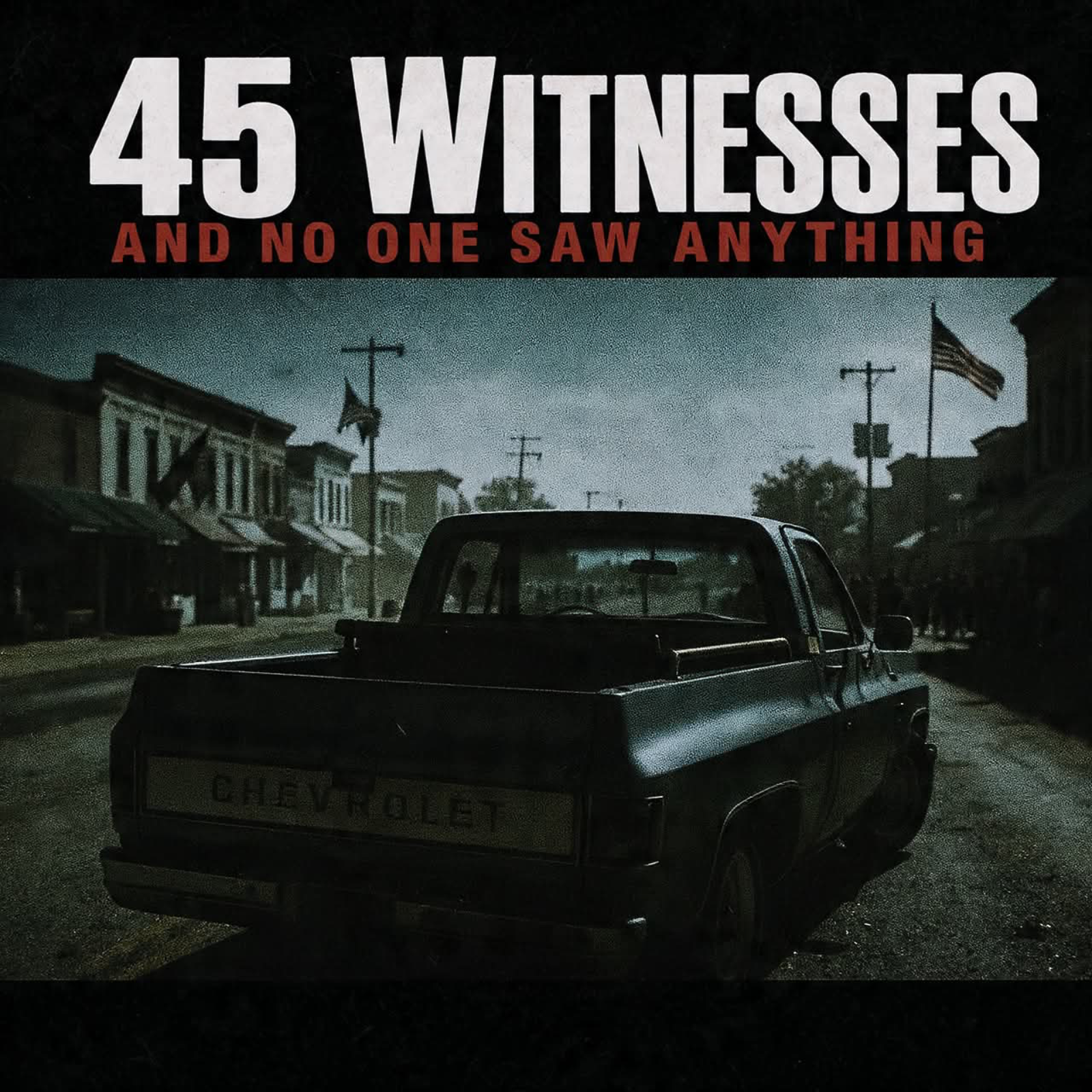
45 Witnesses and No One Saw Anything
The Story
For 20 years Ken Rex McElroy terrorized Skidmore, Missouri. 21 indictments. 0 convictions. On July 10, 1981, he was shot dead in his Chevy Silverado on Main Street in front of 45 witnesses. 3 grand juries. 0 charges. This is the story of the town that decided justice was something they had to take.
Ken Rex McElroy's Chevy Silverado sat idling on Main Street in Skidmore, Missouri, the July heat pressing down on the town like a heavy wet wool blanket. It was July 10th, 1981, and the 47 -year -old man behind the wheel wasn't just a local resident. He was a man who had held this community of 400 people in a state of psychological siege for over two decades. As he sat there, his wife, Trena, beside him, the town was watching. They weren't just watching from a distance. Between 30 and 60 people had gathered around that truck.
They weren't there for a friendly chat. They were there because for 20 years, Ken McElroy had treated the legal system as a suggestion and his neighbors as prey. McElroy was a massive man. Standing over six feet tall and weighing nearly 270 pounds, he had thick sideburns and a stare that people in Skidmore said could freeze your blood. He was the 15th of 16 children born to poor tenant farmers, and by the age of 15, he had already walked away from school to begin a career in theft and intimidation.
But the pivot point for his personality... The moment some say he truly became the man who would terrorize a county happened in 1954. While working construction in Colorado, he suffered a traumatic head injury. When he returned to Missouri shortly after, the petty thief had sharpened into something far more dangerous. He became a master of a very specific kind of psychological warfare, the art of the park and stair. If you cross Ken McElroy, You didn't just get a verbal threat You would wake up in the middle of the night to see his truck parked at the end of your driveway Its headlights cutting through your bedroom window.
He would sit there for hours saying nothing just watching This wasn't a random act of malice. It was a calculated legal strategy over the course of his life McElroy was indicted 21 times for everything from livestock rustling and arson to child molestation and assault. And twenty times he walked away. He knew that if a witness was too terrified to take the stand, the case would collapse. He didn't just target the victims. He went after the system itself. He reportedly burned down a judge's barn and stalked jury members until they were too frightened to deliberate.
He even targeted the wives of law enforcement officers. pulling a shotgun on one woman as she tried to drive to church. His primary tool in the courtroom was a lawyer named Richard G. McFadden. McFadden was a flamboyant, high -priced attorney from Kansas City who knew exactly how to use Missouri's legal loopholes to his client's advantage. His strategy was simple, delay, delay, and delay again. He knew that the longer a trial was pushed back, the more time McElroy had to get busy with the witnesses.
By the time a court date actually arrived, the prosecution's case would be a hollow shell, with victims suddenly suffering from selective amnesia or refusing to show up at all. This cycle of crime and acquittal created a sense of profound helplessness in Skidmore. The town marshal, David Dunbar. eventually resigned after McElroy pulled a gun on him and other officers refused to back him up. The law wasn't just failing. It was being actively dismantled by a single man who understood its weaknesses better than those sworn to uphold it.
The beginning of the end started with something as small as a piece of candy. In April 1980, One of McElroy's daughters was accused of shoplifting at the local grocery store owned by 70 -year -old Ernest Bo Bowencamp and his wife Lois. When the Bowencamps stood their ground, McElroy did what he always did. He began stalking them. He parked outside their home for hours. He fired his shotgun into the air in the middle of the night. Then on July 8th, 1980, he stepped onto the store's loading dock while Bo was waiting for a repairman.
Without a word of warning, McElroy leveled a shotgun and fired. The buckshot tore into Bo's neck, leaving him partially paralyzed and bleeding out on the concrete. Bo survived, and for the first time in 20 years, the system actually worked. McElroy was convicted of second degree assault, and sentenced to two years in prison. But the victory was short -lived. Despite the violent nature of the crime, the judge allowed McElroy to be released on a $2 ,500 bond pending his appeal. He was back in Skidmore within days, and he was more emboldened than ever.
On June 30, 1981, he walked into the D &G Tavern with an M1 Garand rifle. a weapon that featured a bayonet attached to the barrel. He stood there in the middle of the bar and graphically detailed what he was going to do to Bo Bowencamp when he found him. This was a flagrant violation of his bond and several residents finally found the courage to sign affidavits against him. A hearing was set for July 10th to revoke his bail. But when that morning arrived, the town learned that McFadden had successfully secured another postponement.
The legal system had offered one last lifeline, and it had failed. That morning, an impromptu meeting was called at the American Legion Hall. Nearly 60 men showed up, along with the county sheriff, Danny Estes. They were looking for a legal way to protect the bowen camps. But as the discussion dragged on, Word reached the hall that McElroy was already in town. He was sitting in the DNG tavern, drinking. The meeting broke up and the crowd moved as one toward the bar. They didn't storm in. They simply walked in and surrounded him.
They stood in silence, dozens of them, watching him finish his drink that McElroy didn't say a word. He finished his beer, bought a six pack to go. and walked out to his truck. He climbed into the driver's seat, lit a cigarette, and turned the key. The engine of the Silverado roared to life, but before he could put it in gear, the air was shattered by the sound of gunfire. Bullets from at least two different rifles ripped through the back and side windows. One shot struck McElroy in the head, another caught him in the neck.
He slumped over the steering wheel, his foot heavy on a gas pedal. The engine continued to scream a high RPMs as the crowd of 45 people stood and watched. No one ran for help. No one called an ambulance. Trenna McElroy was screaming in the passenger seat, but when the shooting stopped, someone simply opened her door and guided her away to the safety of a nearby bank. When the sheriff finally arrived minutes later, he found a dead man in a truck and 45 witnesses who all told the same story. I heard shots and I ducked.
I didn't see a thing. The aftermath was a master class in collective silence point. Three grand juries were convened and the FBI launched a massive investigation. They interviewed every person on that street, but they hit a wall of stone. Trenna McElroy identified a local rancher as one of the shooters. But even with her testimony, the prosecutor refused to bring charges, citing the total lack of corroborating evidence. The town had decided that the law was an instrument that only Ken McElroy knew how to play, so they had simply stopped playing.
They settled into a pact of silence that remains unbroken to this day. The murder of the Skidmore bully became a national sensation, a dark fairy tale about what happens when a community feels it has been abandoned by the very institutions meant to keep it safe. In the end, Ken McElroy was killed by the same thing he had used to survive for 20 years, the absolute certainty that no one would ever testify against a neighbor. The legacy of that morning still hangs over the empty storefronts and quiet streets of Skidmore.
A reminder of the day a town decided that justice was something they had to take into their own hands. If this story of a community's breaking point intrigue you, please recommend this episode to a friend. That's how I heard it.
 Apple Podcasts
 Castbox
 Castro
 Goodpods
 Moon FM
 Overcast
 Pocket Casts
 Podbean
 Podcast Addict
 Podcast Republic
 Spotify