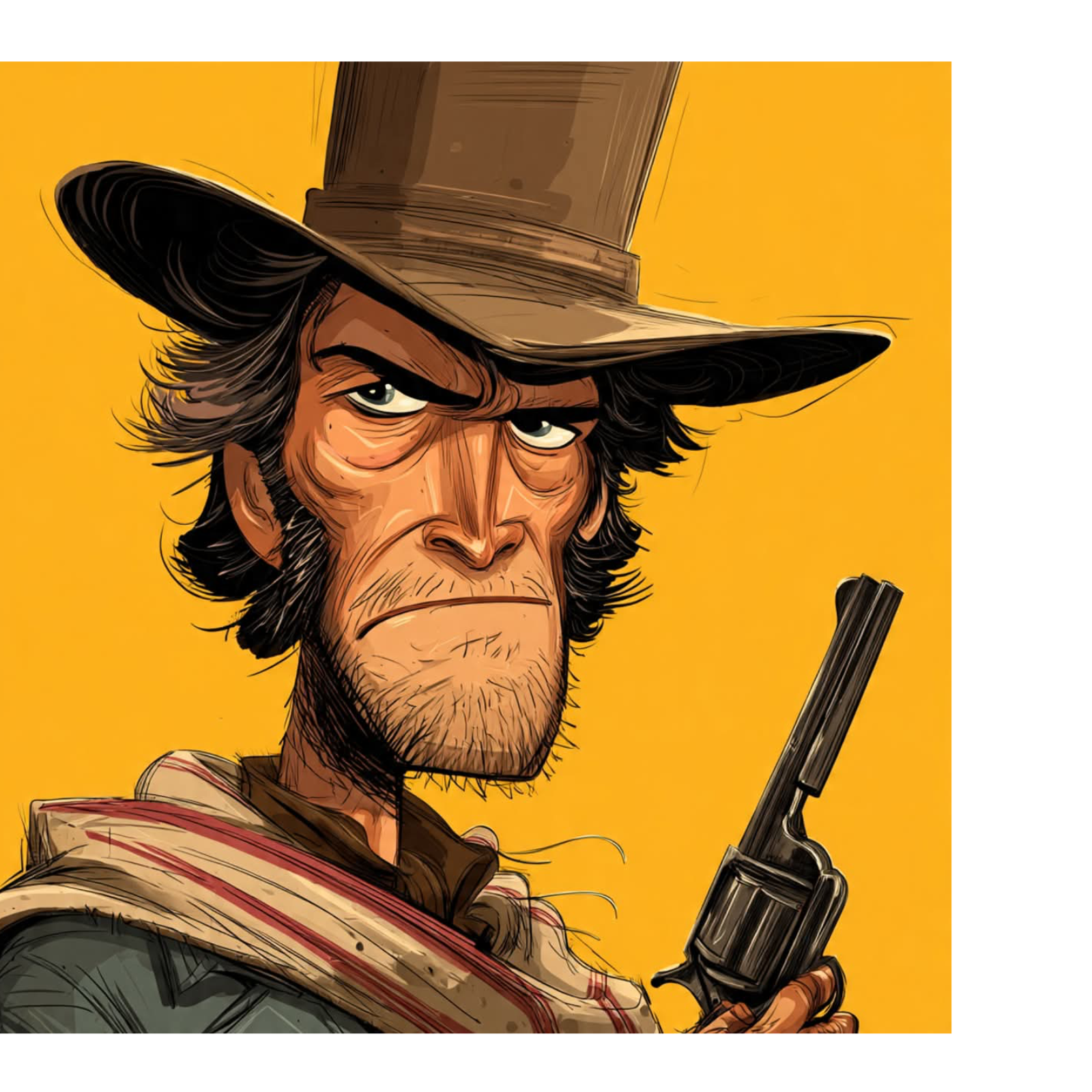
Bruce Lee vs. Clint Eastwood
The Story
What really happened that night?
The red light on camera 2 at NBC Studio 1 in Burbank didn't just signal a recording. In 1971, it signaled the entrance into 30 million American living rooms. On a Thursday evening that September, the curtain pulled back for a man whose name would soon become synonymous with a global revolution. Though at that moment, he was still fighting for a seat at the table. Bruce Lee stepped onto the stage of The Tonight Show starring Johnny Carson, wearing a tailored dark suit that fit his lean, five foot seven frame like a second skin.
He wasn't there to fight. He was there to talk. But in the world of late night television, where the host's wit is the only weapon that matters, the line between an interview and a confrontation can vanish in the time it takes to deliver a punch. For decades. A specific story has circulated in the darker corners of Hollywood lore. A tale of a clash between the philosopher warrior and the ultimate American cowboy, Clint Eastwood. The story goes that they sat on that iconic couch together. That Eastwood delivered a sharp, perhaps even bigoted, jab about Bruce's heritage or his mother.
And that Lee, with a dignity that silenced the room, unclipped his microphone and walked off the set. It's a compelling image, the stoic gunslinger versus the dragon, a collision of two distinct versions of 1970s masculinity. But as with many things that sound too perfect for the movies, the reality of that night and the relationship between these two icons is far more complicated and perhaps more telling than the myth suggests. To understand why people so desperately want this confrontation to be true, you have to look at where both men were in 1971.
Clint Eastwood was already the man with no name. He had the squint, the cigarillo, and a box office record that made him Hollywood royalty. He represented the established order of the Western hero, quiet, immovable, and fundamentally American. Bruce Lee on the other hand was a man in the middle of a bridge The Green Hornet had been canceled years earlier. He was the martial arts instructor to the stars Teaching Steve McQueen and James Coburn, but to the general public he was still that guy who did the high kicks He was back in Hong Kong filming the big boss and his appearance on the Tonight Show was a strategic strike in a campaign to prove he could be a leading man in the West.
He knew that for an Asian man in 1970s Hollywood, being extraordinary wasn't enough. You had to be undeniable. This tension is the fuel for the myth. We want to see the underdog Bruce Lee stand up to the giant Clint Eastwood because it symbolizes the shift that was about to happen in global culture. But if you dig through the NBC archives, if you look for the call sheets and the guest log from the early 70s, a strange pattern emerges. You'll find Bruce Lee's name on a guest list for a 1971 taping, but you won't find him sitting next to Clint Eastwood.
In fact, the most famous English language interview Lee ever gave, the one where he famously told the world to be water, didn't happen in Burbank at all. It happened in Hong Kong on the Pierre Burton show. This interview was lost for 23 years, only resurfacing in 1994, and its rediscovery created a massive hole in the collective memory of Bruce Lee's television history. Because people hadn't seen the Burton interview for decades, they began to graft its deep, philosophical tone onto the most famous stage they knew.
Johnny Carson's. The Tonight Show story often involves a physical demonstration that goes wrong. In one version, Eastwood is dismissive of martial arts, calling it flash and yelling or choreography for the circus. Bruce Lee, sensing the skepticism, supposedly asked for 45 seconds of Eastwood's time. He tells the six foot four actor to throw a punch with full speed and strength. The legend says Eastwood threw seven punches and Lee didn't block or counter. He simply existed in a different space. All seven missed.
Then Lee supposedly placed two fingers against Eastwood's chest and pushed, sending the action star sliding three feet backward. It's a beautiful scene. It feels like it belongs in a script by Sterling Sillifant, the writer who worked with both men. But the mechanics of the story reveal its fictional heart. The two -finger push and the one -inch punch were real techniques Lee performed at the Long Beach International Karate Championships in 1964 and 1967. But there is no contemporary record of him ever performing them on Clint Eastwood.
during a televised broadcast. What actually happened was a collision of timing and technology. In the late 2010s and early 2020s, a wave of highly sophisticated AI -generated lost footage began appearing on the internet. These videos used deepfake technology to place Bruce Lee and Clint Eastwood in the same frame. often using audio from other interviews or scripted dialogue to create the appearance of a heated exchange. One viral video even claimed that Bruce Lee walked off the show after Eastwood made a comment about his mother, Grace Ho.
The video was so convincing that it racked up millions of views and the comments were filled with people claiming they remembered seeing it live in 1970. This is the Mandela Effect in action. Fueled by digital ghosts. We remember the intensity of Bruce Lee's philosophy from the Pierre Burton interview and we remember the stoic power of Clint Eastwood from Dirty Harry and our brains aided by a clever algorithm Stitch them together into a moment of historical conflict that never occurred However, just because the Tonight Show walk -off is a myth doesn't mean there wasn't a real documented connection between the two men.
In 1973, just months before Bruce Lee's tragic death, both men were working on the Warner Brothers lot in Burbank. Eastwood was filming a western and Lee was in post -production for Enter the Dragon. There are accounts from crew members who describe the two meeting in the studio commissary. In this version of the story, which is far more grounded, Eastwood was initially skeptical of the Kung Fu craze. He was a man who believed in the economy of motion, the idea that a hero should do as little as possible to achieve the greatest effect.
Bruce Lee, interestingly, believed the exact same thing. His philosophy of Jeet Kian Do was built on the principle of the simplest, most direct movement. When they finally spoke, it wasn't a clash of egos. It was a meeting of professionals. Lee didn't need to knock Eastwood across the room to earn his respect. He simply had to show him the physics. He explained that martial arts wasn't about the flash the studios wanted. It was about geometry and the redirection of force. Eastwood, a director himself, was fascinated by the technical precision.
He later admitted in interviews that he began to see the similarities between his own strong, silent screen persona and the internal discipline Lee preached. He saw that they were both trying to achieve a kind of unacting acting, being completely present without the need for performance. This realization had a tangible impact on Eastwood's later career. If you watch his 1982 film Firefox, you can see a fight sequence that lasts only 12 seconds. It's quick, brutal, and devoid of the dancing found in typical Hollywood brawls.
When his stunt coordinator suggested a longer, more choreographed sequence, Eastwood reportedly told him to keep it real and economical, a direct echo of the lessons he had discussed with the man who would have been his greatest contemporary. The real tragedy isn't that they didn't fight on a talk show. It's that they never got to work together. There is a legitimate project in the very early stages of discussion, a concept often referred to as the Dragon and the Gun. It was a western that would have paired Eastwood's Gunslinger with Lee's Martial Artist, a proto -buddy cop movie that would have predated the genre's explosion by a decade.
Lee was excited about the prospect because he saw the Western as the only American genre where all this punching and kicking could be justified through historical lens of violence and frontier justice. He wanted to use the genre to dismantle the stereotypes he had fought against his entire life. But the project died on July 20th, 1973 when Bruce Lee passed away at the age of 32. The silence that followed his death was deafening, particularly in the halls of the major networks that hadn't known how to market him while he was alive.
There is no record of The Tonight Show offering a formal tribute to Lee immediately after his passing. As biographer Matthew Pauley noted, at that time, he was still seen by many in the American mainstream as a nobody, a talented curiosity rather than a cultural icon. That IT wasn't until Enter the Dragon became a global phenomenon a month later. That the industry realized what it had lost. Eastwood, however, didn't forget. In 1992, while accepting the Oscar for Best Picture for Unforgiven, he spoke about the nature of real toughness.
He argued that violence in film shouldn't be glorious. It should be ugly and of consequences. This was a philosophy he had first discussed years earlier on a studio lot with a young man from Hong Kong who told him that a true martial artist doesn't want to fight because they know exactly what damage they can do. The truth of The Tonight Show incident isn't found in a grainy non -existent tape or an AI generated viral clip. It's found in the quiet. Lasting influence one man had on another's understanding of power.
It's the story of a smile that started as skepticism and ended as genuine wonder. A 45 second master class that redefined what it meant to be the toughest man in the room. We don't need the myth of the walk -off to see the impact Bruce Lee had on the Titans of Hollywood. We only need to look at the way they moved after they met him. If this look into the intersection of Hollywood legends and the myths we create around them gave you a new perspective, share this episode with a friend. And that's how I heard it.
 Apple Podcasts
 Castbox
 Castro
 Goodpods
 Moon FM
 Overcast
 Pocket Casts
 Podbean
 Podcast Addict
 Podcast Republic
 Spotify