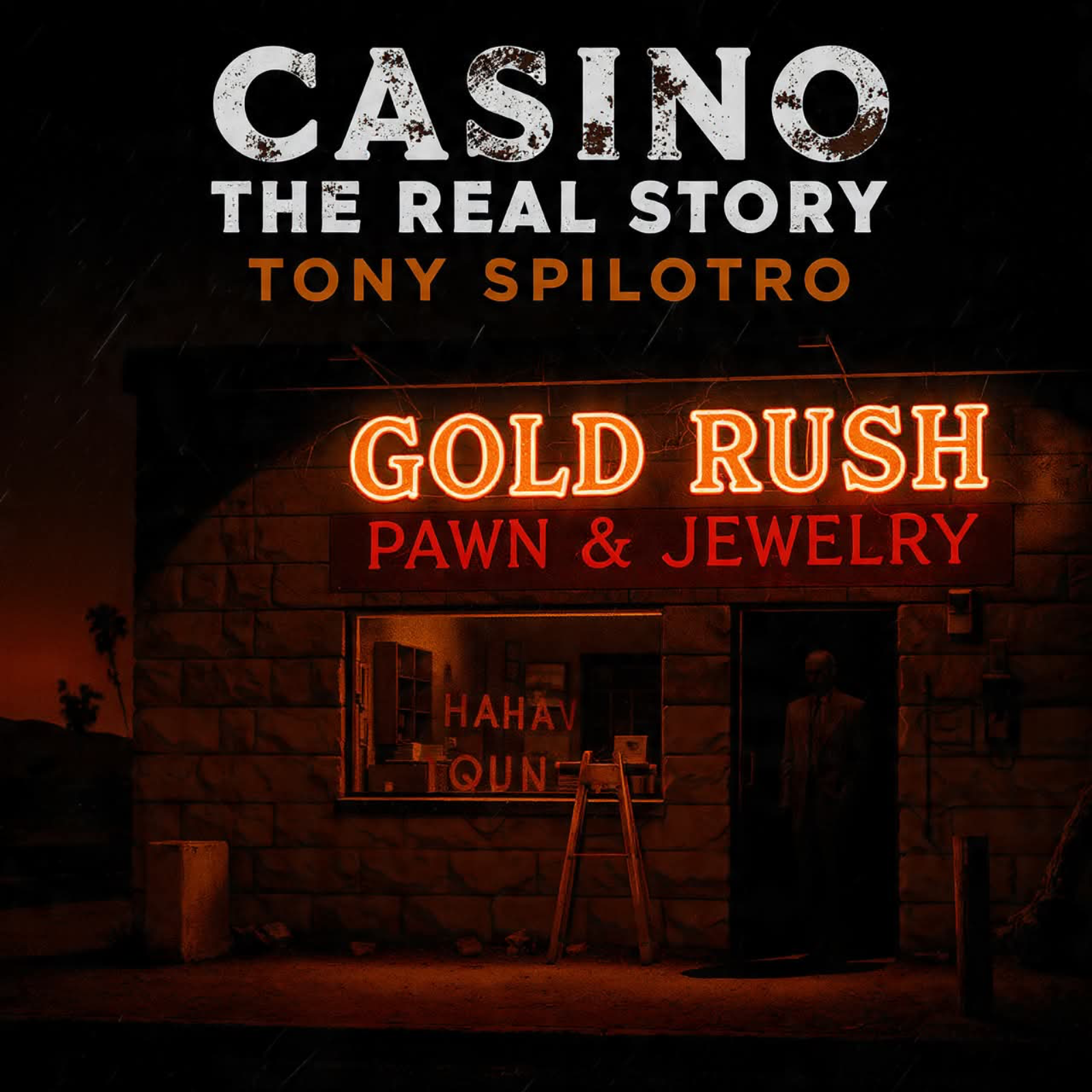
CASINO: TONY SPILOTRO - The Real "Ant" Who Destroyed The Vegas Skim
The Story
He was 5'2" and ran Las Vegas.
This is the real Tony "The Ant" Spilotro.
The man who protected the skim at the Stardust.
Who formed the Hole in the Wall Gang.
Who slept with Lefty's wife.
And who brought the FBI down on the entire Outfit.
Pesci played him calm.
The real Ant was pure chaos.
In the movie, Casino Joe Pesci played Nicky Santoro and played him well, but in reality, Spolatro was much more unhinged. When your own crew fears your unpredictable behavior, you're definitely a psychopath. Anthony John Spolatro stood exactly five feet, two inches tall, a measurement that would one day lead a frustrated FBI agent named William Romer to dismiss him as a little piss ant. The media, ever eager for a headline, softened the insult but sharpened the image, christening him Tony the Ant.
But by the time he reached the age of 21, that small frame had already been processed through Chicago police stations 13 times. He was a high school dropout from Steinmetz High, a kid who had traded his textbooks for the lessons learned at Pazzi's restaurant, the Italian eatery his parents ran on the city's northwest side. It was a place where the air was thick with the scent of garlic and the heavy presence of men like Sam Giancana and Frank Nitti. Tony didn't just serve them coffee. He studied the way they commanded a room, the way a whispered word from a man in a tailored suit could change a life or end one.
While his brother Patrick went on to become a dentist, Tony and his brothers John, Vincent, Victor, and Michael found their calling in the shadows of the patch. A neighborhood where loyalty was the only currency that never devalued. He wasn't just another street hood. He was a protege of the most depraved Tudor in the Chicago outfit. Mad Sam DeStefano, a man so unstable he was known to urinate on barroom floors just to prove he could. Under DeStefano's wing, Tony learned that violence wasn't just a tool, it was a language.
The year was 1962. and Tony was about to earn his stripes in a way that would cement his legend and eventually haunt his final moments. Two thieves, Billy McCarthy and Jimmy Miraglia, had made the fatal mistake of killing two connected men in a cocktail waitress in Elmwood Park, a territory the outfit considered sacred ground. Tony was part of the crew sent to recover the stolen honor in a basement that smelled of cold concrete and fear. Tony used a literal carpenter's vise to extract information from McCarthy.
He tightened the handle until the man's eyeball popped out of its socket, a gruesome detail that wasn't just a piece of mob lore, but a verified fact that later emerged in the Family Secrets trial decades later that McCarthy talked. And then he and Miraglio were found dead in the trunk of a car, their throats slashed, their bodies a message from the outfit. This was the work that made Tony Spolatro a made man at the young age of 25. He was a golden boy of a syndicate, a reliable enforcer who didn't just follow orders, he exceeded them.
When Sam DeStefano himself became a liability in 1973, facing trial alongside Tony, a shotgun blast ended Mad Sam's life before he could take the stand. The FBI suspected Tony pulled the trigger. Removing his own mentor to protect the family, that IT was a cold -blooded pragmatism that the bosses in Chicago, men like Tony Iacardo and Joey Iapa, found immensely valuable. In 1971, the Outfit decided it was time to send their most aggressive pitbull to the neon -drenched desert of Las Vegas. Their goal was simple.
Protect the skim. Millions of dollars were being diverted from the counting rooms of casinos like the Stardust and the Fremont before the IRS could ever see a penny. To manage the money, they had Frank Lefty Rosenthal, a brilliant Jewish handicapper who couldn't be a made man but could certainly make the mob rich. To protect the money, they sent Tony. The two had been boyhood friends in Chicago, a partnership of brains and brawn that seemed like a masterstroke. Tony set up his base of operations at the Gold Rush, a jewelry and pawn shop on Sahara Avenue.
Officially, he was a merchant. Unofficially, he was the king of the strip. But Tony was never one for the quiet life. He was bored with just watching the counting rooms. So he formed the Hole -in -the -Wall Gang, a crew of specialists including his childhood friend Frank Collada and his brother Michael. They earned their name by literally drilling through the exterior walls and ceilings of businesses and luxury homes to bypass sophisticated alarm systems. They weren't just common burglars. They were a paramilitary unit of thieves, hitting targets like Bertha's Gifts and home furnishings on July 4, 1981, while the rest of the city was watching fireworks.
But as Tony's power grew, so did his recklessness. He began to believe he was bigger than the desert itself. That he didn't just enforce the rules. He started making his own. And that included the most sacred rule of all. You don't touch another man's wife. Lefty Rosenthal had married a glamorous showgirl named Jerry McGee. A woman whose beauty was matched only by her volatility and her appetite for the high life. As Lefty's marriage crumbled under the weight of his controlling nature and her addiction to pills and alcohol, she turned to the one man who didn't care about Lefty's rules.
The affair between Tony and Jerry became the worst kept secret in Vegas, a blatant disrespect that burned through the long -standing friendship between the two men. One night, Lefty returned home to find his daughter tied to a bedpost with a clothesline and his wife gone. She was with Tony at a bar, and when Lefty confronted them, Tony didn't apologize. He told Lefty to be gentle with her, a mockery of the man's authority. The tension reached a boiling point on October 4th, 1982, when Lefty walked out of Tony Roma's restaurant and started his Cadillac El Dorado.
The car erupted in a sheet of flame, a bomb intended to end the feud once and for all. Lefty survived only because a steel stabilizing plate under the driver's seat deflected the blast. He emerged from the wreckage with his clothes on fire, screaming that they were trying to kill him. While never proven in court, everyone in the underworld knew the fuse led back to the outfit. Tony's ego didn't just alienate his friends, it put a bull's eye on his back for the authorities. He wasn't the kind of mobster who stayed in the shadows.
He was a constant presence in the courtroom, represented by his charismatic attorney Oscar Goodman, the future mayor of Las Vegas. Goodman would later describe their relationship as cordial Recalling how Tony would wake him up at 4 a .m. By banging pots in the kitchen because he didn't like to drink his morning coffee alone But the charm was a mask for a man who was increasingly out of control When the Nevada gaming Commission led by a young Harry Reid moved to put Tony and lefty in the black book Effectively banning them from every casino in the state.
Tony didn't just fight it legally Reid began receiving death threats so severe he had to start his car with a remote control and have a patrol car station outside his house every night. Even the governor of Nevada, Robert List, was warned to back off, eventually resorting to wearing a bulletproof vest. Tony was no longer a shadow enforcer. He was a glaring spotlight, drawing the full weight of the FBI and local police onto the outfit's lucrative skimming operation. The bosses in Chicago watched as their investments were dismantled by the very man they had sent to protect them.
The arrests of the hole in the wall gang in 1981, followed by Frank Collada turning government witness after he realized Tony had put a contract on his life, was the beginning of the end. By June 1986, Tony's bilateral had become a liability that the Chicago outfit could no longer afford to carry. He was facing three major trials. His name was a permanent fixture in the headlines and he had lost the respect of his peers. A meeting was called. Tony and his brother Michael were told they were being summoned back to Chicago for a promotion.
Tony was to become a captain and Michael was finally going to be a made man. On June 14th, they drove to a house in Bensonville, Illinois, believing they were walking into their greatest triumph. Instead, They walked into a basement filled with ten of their own people. The promotion was a death sentence. As Tony realized the trap, he reportedly asked his executioners, Can I say a prayer? There was no answer. The brothers were beaten with blunt force, their bodies stripped to their underwear and driven across the state line to a cornfield in Enos, Indiana.
They were buried one on top of the other in a shallow grave, intended to be forgotten in the dark soil of the Midwest. A few days later, A farmer noticed the freshly turned earth, thinking a poacher had buried a deer out of season. When he dug into the dirt, his shovel struck a human midsection. The identify of the bodies was confirmed through dental records provided by their brother Patrick, the dentist. The aunt, who had once ruled the neon lights of the strip with a vice and a drill, ended his story in the silence of a cornfield, a victim of the very violence he had perfected.
The reign of the mob in Las Vegas didn't just end, it was buried alongside them. If you found this look into the brutal reality of a Las Vegas underworld compelling, share this episode with someone who thinks they know the true story behind the movies. And that's the way I heard it.
 Apple Podcasts
 Castbox
 Castro
 Goodpods
 Moon FM
 Overcast
 Pocket Casts
 Podbean
 Podcast Addict
 Podcast Republic
 Spotify