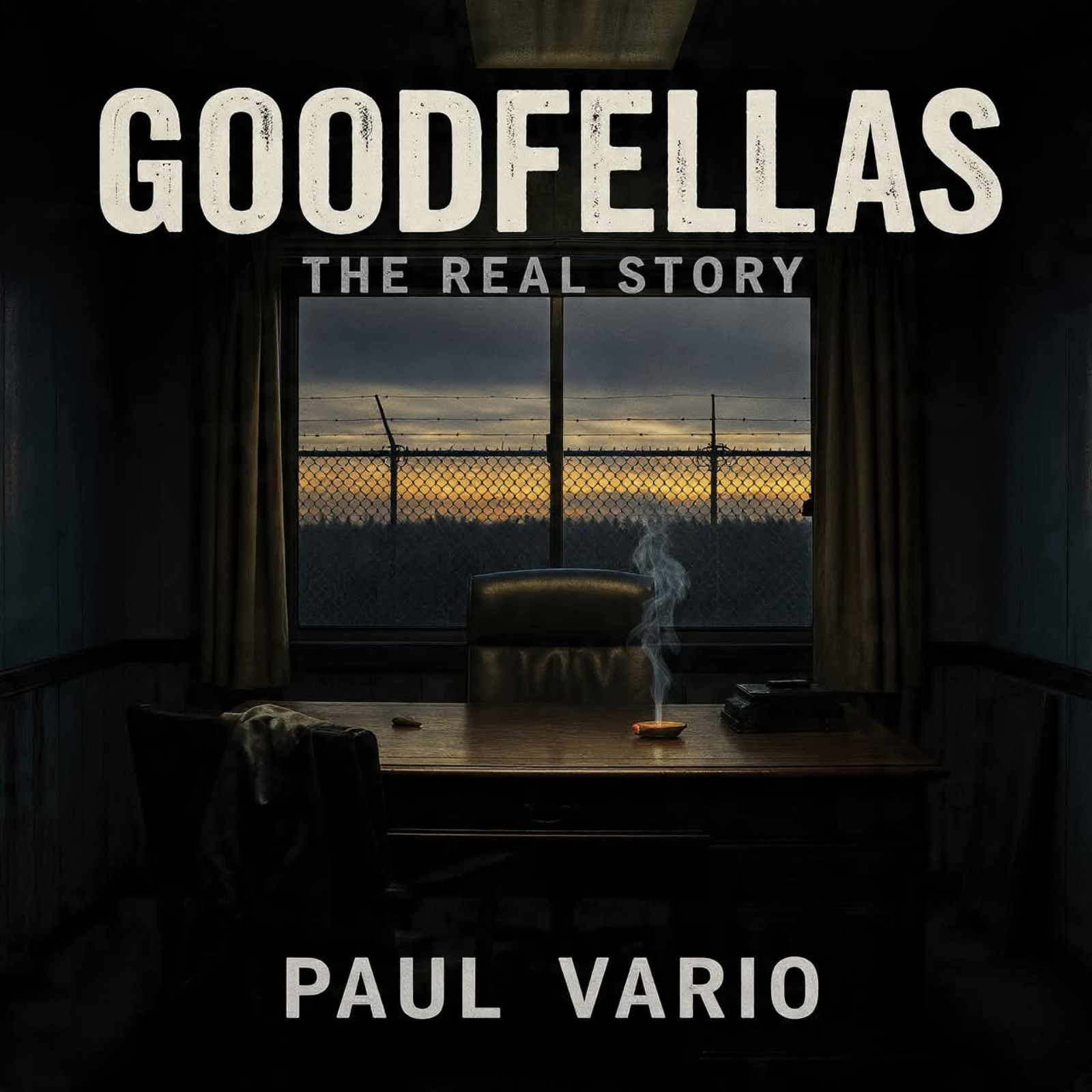
PAUL VARIO - The Real King of JFK Airport & Avenue D
The Story
He made $25,000 a day out of a junkyard trailer.
This is the real Paul Vario.
The man who turned truck hijacking into a corporation.
Who owned JFK Airport through the unions.
Who had an affair with Henry's wife.
And who signed Tommy's death warrant.
The calm in the movie. The monster in Canarsie.
Paul Vario stood six foot three and weighed 250 pounds a massive Unkempt man who preferred the grease of a Brooklyn junkyard to the silk of a Manhattan Social Club in the early 1970s He operated out of a 40 by 15 foot blue gray trailer park deep within bargain auto parts at 5702 Avenue D in Canarsie This wasn't just a salvage yard. It was the nerve center for one of the most powerful crews in the Lucchese crime family surrounded by a 14 -foot steel fence topped with barbed wire and patrolled by two savagely trained German shepherds.
Vario held court. He was a man who turned truck hijacking into a high -volume industry, presiding over a group of associates, men like Henry Hill and Jimmy Burke, who looked at John F., Kennedy International Airport, not as a transit hub, but as a personal vault that Vario's philosophy was built on a quiet, terrifying lethargy. He moved slowly, spoke softly, and exerted absolute control, earning an estimated $25 ,000 a day while ostensibly running a taxi stand and a flower shop. Yet for all the calm portrayed by Hollywood in later years, the real Paul Vario was a man of explosive, unpredictable violence, a man whose empire was ultimately undone by the very loyalty he demanded but rarely truly returned.
To understand how Vario became the Tsar of Canarsie, you have to go back to a New York that was still carving out its underworld territories. Born in 1914 to Sicilian immigrants, Vario was a product of the streets long before he was a captain. By age 11, he was already in juvenile detention for truancy, and by his early 20s, he was caught in the middle of a brutal felony. In 1937, A 16 -year -old girl from Howard Beach identified Vario and an associate, Anthony Romano, as the men who had sexually assaulted her after a church function.
Vario was convicted of rape and sentenced to 10 to 20 years in Sing Sing. He was paroled twice and sent back twice for violations, including burglary and dealing in stolen property. It was during these years behind bars that he forged the connections that would define his life. When he finally earned a discharge from state parole in 1962, the Lucchese family was waiting. Vario didn't just join the ranks. He ascended. He was a protege of Joseph Schiavo, and when Schiavo stepped down, he recommended the imposing Vario to take over the Brooklyn crew.
This was the birth of the Vario crew, a collection of hijackers, bookmakers, and enforcers who would eventually control the flow of goods across the entire eastern seaboard. The mechanics of Vario's operation were elegantly simple and devastatingly effective. His crew focused on the logistics of theft. They didn't just rob trucks, they owned the environment where the trucks lived. Vario utilized his influence over the cargo haulers unions to ensure that when a hijacking happened, the paperwork went missing or the investigations hit a wall of silence.
At JFK airport, his associates were so entrenched that they famously boasted, we own the airport. It was like a city bank with the doors left open. The process was a well -oiled machine. A tip would come in about a shipment of electronics, pharmaceuticals, or high -end clothing. The truck would be intercepted, driven to a safe location, off in the junkyard on Avenue D and stripped. Vario was the master of the fence, moving millions of dollars in stolen goods through a network that reached into every corner of the city.
He strictly forbade his men from dealing in narcotics, not out of morality, but out of a calculated fear of the long prison sentences that led men to flip. He knew that drug money brought heat. and heat was the only thing that could melt his iron grip on Brooklyn. He preferred the steady, massive profits of hijacking and gambling, where the arrests usually resulted in nothing more than a fine or a short stint on probation. However, the calm exterior of the man who supposedly never used a telephone was often a mask for a terrifying temper.
Henry Hill once recalled a night when Vario took his wife, Phyllis, out to dinner. A matron de -accidentally spilled wine on Phyllis's dress and then, in a clumsy attempt to help, tried to wipe it off with a dirty rag. Vario didn't just complain. He hit the man twice, right there in the dining room. But that wasn't the end of it. Later that night, Vario sent two carloads of men armed with baseball bats and lead pipes back to the restaurant. They waited for the staff to clock out and then chased the waiters through the streets of Brooklyn.
breaking bones as a message that no one touched to Vario with disrespect. This wasn't an isolated incident. Vario was known to chase debtors up five flights of stairs with a baseball bat well into his 50s. His violence was a tool of management, a way to ensure that the fear remained palpable even when he was just sitting in a trailer sipping coffee and reading medical journals, which was his peculiar hobby. He was a man who understood that power in the mob wasn't just about the money you made. It was about the consequences people believed would follow if they crossed you.
The height of Vario's power coincided with a period of intense law enforcement pressure that he initially managed to evade with brazen confidence. In 1972, the Brooklyn District Attorney, Eugene Gold, launched Operation Gold Bug. Detectives wore padded suits to protect themselves from Vario's German shepherds and snuck into the junkyard at four in the morning to plant a transmitter in the ceiling of Vario's office trailer. For six months, they listened to everything. They heard him talk about hijackings, bribes to union officials, and a list of informants he was trying to buy from a detective he thought was corrupt.
When Annette finally closed on November 1st, 1972, Vario didn't go quietly. He led police on a dramatic 20 -minute car chase through the streets of Brooklyn before finally pulling over. The resulting raid involved 1 ,200 police officers and over 600 subpoenas. It was the largest organized crime sweep in New York history at the time. Vario was hit with charges of witness tampering, insurance fraud. He had reportedly sunk his own boat for a $7 ,000 claim and tax evasion. But even as he was headed to federal prison in Lewisburg, Pennsylvania, his influence remained.
In prison, he was part of the infamous Mafia Row, living a life of relative luxury, bribing guards to bring in steak, liquor, and women. While Vario was serving his time, the stability of his crew began to fracture. His son, Leonard Vario, died under mysterious circumstances in July 1973. The 23 -year -old was found at the door of Wyckoff Heights Hospital, burned over 90 % of his body after an arson attempt went wrong at a construction site. True to the code his father lived by, Leonard refused to say a word to investigators, even as he was dying.
The funeral that followed was a scene of pure chaos. When television crews from WABC and WNBC tried to film the procession at St. Fortunata's church, Vario's mourners poured out of their limousines. They smashed cameras and severely beat two cameramen and a detective on surveillance duty. It was a public display of the Vario brand of loyalty. Absolute silence for the law, absolute violence for anyone else. But during this same period, Vario's personal betrayals were beginning to seed his downfall.
While Henry Hill was in prison for an unrelated extortion charge, Vario began an affair with Hill's wife, Karen. At the same time, Another associate, the volatile Tommy DeSimone, attempted to rape Karen. When Vario found out about DeSimone's various unauthorized murders, including the killing of a made man from the Gambino family, he reportedly set DeSimone up to be killed, partly as revenge for the assault on Karen Hill. It was a tangled web of infidelity and blood that would eventually push Henry Hill toward the FBI.
The final chapter of Vario's empire was written at JFK Airport with the Lufthansa heist of 1978. While Vario was living in Florida on parole, Jimmy Burke reached out to him for approval to rob the Lufthansa cargo terminal. Vario gave the green light, provided Burke supervised the job. It was the largest cash robbery in US history, netting nearly $6 million. But the aftermath was a bloodbath as Burke began murdering the participants to keep the money and silence potential witnesses. Vario, increasingly paranoid, watched as the crew he had built for 30 years began to disappear or turn.
The end came in 1980 when Henry Hill, convinced that Vario and Burke were planning to have him killed for his secret drug dealing, entered the witness protection program. Hill's testimony was a sledgehammer. He revealed the fictitious restaurant job Vario had arranged for him to get parole. leading to a fraud conviction in 1984. Then came the extortion charges involving air freight companies at JFK. Vario, once the untouchable king of Canarsie, was sentenced to a total of 14 years. He died on May 3rd, 1988, at the age of 73, not in a trailer or a quiet Brooklyn bar, but in a federal prison in Fort Worth, Texas.
His cause of death was respiratory failure brought on by lung cancer. A quiet end for a man whose life had been defined by the roar of hijacked engines and the silence of grave. The legacy of Paul Vario is often viewed through the lens of cinema, where he is remembered as the calm, fatherly figure who never used a phone and wanted his associates to stay out of trouble. But the real story is one of a brutal pragmatist who turned theft into a corporate enterprise and maintained his position through a cold, calculated willingness to use violence.
He was a man who understood the value of every truck that left the airport and every secret kept in a junkyard trailer. When he died, he was buried at St. John's Cemetery in Queens, leaving behind a criminal blueprint that would eventually be dismantled by the very people he had brought into the life. Recommend this story to a friend who appreciates the reality behind the legends would be a great way to share this history. That is all for this account of the man who ruled Brooklyn from the shadows.
And that's the way I heard it.
 Apple Podcasts
 Castbox
 Castro
 Goodpods
 Moon FM
 Overcast
 Pocket Casts
 Podbean
 Podcast Addict
 Podcast Republic
 Spotify