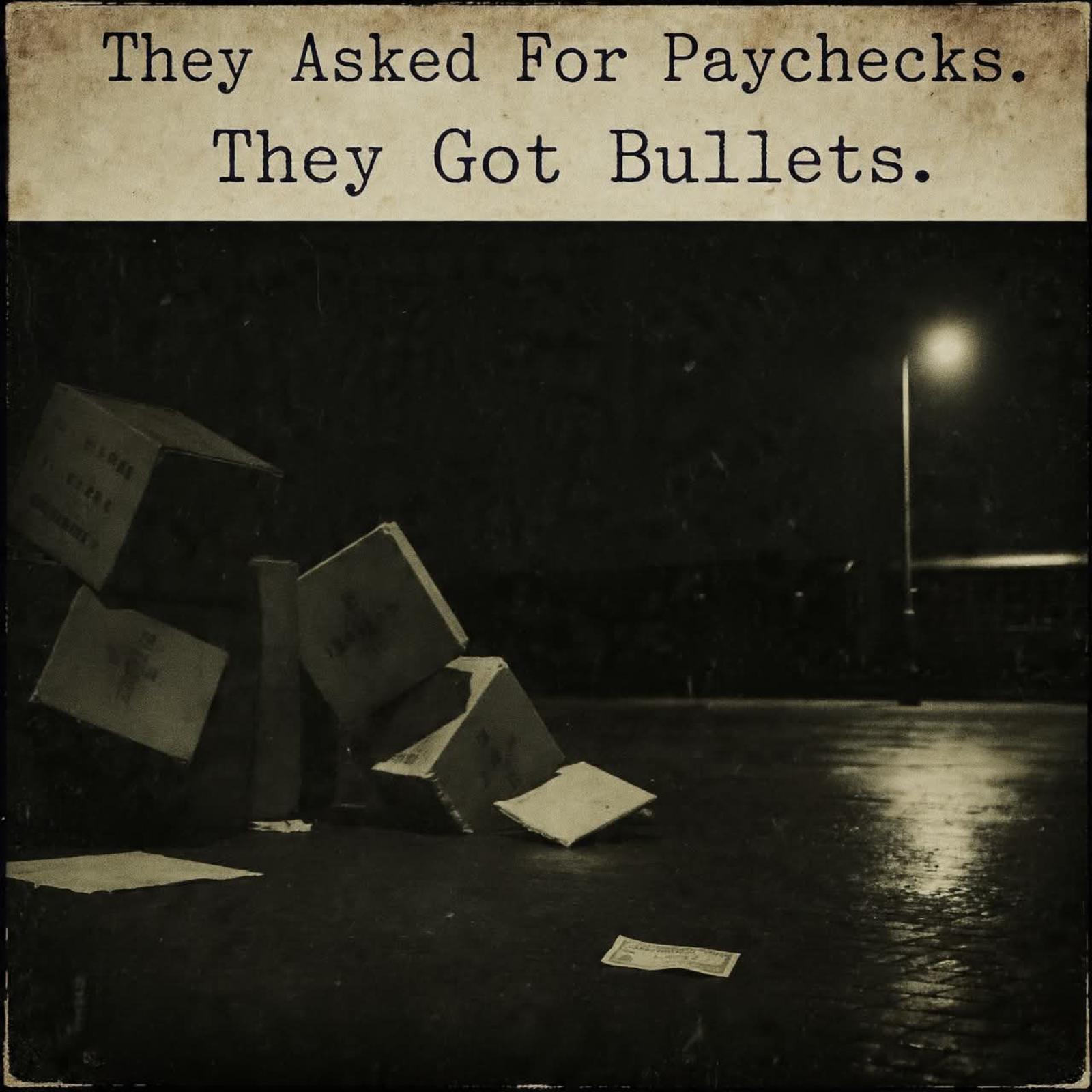
They Asked For Paychecks. They Got Bullets.
The Story
The workers in Magdalena weren't asking for revolution. They wanted Sunday off and to be paid in money, not coupons. United Fruit said no. The Colombian government said no. Then General Cortés Vargas gave them 5 minutes to leave the plaza. When they didn't, the army fired. The bodies went on trains to the sea. For decades the official story was: "There were no dead." Until a politician held up a child's skull in congress, and a novelist made the world remember.
The Banana Massacre began on December 5, 1928, when General Carlos Cortez Vargas ordered 700 Colombian troops to aim their rifles at striking United Fruit Company workers in Cienega. The plaza outside the train station was packed with thousands of laborers, their wives, and their children. They had gathered under the humid Caribbean night sky. because they believed the governor of the Magdalena department was coming to negotiate. They expected a settlement. They received decree number one instead.
General Cortez Vargas stood before the crowd. He carried the full backing of the conservative government of President Miguel Obedia Mendez in Bogota in a silent, heavy expectation of the United Fruit Company executives who watched from the safety of their guarded compounds. The decree declared a state of siege in the banana zone. The general gave the crowd a five -minute warning to disperse. The workers, exhausted after nearly a month on strike, stood their ground. Someone in the crowd shouted a defiant reply, a declaration that they were all in charge.
When the five minutes expired, the order to fire rang out over the plaza. To understand how an army turns its weapons against its own citizens on behalf of a foreign corporation, you have to look at the dirt, the sweat, and the sheer scale of the United Fruit Company's operation in Colombia during the 1920s. By 1928, this American corporation owned 220 ,000 acres of Colombian farmland. Colombia was the third largest banana producer in the world. exporting over 10 million ray seams of bananas from the Magdalena region alone.
The fruit was harvested by a sprawling, invisible army of 25 ,000 laborers who lived and died in the sweltering heat of the tropical coast. The mechanics of this agricultural empire were designed to extract maximum value while shedding all responsibility. The United Fruit Company did not hire the vast majority of these workers directly. They used a system of subcontractors. This legal buffer meant the company owed the men nothing in terms of employment rights, healthcare, or liability. A worker cutting heavy stems of green bananas with a machete could slip in the mud.
sever a tendon and find himself discarded the same afternoon with zero compensation for the work accident. The compensation they did receive was a closed loop of exploitation. The men were not paid in Colombian pesos. They were paid in pieces of paper, company coupons. A worker would exhaust himself for six or seven days a week. carrying heavy loads through mosquito -infested swamps, only to receive a slip of paper that was entirely worthless anywhere except at the United Fruit Company's administrative office stores.
The company controlled the prices of food, clothing, and basic necessities. The workers bought their sustenance from the very entity that profited from their labor, paying inflated prices with arbitrary currency. They were tethered to the plantations, living in unhygienic, crowded dormitories. Decades of this grinding reality built a profound resentment. A decade earlier, a strike had sputtered out with little change, but by late 1928, the atmosphere in Magdalena had shifted. Radical members of the Liberal Party, along with organizers from the Socialist and Communist parties, began speaking with the workers.
But the core of the movement was not a grand geopolitical conspiracy, despite what the executives claimed. The core of the movement was a list of nine simple demands drafted on October 6th, 1928, by the Workers' Union of Magdalena. The demands read like a basic blueprint for human dignity. They wanted to stop to the practice of hiring through subcontractors. They asked for mandatory collective insurance and compensation for work accidents. They requested hygienic dormitories and six -day work weeks so they could have a day of rest on Sundays.
They demanded a 50 % increase in daily pay for those earning less than 100 pesos per month. They wanted to be paid weekly and, crucially, they demanded the abolition of the company's stores and an end to the payment system that relied on coupons rather than actual money. Finally, they asked for the improvement of hospital services. They presented these nine demands to the United Fruit Company and to the Colombian government, asking the General Labor Office to mediate. The United Fruit Company flatly refused to negotiate.
They did not recognize the workers as their employees. They saw the demands not as a plea for basic rights, but as a dangerous breach of their absolute authority. On November 12th, 1928, the workers stopped cutting the bananas. The largest labor movement Colombia had ever witnessed paralyzed the Magdalena banana zone. 25 ,000 workers laid down their machetes. The trains stopped running. The fruit began to rot on the trees. The strike tested the United Fruit Company's ability to exert power through its traditional channels.
They immediately leveraged their diplomatic influence. United States officials in Colombia, working closely with United Fruit representatives, began sending frantic telegrams to Washington. They bypassed the reality of the nine demands and framed the strike entirely through the lens of Cold War -style paranoia, decades before the Cold War even began. In telegrams directed to United States Secretary of State Frank B. Kellogg, diplomats portrayed the strike as a communist uprising with subversive tendencies.
The pressure on the conservative government of President Miguel Obedia Mendez was immense. The Colombian government was terrified of losing the banana trade, which fed significant markets in the United States and Europe. Worse, there were murmurs and veiled threats of direct American military intervention to protect American interests. The United States had already sent a warship to the region. though the ambassador claimed it was merely a diplomatic visit. Fearful of an invasion and desperate to maintain the flow of capital, Bogota chose a side.
The government appointed General Carlos Cortez Vargas as the military chief of the Magdalena Department and dispatched the army to break the strike. The military arrived in Cienega with orders to restore order. but their presence only escalated the tension. The army banned striking workers from using the trains. In retaliation, workers sabotaged the railway lines, leading to the arrest of 400 strikers. The conflict tightened like a coiled spring. Local merchants, who had long suffered under the monopoly of the United Fruit Company stores, actually sympathized with the workers.
providing them with food and supplies to keep the strike alive. By early December, the stalemate had grown intolerable for the company and the government. Word spread among the workers that the governor of Magdalena was traveling to Cienega to personally hear their grievances and settle the strike. Believing a diplomatic breakthrough was at hand. Workers descended from the hills. emerging from the plantations, bringing their families with them. They gather in the town square near the train station, a sprawling sea of tired but hopeful faces waiting in the dark.
There was no negotiation. There was only decree number one. The mechanics of the massacre were swift and brutal. When the five minutes elapsed and the workers refused to move, The soldiers on the rooftops and around the perimeter opened fire into the dense crowd. The crack of Mauser rifles shattered the humid night. Panic consumed the plaza. Men, women, and children were caught in a deadly crossfire, trampled in the mud as they tried to flee the bullets. The exact duration of the gunfire remains obscured by history, but the devastation it wrought was absolute.
When the sun rose over Cienega the next morning, the cover -up began. The Colombian military immediately took control of the narrative and the physical evidence. The bodies were rapidly cleared away. According to local lore and testimonies gathered years later, the dead were loaded onto the very trains they had refused to operate, transported to the coast, and thrown into the Caribbean Sea. Others were reportedly buried in unmarked mass graves deep within the banana plantations Swallowed by the soil they had worked their entire lives The true death toll of the banana massacre is one of the most fiercely debated controversies in Colombian history General Cortez Vargas took official responsibility for just 47 casualties presenting the action as a necessary military engagement against a subversive threat.
He claimed he ordered the firing to prevent a communist revolution and to preempt American military intervention, effectively framing the slaughter of unarmed workers as an act of patriotic defense. The internal communications of the United States government told a wildly different story. A telegram from the Bogota embassy to the Secretary of State on December 5th confirmed the Colombian government's intent to arrest strike leaders and protect American interests. Shortly after the massacre, a United States embassy official reported a staggering discrepancy.
He relayed that the Bogota representative of the United Fruit Company had privately admitted the total number of strikers killed by the Colombian military exceeded 1 ,000. Other labor leaders and survivors estimated the dead at up to 3 ,000. The vast canyon between 47 and 3 ,000 deaths is where the truth of the banana massacre was buried. The conservative government imposed strict censorship. Newspapers were pressured. The official line was that a minor riot had been quelled with minimal force. The blood was washed from the stones of the Cienega Plaza, and the United Fruit Company resumed its operations, harvesting bananas with a newly terrified, heavily policed workforce.
But the silence could not hold. The controversy erupted in the halls of the Colombian Congress thanks to a young, fiery liberal party representative named Jorge Elisa Gaitán. Gaitán traveled to the banana zone. conducting his own clandestine investigation. He interviewed survivors, workers, and grieving mothers. He gathered evidence that the military and the government had desperately tried to erase. When Gaetan returned to Bogota in 1929, he launched a blistering series of speeches in the lower house of Congress.
He delivered a masterful, devastating critique of the Obedia Mendez administration. He did not speak in abstract political terms. He brought the visceral horror of Syenaga into the sterile halls of power. In a moment that stunned the nation, Gaetan stood before his colleagues and held up the small, fragile skull of a child who had been killed by an army bullet during a massacre. He accused the conservative government of bowing to the demands of a foreign corporation while turning its weapons on its own people.
He painted the administration as spineless pawns of American business interests, declaring that the army had the knee on the ground before the foreign gold, but the rifle on the shoulder to shoot their own brothers. Gaetan's relentless exposure of the massacre shattered the government's carefully constructed narrative. The ensuing public outrage played a pivotal role in ending 44 years of conservative hegemony in Colombia, propelling the Liberal Party to power the following year. Yet, despite the political upheaval, the victims of the Banana Massacre remained largely faceless, their names unrecorded, their exact numbers a ghostly cipher.
The United Fruit Company faced no legal consequences for the deaths. They continued to operate in Colombia for decades, eventually rebranding as Chiquita Brands International, a company that would later face its own severe controversies regarding payments to armed paramilitary groups in the very same regions. The true legacy of the Banana Massacre, however, was not secured in a courtroom or a political debate. It was secured in the realm of literature. A child born in the banana town of Ercataca, just a few miles from Cienega, grew up listening to the whispered stories of the strike, the trains filled with bodies, and the silence that followed.
That child was Gabriel Garcia Marquez. When Garcia Marquez wrote his masterpiece, 100 Years of Solitude, he transformed the forgotten history of his homeland into myth. In the novel, The town of Macondo is invaded by a foreign banana company that brings unnatural weather, exploitation, and eventually a devastating strike. Garcia Marquez dramatizes the massacre with chilling precision, depicting thousands of workers gathered in a plaza hemmed in by soldiers and given a five -minute warning to leave.
After the slaughter, his character Jose Arcadio Segundo wakes up on a dark, silent train heading toward the sea, surrounded by three thousand corpses. When Jose Arcadio Segundo escapes and returns to Macondo, he finds the blood washed away and the townspeople repeating the official government line. There were no dead. The collective amnesia imposed by the state becomes a central tragedy of the novel. By inflating the numbers to 3 ,000 and rendering the horror in visceral, unforgettable prose, García Márquez forced the world to look at Cienega.
He took an event that the government and the United Fruit Company had tried to erase and carved it permanently into the cultural memory of Latin America. The real workers who stood in the plaza that night in 1928 were not mythical figures. They were men holding worthless paper coupons, asking for a day off, a living wage, and the dignity of being recognized as human beings. They were crushed by a machine of international capital and state violence that demanded smooth operations at any human cost.
General Cortez Vargas and the executives he protected thought the bullets will be the end of the dispute. They believed the sea would swallow the evidence and the soil would hide the bones. Instead, the echo of those rifles in the Sienega train station carried across a century. The nine demands written on a piece of paper became a testament to a labor movement that refused to be invisible. The silence they tried to impose was broken by a politician holding a skull and completely shattered by a novelist who ensured that the victims of the banana plantations would outlive the very empire that killed them.
Send this episode to a friend who appreciates stories that refuse to stay buried. And that's the way I heard it.
 Apple Podcasts
 Castbox
 Castro
 Goodpods
 Moon FM
 Overcast
 Pocket Casts
 Podbean
 Podcast Addict
 Podcast Republic
 Spotify