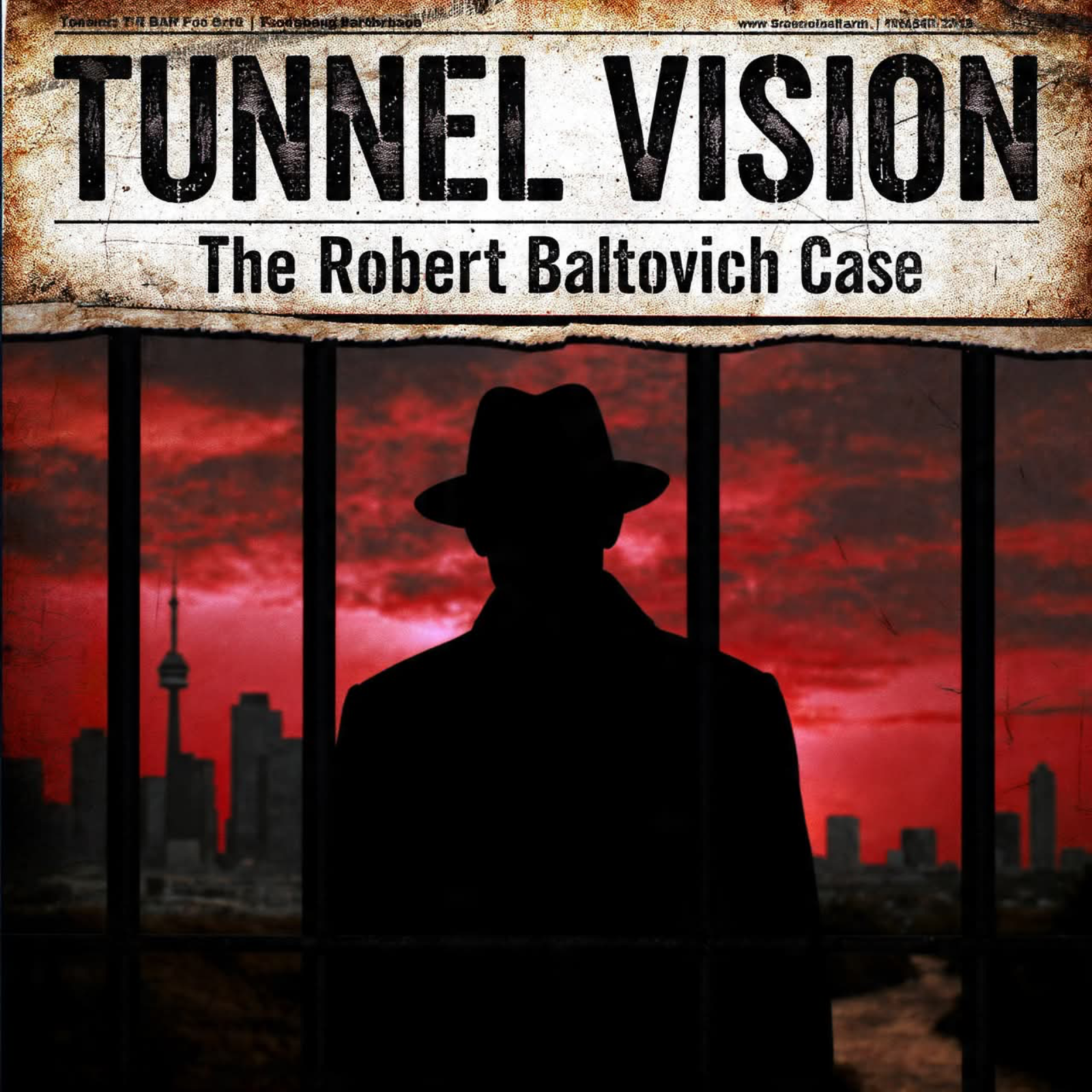
Better 10 Guilty Go Free: The Robert Baltovich Story
The Story
Better for ten guilty people to go free than for one innocent person to suffer."
But what happens when the system forgets that? In 1992, Robert Baltovich went to prison for murder. The problem: he didn’t do it. And while he sat in a cell, a serial killer was still walking free.
In 1992, a jury sent Robert Baltovich to prison for the murder of his girlfriend, Elizabeth Bain, relying heavily on witness memories that have been artificially altered by police hypnotists. How does the justice system lock away an innocent man for eight years when the real killer might have been one of the most notorious predators in Canadian history? The answers lie in a perfect storm of investigative tunnel vision, junk science, and a judicial process that completely failed to protect the basic presumption of innocence.
The social contract of our legal system is built on the idea that it is better for ten guilty people to go free than for one innocent person to suffer. But cases like this reveal Just how fragile that contract really is when police are under pressure, the public is terrified, and the actual science of evidence is abandoned in favor of a convenient narrative. To truly understand how the system failed Robert Boltovich, we have to look closely at the atmosphere of Scarborough, Ontario. In the early summer of 1990, Scarborough was a sprawling suburban district of Toronto.
defined by its deep ravines, quiet residential streets, and the striking, isolated architecture of the University of Toronto Scarborough campus. On June 19, 1990, 22 -year -old Elizabeth Bain left her family home. She told her mother she was taking the short, 10 -minute drive to the university campus to check the tennis schedules. She was an active, vibrant student with a full life ahead of her. Bank records show that she stopped at a local branch and withdrew $80 at 3 .45 that afternoon. That perfectly mundane banking transaction is the absolute last confirmed trace of her existence.
When Elizabeth did not return home for dinner, her family immediately felt a creeping sense of dread. She was not the type of person to simply vanish without telling anyone, nor would she abandon her routines without warning. After three agonizing days of searching, the break in the case came from her own brother. He discovered her silver Toyota Tursle abandoned on Military Trail, a winding road that runs adjacent to the university campus. When police forced their way into the vehicle, They found a gruesome scene.
Spread across the floor of the backseat was a massive pool of blood. The volume of blood strongly indicated a fatal injury. Forensic testing quickly confirmed the blood belonged to Elizabeth. The car was there, the blood was there, but Elizabeth's body was nowhere to be found. Decades later, it has still never been recovered. The discovery of the blood -soaked car triggered a frantic police response, heavily influenced by the cultural climate of the area. The community of Scarborough was already on a razor's edge.
For several years, an unidentified, highly violent predator known as the Scarborough Rapist had been terrorizing women in the district. This assailant was known to strike near the very ravines bus stops, and secluded campus paths that defined the local geography. There was a curfew mentality settling over the neighborhoods. Women were warned not to walk alone, and community watch groups were on high alert. But the homicide detectives investigating Elizabeth's disappearance did not pivot their attention toward this known escalating offender.
Instead, they relied on a statistical heuristic that dictates that when a woman is murdered, the culprit is most likely her romantic partner. They locked their sights entirely on Elizabeth's 24 -year -old boyfriend, Robert Baltovich. Baltovich had just graduated from a university a few weeks prior with a degree in psychology and history. By all accounts from those around him, he was deeply grieving, bewildered, and entirely cooperative with the authorities. He voluntarily provided DNA samples to the detectives.
He sat for extensive, grueling police interviews without demanding legal protection or a lawyer present. He actively helped organize and participate in search parties for Elizabeth walking the ravines alongside her family. But the homicide detectives had already formulated their narrative and Boltevich was the villain of their story. This is the precise moment where a psychological phenomenon known as tunnel vision begins to infect an investigation. Tunnel vision is a cognitive bias that operates like a set of psychological blinders.
It happens when investigators fixate on a specific suspect early in a case and then filter every single piece of incoming evidence through that initial premise. Evidence that supports the guilt of the chosen suspect is elevated, highlighted, and treated as absolute truth. Meanwhile, any evidence that contradicts the theory or points to an alternative suspect is ignored rationalized away, or actively hidden. It is like looking at a vast landscape through a straw. You only see what is directly in front of you, and you assume it represents the entire world.
The police decided that Baltovich was a jealous, obsessive partner who murdered Elizabeth in a fit of rage when she attempted to end their relationship. They had absolutely no physical evidence. tying him to the crime. There was no murder weapon, no secondary crime seen, no defensive wounds on Baltovich, and certainly no confession. But the narrative of the jealous boyfriend was familiar to the detectives, and they set about finding puzzle pieces to fit that specific picture, regardless of how forcefully those pieces had to be manipulated.
because there were no forensic links to tie Baltovich to the terrible scene inside the Toyota. The Crown's entire case had to be built on circumstantial evidence and eyewitness testimony. And this is where the investigation crossed a dark line from merely flawed to actively dangerous. Desperate for a breakthrough, The police utilized a technique that has since been widely discredited and banished from courtrooms, hypnotically enhanced memory. To understand why this happened, you have to look at the law enforcement trends of the late 1980s and early 90s.
This was an era fascinated by the idea of repressed memories. A time when the idea that you could regress a witness to uncover hidden truths was still treated by some agencies as a valid tool. Investigators subjected several key witnesses to hypnosis in an attempt to sharpen their hazy recollections of the days surrounding Elizabeth's disappearance. One of the Crown's most crucial witnesses was a young woman named Mary Ann Pears. She testified that she saw Elizabeth sitting at a picnic table on a university campus with a man who somewhat resembled Boltovich late in the afternoon of June 19th.
This was a critical piece of the timeline, as Boltovich had always maintained he was at home having dinner with his family at that exact hour. But the problem with Peirce's memory was that it was entirely unstable. Her description of the man she saw evolved significantly over time. It changed most notably after she was shown a photograph of Baltovich plastered across the front page of the Toronto Sun, which explicitly identified him as the prime suspect. And crucially, her memory solidified only after police placed her under hypnosis to lock in her testimony.
The scientific consensus today is that human memory does not function like a video camera that can be paused, rewound, or digitally enhanced. Memory is a highly fluid, reconstructive process. Every time you recall an event, your brain essentially rewrites the file, making it incredibly susceptible to suggestion. When police use hypnosis on a witness, they run the severe risk of causing a phenomenon called confabulation. The brain essentially fills in missing gaps in a memory with fabricated details, and the hypnosis creates a false sense of absolute certainty in the witness's mind.
The witness believes they are telling the honest truth, but they are actually reciting a script co -authored by the suggestive questioning of the hypnotist and the media coverage they have consumed. Another crucial witness, David Dibbin, testified that he saw Baltovich driving Elizabeth's car on the specific day it was found abandoned. Much like the previous witness, Dibbin's description of the driver shifted drastically over the course of the legal proceedings. His initial statement to police was vague and generalized.
By the time of the preliminary hearing, the description had narrowed, and by the time he took the stand of the trial, His description of a driver was meticulously tailored to perfectly match Robert Baltovich. The police and the prosecution relied heavily on these highly malleable, shifting memories to build a circumstantial cage around their target, compensating for their complete lack of physical proof. The trial began in February 1992, presided over by Justice John O'Driscoll. The fundamental role of a judge in a jury trial is to act as an impartial referee.
They must ensure the jury understands the law, the burden of proof, and the evidence without ever being swayed by the judge's personal opinions on the guilt or innocence of the accused. But the trial of Robert Baltovich was shockingly unbalanced. The Crown prosecutors painted a vicious picture of a possessive lover. utilizing isolated entries from Elizabeth's diary to construct a narrative of a turbulent, toxic relationship. When it came time for Justice O'Driscoll to deliver his final instructions to the jury, a critical process known as the jury charge, he entirely abandoned his required neutrality.
He launched into a series of rhetorical questions that clearly broadcast to the jury his personal belief that Baltovich was a murderer. Juries look to judges for ultimate guidance and they absorb their biases. On March 31st, 1992, swayed by questionable science and a biased bench, the jury convicted Robert Baltovich of second degree murder. He was sentenced to life in prison with no chance of parole. for 17 long years. Following the conviction, Robert Baltovich was transferred to a maximum security prison where he would spend the next eight years of his life.
He worked as a prison librarian, navigating the daily, crushing reality of being locked in a cage for a brutal crime he did not commit. He maintained his innocence completely, refusing to show remorse for a murder he had no part I end it, I end the parole system. Refusing to admit guilt is often seen as a lack of rehabilitation, a stance that makes life inside prison even harder and early release nearly impossible. But while Boltovich sat in a cell reading books and filing appeals, a terrifying ghost was haunting the edges of his case, waiting to be dragged into the light.
During his 1992 trial, Baltovich's defense lawyers had tried valiantly to suggest that the unidentified Scarborough rapist might be responsible for Elizabeth's death. The Crown prosecutors dismissed the idea entirely, arguing to the jury that the rapist was a sexual predator, not a murderer, and that there was no link. The Crown was catastrophically wrong. In 1993, police finally arrested the Scarborough rapist. His name was Paul Bernardo. The Canadian public would soon learn the horrifying truth that Bernardo had escalated from sexual assault to the brutal torture and murder of teenagers Kristen French and Leslie Mahaffey.
But Bernardo's earlier crimes, his initial hunting grounds, overlapped chillingly with the exact time and place of the disappearance of Elizabeth Bain. Bernardo had been highly active in Scarborough throughout the late 1980s and into the summer of 1990. He committed violent, blitz style attacks in the very neighborhoods where Elizabeth lived and studied. The geographical and temporal overlap was a massive red flag that the original investigators had simply ignored in their rush to convict the boyfriend.
As the years went on, Deeply concerning specific connections began to surface. A pack of Bernardo's preferred specific brand of cigarettes was found in the bloodstained back seat of Elizabeth's car. A woman who had briefly dated Bernardo called the police tip line shortly after Elizabeth vanished. She reported that she had seen a man closely resembling Bernardo lurking outside Elizabeth's classroom. Police dismissed her at the time explicitly telling her they were not looking at the Scarborough rapist for this particular case This is the ultimate devastating cost of tunnel vision by focusing entirely on a convenience suspect like baltavich Investigators left a prolific serial killer free on the streets to continue his escalation The tide finally began to turn in 1997 with the publication of a landmark book by investigative journalist Derek Finkel, titled No Claim to Mercy.
Finkel's exhaustive, meticulous investigation laid out the glaring flaws in the Crown's case, dismantled the junk science of the hypnotized witnesses, and highlighted the compelling circumstantial links to Paul Bernardo. The book acted as a massive cultural catalyst. It generated public outrage and caught the attention of the Association in defense of the wrongly convicted, an elite legal advocacy organization now known as Innocence Canada. Lawyers James Lockyer and Joan McLean took up Baltovich's cause.
They gathered the fresh evidence regarding Bernardo and began the arduous process of fighting the appellate system. In March 2000, based on the sheer weight of this new evidence, a judge granted Boltovich bail pending his appeal. It was a rare and highly significant victory. He even received public support from Rubin Hurricane Carter, the famed boxer and fellow victim of a wrongful conviction. Boltovich was allowed to step out of prison. blinking in the sunlight as he prepared for the final legal battle of his life.
The wheels of the appellate courts turn with agonizing slowness, especially when the system is asked to admit a mistake of this magnitude. It was not until September 2004 that the Ontario Court of Appeal finally convened to hear the case. The defense team laid out a devastating critique of the original proceedings. They argued that Baltovich had been fundamentally denied a fair trial, heavily criticizing Justice O'Driscoll's biased, unbalanced charge to the jury and pointing to the mountain of fresh evidence implicating Paul Bernardo.
In December 2004, the Court of Appeal delivered a searing judgment. They completely agreed that the original trial was unfair. The appellate judges noted that the trial judge had unduly promoted the Crown's case while effectively ignoring and denigrating the case for the defense. The original conviction was formally set aside and a new trial was ordered. By the time the second trial finally began in April 2008, the legal landscape in Canada had shifted entirely. In 2007, The Supreme Court of Canada delivered a landmark ruling in a case called R versus Trocham.
The High Court officially recognized what cognitive scientists had known for decades. Eyewitness testimony derived from hypnosis is inherently unreliable and dangerous. The Supreme Court ruled that such evidence was no longer admissible in any Canadian court. This sweeping decision completely dismantled the Crown's remaining case against Boltevich. They could no longer rely on the hypnotic, shifting testimonies of Marianne Peirce and their other key witnesses. The foundation of their circumstantial case simply dissolved.
On April 22, 2008, nearly 18 years after Elizabeth Bain disappeared, Robert Baltovich stood in a Toronto courtroom for the start of his retrial. But there was no dramatic legal showdown. The Crown prosecutors stood up and announced they would be calling no evidence whatsoever against him. They conceded that without the hypnosis tainted testimonies, there was no reasonable prospect of a conviction. The judge instructed the jury and they immediately found Baltovich not guilty. After an 18 -year nightmare of suspicion, trials, and imprisonment, he was finally, officially, and unequivocally a free man.
The legacy of the Robert Baltovich case is a profoundly sobering lesson in the extreme fragility of the justice system. It stands today as a textbook example of how quickly police tunnel vision can derail an investigation. leading authorities to ignore crucial alternative suspects even when a monster serial killer is actively operating in their own backyard. The case forced the Canadian legal establishment to confront the dangers of junk science and judicial bias, setting vital legal precedents that now protect future defendants from the flawed memories of hypnotized witnesses.
In 2010, Baltovich filed a civil suit against the authorities seeking some measure of accountability for malicious prosecution and negligent investigation, highlighting the immense difficulty of rebuilding a life after the state has systematically destroyed it. But the exoneration of Robert Baltovich does not and cannot erase the deep tragedy at the center of this story. Elizabeth Bain was robbed of her future and her family was robbed of the truth and of closure. Because the police spent a decade relentlessly pursuing the wrong man, the real killer was never officially identified or brought to justice for her death.
Whether it was Paul Bernardo or another predator entirely, that person escaped accountability. The murder of Elizabeth Bain remains an officially unsolved cold case, a dark, lingering, and permanent stain on the history of Canadian law enforcement. If you found this breakdown of a Robert Baltovich case valuable, send it to a friend who appreciates a deep dive into the realities of our justice system. And that's the way I heard it.
 Apple Podcasts
 Castbox
 Castro
 Goodpods
 Moon FM
 Overcast
 Pocket Casts
 Podbean
 Podcast Addict
 Podcast Republic
 Spotify