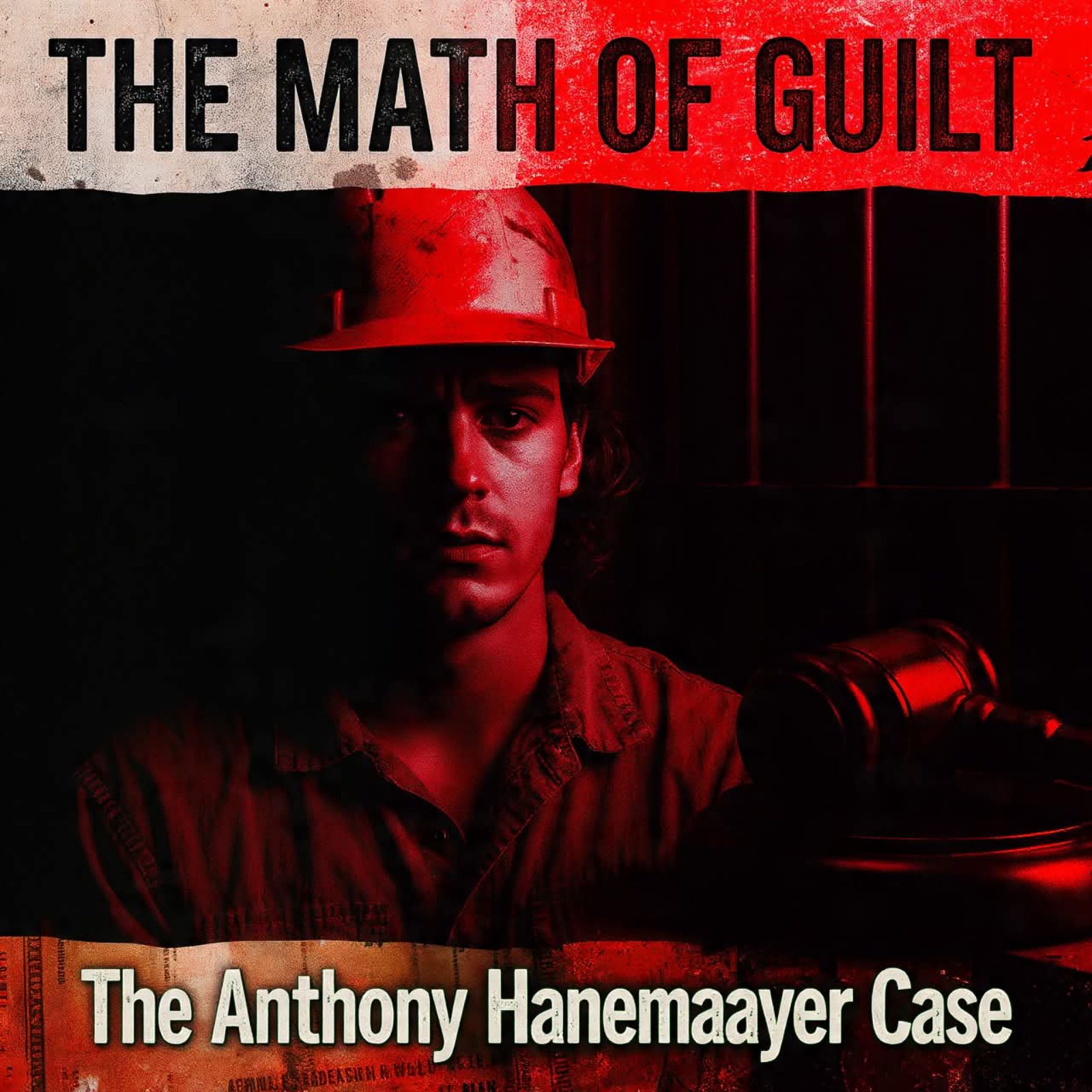
Two Years vs 10 Years: The Plea Bargain That Destroyed a Teen
The Story
What would you do if the choice was: lose 10 years of your life to a jury... or lose 2 years by lying and saying you did it? A 19-year-old roofer from Toronto had to do that math. And the system bet on him folding
A 19 -year -old roofer from Toronto chose to confess to an armed assault he did not commit because the math of the justice system made pleading guilty his safest option. Anthony Hanemayer spent 16 months in prison for a crime that notorious serial killer Paul Bernardo committed. Today, we are dissecting Hanemayer's case. examining how flawed eyewitness identification and the structural pressure of plea bargains coerce innocent people into taking the fall. Sophie, the concept of an innocent person pleading guilty defies our basic assumptions about self -preservation.
The phenomenon of false guilty pleas forces us to look at the criminal justice system as a marketplace of risk rather than a search for truth. To understand the pressure Haymeyer faced, we need to trace the events back to September 29th, 1987, in Scarborough, Ontario. An intruder broke into a home and assaulted a 15 -year -old girl at Knife Point. Her mother woke up, ran into the dark bedroom, and confronted the attacker. He raised his arms, roared at her, and fled into the night. That brief Chaotic encounter in a dark room formed the entire basis of the prosecution's case.
The mother later noticed Haymeyer working at a nearby construction site and identified him based on that connection. Law enforcement then constructed a photo lineup. The mechanics of that photo lineup deserve intense scrutiny. The Canadian Registry of Wrongful Convictions notes that the mother identified him from a police photo array after conducting her own investigation of the construction site. The officers running the lineup failed to protect the witness from structural bias. The witness is pressured to pick the person who looks most like their vague memory rather than making a genuine recognition.
The officers running the lineup knew who the primary suspect was, opening the door to subtle cues. The identification procedure was quite flawed from the start. The Innocence Project notes that eyewitness misidentification contributes to an overwhelming majority of wrongful convictions overturned by post -conviction DNA testing. The human brain does not function like a video camera recording objective reality. Memory is malleable. In the Hay Mayer case, the mother saw the attacker in the dark for mere seconds.
The Canadian Registry of Wrongful Convictions calls these fleeting glance scenarios. The situation also involved the weapon's focus effect, where a witness's attention is drawn to the knife. rather than the perpetrator's face. Yet, when she picked his photo, the external validation from the procedure inflated her confidence over time. By the time the trial began in October 1989, she testified with absolute conviction. That inflated certainty created an impossible situation for the defense. Hayne Mayer maintained his innocence during his initial police interviews.
and his wife provided an alibi, stating he was with her on the morning of the attack. He turned down two separate plea deals before the trial. He took the case to trial. But on the very first day, the mother took the stand and pointed him out in open court. The visual impact of a confident mother identifying her daughter's attacker is devastating to a jury. His defense attorney evaluated the room. and presented him with a bleak calculation. The lawyer explained that if the jury convicted him, which seemed inevitable after that testimony, he faced a sentence of six to ten years in a penitentiary.
However, if he changed his plea to guilty right then, he could secure a sentence of two years less a day. This is the core of the false guilty plea. Innocence Canada lists false guilty pleas as a primary cause of wrongful convictions right alongside eyewitness error and police tunnel vision. Hayne Mayer was 19 years old. He was denied bail. He lacked the financial resources to mount a prolonged appellate fight. He looked at losing a decade of his life versus getting out in a fraction of that time.
He made a rational calculated choice to survive and confess to a crime he did not commit. The concept of plea bargaining originated as a tool to relieve overburdened courts. The Law Reform Commission of Canada warned decades ago that resolution discussions could persuade innocent people to plead guilty. Critics argue that the system operates via coercion. Prosecutors hold massive leverage. stacking charges to create a frightening maximum sentence, then offering a steep reduction for a plea. The defendant is forced to gamble their life on the unpredictable emotions of 12 jurors.
To compare it to a casino, the house sets the odds so high that folding is the logical move. For Heynmayer, Folding meant 16 months behind bars and carrying the lifelong stigma of a violent conviction. The tragedy deepened because the actual perpetrator was operating in the same area. The 1987 assault fit the escalating pattern of Paul Bernardo, the notorious Scarborough rapist who later became one of Canada's most infamous serial killers. Hey Mayor looked nothing like Bernardo. Hey Mayor had straight blonde hair while Bernardo had thick curly brown hair.
The tunnel vision of the investigators prevented them from connecting the dots. They locked onto the neighborhood roofer and ignored the fact that a serial attacker was terrorizing the district. Hey Mayor finished his sentence and spent the next 15 years living as a convicted sex offender. The delayed exoneration introduces another severe failure in the system. According to the Canadian Registry of Wrongful Convictions, Bernardo's lawyer emailed the Toronto Police Sex Crimes Unit in October 2005.
The lawyer provided a list of 18 unsolved assaults Bernardo wanted to confess to, including the September 1987 Scarborough break -in. In early 2006, police interviewed Bernardo, who gave a detailed, accurate account of the crime. The authorities realized they had convicted the wrong man. Yet, they chose not to inform Haymeyer. The Crown and the police remained silent. That silence reveals an institutional reluctance to admit fault. Law enforcement agencies often prioritize finality over truth. They closed the case in 1989, reopening it meant acknowledging a massive investigative failure that let a serial killer remain on the streets.
Hey Mayor found out the truth in late 2007 through sheer chance. James Lockyer, a lawyer with the association in defense of the wrongly convicted, was preparing for the retrial of another man, Robert Baltovich. While reviewing police files related to Bernardo, Lockyer found the confession that he contacted Haymeyer. Without that accidental discovery by a third -party lawyer, Haymeyer might never have known his name could be cleared. The legal aftermath culminated in June 2008 when the Ontario Court of Appeal set aside the conviction.
Justice Mark Rosenberg declared that an honest but mistaken identification caused a miscarriage of justice. Hay Mayer later filed a $1 .1 million civil lawsuit against the police, the Crown, and his former defense attorney, alleging a rush to judgment and negligent failure to disclose Bernardo's confession. This case acts as a harsh critique of the legal framework surrounding identification. Canadian courts still resist allowing expert testimony on the frailties of eyewitness memory during trials, preferring to rely on standard judicial warnings to juries.
Why does the legal system continue to trust the type of evidence that science has proven to be so fragile? The legal system values precedent and human narrative that the confident eyewitness pointing from the stand provides a compelling emotional story that juries understand. Replacing that with cognitive scientists, explaining estimator variables and memory malleability feels clinical. However, the Hay -Meyer case forced some structural changes. Modern best practice dictates sequential photo lineups.
showing one picture at a time to prevent relative judgments. Officers must record confidence statements right after the identification before any feedback can contaminate the witness's memory. They must also explicitly warn the witness that the suspect might not be in the lineup at all. Despite those reforms, the pressure cooker of the plea bargain system remains untouched. The power dynamic between the state and the accused ensures that false guilty pleas will continue. A person facing insurmountable odds will always calculate the cost of fighting.
If the penalty for exercising your constitutional right to a trial is a decade in prison, the right to a trial becomes an illusion. The state uses the plea bargain to process humans through the system with ruthless efficiency. It turns justice into an assembly line. When an innocent person steps onto that line, the machinery does not pause to evaluate truth. It just processes the plea. We can trace this tension back to the core design of adversarial justice. We pit two sides against each other and assume the truth will emerge from the combat.
But when one side controls the evidence, the charges In the timeline, the combat is rigged. Haymeyer's decision to accept the two -year sentence underscores the survival instinct. He did not plead guilty because he lacked moral fortitude. He pleaded guilty because the state threatened to take away his entire youth. The academic community highlights that we do not even know the true scope of false guilty pleas. We only catch the cases where a serial killer happens to confess decades later. The reliance on volunteer organizations like Innocence Canada to uncover these injustices exposes the lack of internal auditing within the justice system.
The government does not search for its own mistakes. The burden of proving innocence falls on the convicted person who is stripped of resources and credibility. To use an analogy, it is like forcing a passenger to investigate a plane crash while they are trapped under the wreckage, while the airline refuses to hand over the black box. Haymeyer spent two decades under that wreckage before a lawyer looking for something else stumbled upon the truth. The concept of the unsavory witness also plays a role in the broader context of wrongful convictions.
Though here the witness was sincere but wrong. The system's inability to differentiate between a sincere error and the truth is the core defect. The mother in this case believed with all her heart that Haymeyer was the man she saw. She suffered trauma and her brain tried to fill in the blanks using a face she recognized from the neighborhood. Blaming the victim's mother ignores the systemic guardrails that should have caught the error. The police officers who constructed the flawed lineup and the legal framework that permitted the coercive plea deal are the architects of the wrongful conviction.
Acknowledging that our own memory is unreliable challenges our sense of self. We navigate the world believing that our eyes report absolute facts. When neuroscientists explain that recalling a memory rewrites it, altering the details each time, it disrupts the foundation of eyewitness testimony. The legal system was built centuries before we mapped the human brain. It operates on medieval assumptions about human recall that Heymayer's story forces the courts to confront modern cognitive science.
The civil suit Hayne Mayer filed sought damages for the profound psychological harm inflicted by the delayed disclosure. The police sat on Bernardo's confession for over a year. The duty of care that law enforcement owes to a convicted person is a controversial area of law. Once a person is convicted, the system considers them guilty, stripping them of the presumption of innocence. The inertia of a closed case means that new evidence is viewed as an annoyance rather than a mandate for justice. The officers who interviewed Bernardo in 2006 had the power to right a historical wrong.
Their choice to bury it speaks to a culture of self -protection. The narrative of the Canadian justice system is often presented as fair and restrained. Yet, Blackstone's ratio, the principle that it is better that 10 guilty persons escape than one innocent suffer, failed here. The state secured a conviction, cleared a case, and imprisoned a 19 -year -old while Paul Bernardo remained free to escalate his crimes. The false guilty plea obscures the failure. When a defendant admits guilt in court, the system absolves itself of the responsibility to investigate further.
It creates a neat conclusion to a messy conclusion. That neat conclusion is the poison in the system. The vast volume of cases moving through the courts requires plea deals to function. If every defendant demanded a trial, the system would collapse overnight. Therefore, the system must incentivize pleas. The reduction must be steep enough to make pleading attractive, and the trial penalty must be severe enough to make fighting terrifying. Heymayer's lawyer understood this math. The advice to plead guilty was the best legal advice available under the circumstances.
The lawyer saved him from a potential 10 -year sentence by participating in the conviction of an innocent man. That paradox is the most unsettling aspect of this history. The lawyer did their job by minimizing the prison time. The judge processed the plea according to procedure and the police cleared the case based on an identification. Everyone followed the rules and the result was the destruction of an innocent life. The Hay -Mayer case forces us to ask whether a justice system that relies on coercion can ever claim to be just.
It demands that we look at the people locked away right now, who took the deal because they were terrified of the trial. As law schools and police academies study this case today, the focus must remain on the human cost. Hay -Mayer's straight blonde hair and Bernardo's curly brown hair symbolized the blindness of a system desperate for closure. We have updated lineup procedures and implemented new rules for taking confidence statements. But until we address the coercive power of the plea bargain, the marketplace of risk remains open for business.
Innocent people will continue to run the numbers and choose to confess. The story of Anthony Heynmayor demonstrates that a confession in open court is not always a reflection of the truth. It is often just a reflection of the leverage the state holds over an individual. The justice system manufactured a guilty plea to cover up its own investigative failures. We have to reconsider every assumption we make when we hear someone took a plea deal. Share this episode with someone who assumes the justice system never coerces the innocent and that's how we heard it
 Apple Podcasts
 Castbox
 Castro
 Goodpods
 Moon FM
 Overcast
 Pocket Casts
 Podbean
 Podcast Addict
 Podcast Republic
 Spotify