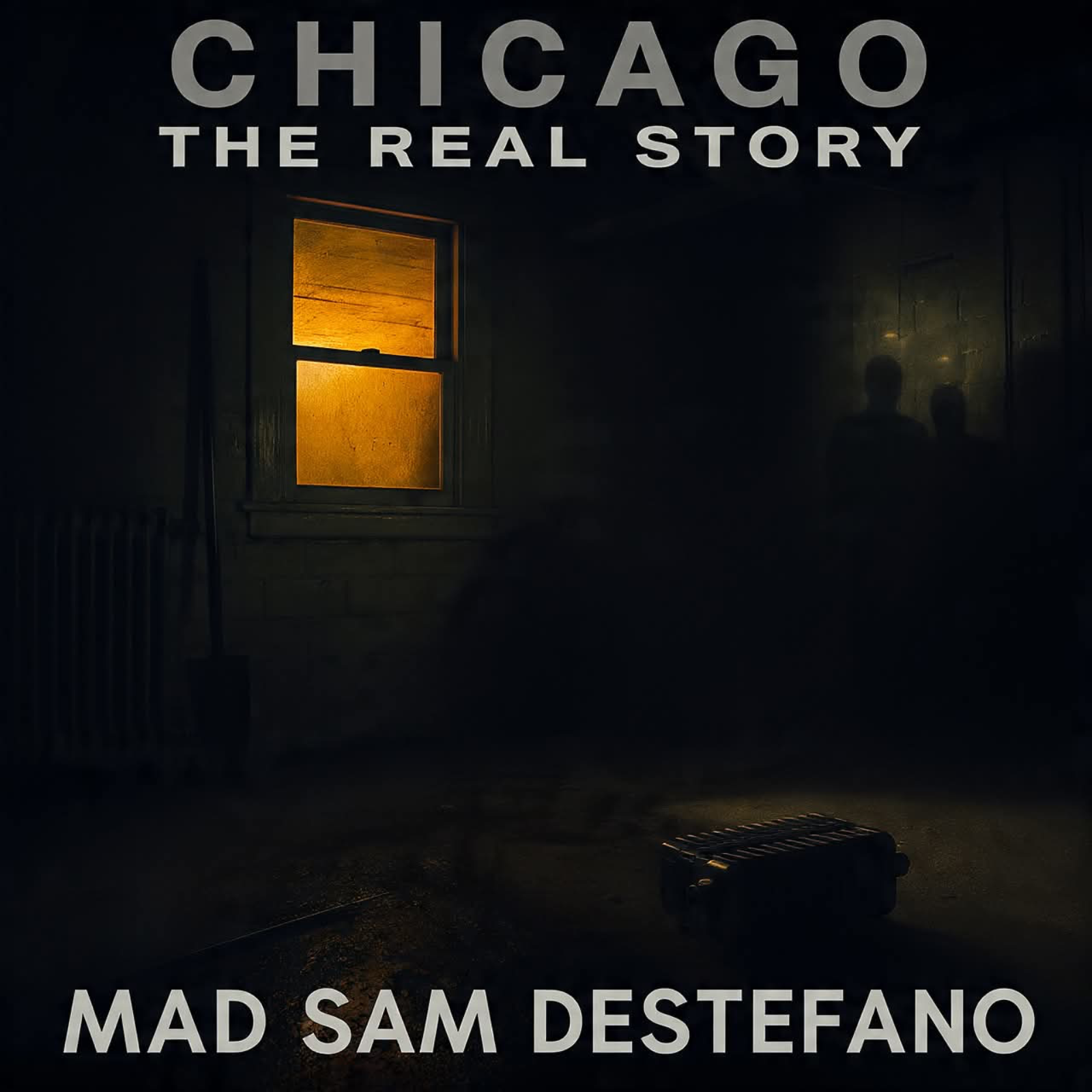
MAD SAM DESTEFANO: The Chicago Torture Killer Who Trained Tony Spilotro
The Story
Before Tony "The Ant" Spilotro ran Vegas...
He had a teacher.
Sam "Mad Sam" DeStefano.
King of the juice racket.
Master of the basement on Sayre Avenue.
Ice picks. Radiators. A block of ice with a body inside.
He claimed he spoke to Satan.
In 1973, the Outfit decided he was too crazy to live.
So they sent his best student to kill him.
This is Mad Sam.
1656, North Sayre Avenue. Galewood, Chicago. Upstairs, wife and three kids sleeping. Downstairs, soundproof concrete, a radiator, and an ice pick. His name was Sam DeStefano. The outfit called him useful. Chicago called him Mad Sam. Sam DeStefano leaned over the blood -slicked concrete floor of his basement at 1656, North Sayre Avenue. gripping a sharp ice pick while Leo Foreman groaned against the heat of a radiator. It was November 1963, and the soundproof walls of that Chicago cellar were designed to ensure that no matter how loud a man screamed, the neighbors in the quiet Galewood neighborhood would only hear the rustle of the wind through the trees.
Besides, Sam stood a young, cold -eyed apprentice named Tony Spillatro, watching as his mentor demonstrated the specific, agonizing mechanics of a deck collection. This wasn't just a murder. It was a ritual of sadism that would define the darkest era of the Chicago outfit. Within the first 30 words of this story, you have to understand that Sam DeStefano wasn't just a mobster. He was a man who lived for the moment the light left another person's eyes. To understand how a man could build a torture chamber beneath the living room where his wife and three children slept, you have to look back at the jagged streets of 1920 Chicago.
Sam was born in 1909 in Streeter, Illinois, but he found his true calling when his family moved to the city's west side. He didn't start at the top. He started in the 42 Gang, a notorious pack of teenage hoodlums that serve as the farm team for the Chicago outfit. This was the same crew that produced Sam Giancana and dozens of other future bosses. But even among a group of young men who viewed violence as a career path, Sam was different. He was reckless, volatile, and possessed a streak of cruelty that made even the most hardened street thugs uneasy.
By the time he was 17, he was already behind bars for rape, a crime so brutal that it signaled the departure of any moral compass he might have once possessed. His early career was a revolving door of prison cells and street corners. In 1933, he was caught escaping a bank robbery in Wisconsin and slapped with a 40 -year sentence. Most men would have broken or faded away, but Sam used his time in the Leavenworth Federal Penitentiary to perform the ultimate networking feat. He met Paul the waiter, Ricka, one of the intellectual giants of the Chicago outfit.
Ricka saw something in Sam. Not a leader, not a strategist, but a tool. He saw a man who would do the things that made other men's stomachs turn. When Sam was released in 1944, he didn't just return to the streets. He returned with a mandate from the top. He was going to corner the market on the one business the old -school mobsters initially found beneath them, the juice racket. The mechanics of the juice loan were simple and predatory. If a gambler lost his shirt at a casino, or a businessman's credit had run dry at the bank, they went to Sam.
He was the king of the six -for -five loan. You borrow 500 on Monday. You owe 600 the following Monday. That's 20 % interest a week. If you can't pay the principal, you pay the juice, the interest forever. Sam didn't just want the money, though. He specifically targeted high -risk debtors, drug addicts, and people he knew would fail that he wanted them to default because a default meant he could bring them to the basement on Sayre Avenue. He was a businessman who preferred the blood to the cash.
By the mid -1950s, Sam was the most profitable associate the outfit had. He was bringing in millions of dollars a year. and the bosses like Tony Iacardo and Sam Giancana were happy to look the other way. Despite the fact that Sam was clearly losing his mind, he began to claim he was a disciple of Satan. He would tell his associates that he spoke directly to the devil, and at night he would roll on the floor of his home, foaming at the mouth, screaming incantations .to the outfit. This was a quirk they could tolerate as long as the envelope stayed heavy.
But for the people of Chicago, Sam became a phantom of terror. He didn't just kill, he performed. When a restaurant owner named Arthur Adler fell behind on his payments, Sam kidnapped him, tortured him with ice picks, and dumped his body in a sewer. When a spring thaw came, sanitation workers found Adler's body perfectly preserved in a block of ice, his skin riddled with stab wounds. Sam laughed about that for weeks, telling the story to anyone who would listen at the local social clubs. The depth of his ruthlessness wasn't reserved for strangers or debtors.
In 1955, the outfit issued a decree that drug addiction was a liability they wouldn't tolerate. Sam's own younger brother, Michael, had become a heroin addict. The bosses didn't want the heat Michael was drawing, so they told Sam to take care of it. Most men would have agonized over such an order, but Sam saw it as a duty. He lured Michael into his car. shot him five times in the head, and then, in a display of what he called humane treatment, he cleaned the body, dressed it in a brand new suit, and left it in a car trunk where it would be found quickly to ensure a proper open casket funeral.
He believed this was a grand gesture of brotherly love, that IT was this total lack of human empathy that allowed him to mentor the next generation of killers, most notably a young Tony Spolatro. Tony the ant, Spilatro was a high school dropout who caught Sam's eye early on. Sam saw in Tony a reflection of his own early years, but with a colder, more disciplined edge. He took Spilatro under his wing, teaching him the finer points of the juice business and the brutal necessity of the hit. Their partnership was cemented in the basement with Leo Foreman.
Foreman was a real estate agent who had actually been a collector for Sam. but he had made the fatal mistake of throwing Sam out of his office during an argument. You didn't throw Sam de Stefano out of anywhere. Sam had Spolatro and another associate, Chucky Cromaldi, lure Foreman to Sam's brother Mario's house. When Sam arrived, he didn't just kill Foreman. He spent hours with a hammer and an ice pick, carving pieces of the man away, while Spolatro watched and assisted. It was a graduation ceremony for the aunt.
a ritual that transformed the protege into a monster in his own right. However, the very madness that made Sam a legend was also what made him a target. By the late 1960s and early 70s, Sam's behavior was becoming an embarrassment to the outfit. The mob thrives on silence and the shadows, but Sam craved the spotlight. When he was finally indicted for the Foreman murder a decade after the fact, He decided to turn the courtroom into his own personal theater. He insisted on representing himself. He would arrive at the Dirksen Federal Building in a wheelchair or on a stretcher, wearing silk pajamas and a bathrobe.
He carried a bullhorn into the courtroom, using it to shout down the judges and badger the witnesses. He would ramble incoherently about his rights and his connection to the spiritual world. For the first time, The bosses realized that Sam wasn't just a useful lunatic. He was a loose cannon who could sink the whole ship. Tony Iacardo and the other leaders of the outfit watched the news coverage with growing fury. Sam was facing the same trial as his brother Mario and his protege, Tony Spolatro. The outfit knew that if Sam went to prison or even if he stayed on the stand, he was going to talk.
He was too unstable to trust and his public antics were inviting a level of federal scrutiny that threatened the entire organization's infrastructure. The decision was made in the shadows of a backroom meeting. Sam DiStefano had to go. And to ensure there was no hesitation, the contract was given to the two men Sam trusted most, his brother Mario and his mentee Tony Spolatro. On the morning of April 14th, 1973, the sun was shining over the Galewood neighborhood. It was a quiet Saturday. Sam was in his garage at the house on Sayer Avenue, working on one of his cars.
He heard a vehicle pull into the driveway. When he looked up, he saw his brother Mario and his prized pupil, Tony. He waved them inside, likely expecting a discussion about the upcoming trial. He had no reason to fear them. They were his blood and his creation. As they walked toward him, Spilatro reached under his coat and pulled out a shotgun. He didn't hesitate. The first blast caught Sam in the right arm. nearly severing it at the elbow. As Sam collapsed, reaching out with his remaining hand, Spolatro stepped closer and delivered a second blast directly into his chest.
Mad Sam DiStefano, the man who had terrified Chicago for three decades, died on the oil -stained floor of his own garage. The aftermath was as cold as the man himself. Mario and Tony walked away, leaving the body to be found by Sam's family. Months later, both Mario and Spolatro went to trial for the Leo Foreman murder. With Sam dead, the primary source of the chaos was gone. Mario was eventually convicted, but Tony Spolatro was acquitted. The protege had not only survived his mentor, he had surpassed him.
Spolatro would go on to take the lessons Sam taught him about fear and violence to Las Vegas, where he would run this skim, and become the basis for some of the most enduring legends in organized crime history. He took Sam's brutality but stripped away the madness, replacing it with a business -like efficiency that the outfit preferred. Sam DiStefano's legacy is a stain on the history of Chicago, a reminder of a time when the city was held hostage by a man who saw pain as a commodity. He was a product of the 42 Gang, a fixer who could buy any judge, and a sadist who found beauty in a basement torture chamber.
But in the end, he was undone by the very thing he taught his student, that in their world, there is no room for loyalty when a man becomes a liability. He was killed by the hands he had trained, silenced by the echoes of his own violence. The house on Sayre Avenue still stands, a suburban facade that hides the memory of the screams that once filled its foundation. pass this story along to someone who appreciates the darker corners of history. And that's the way I heard it.
 Apple Podcasts
 Castbox
 Castro
 Goodpods
 Moon FM
 Overcast
 Pocket Casts
 Podbean
 Podcast Addict
 Podcast Republic
 Spotify