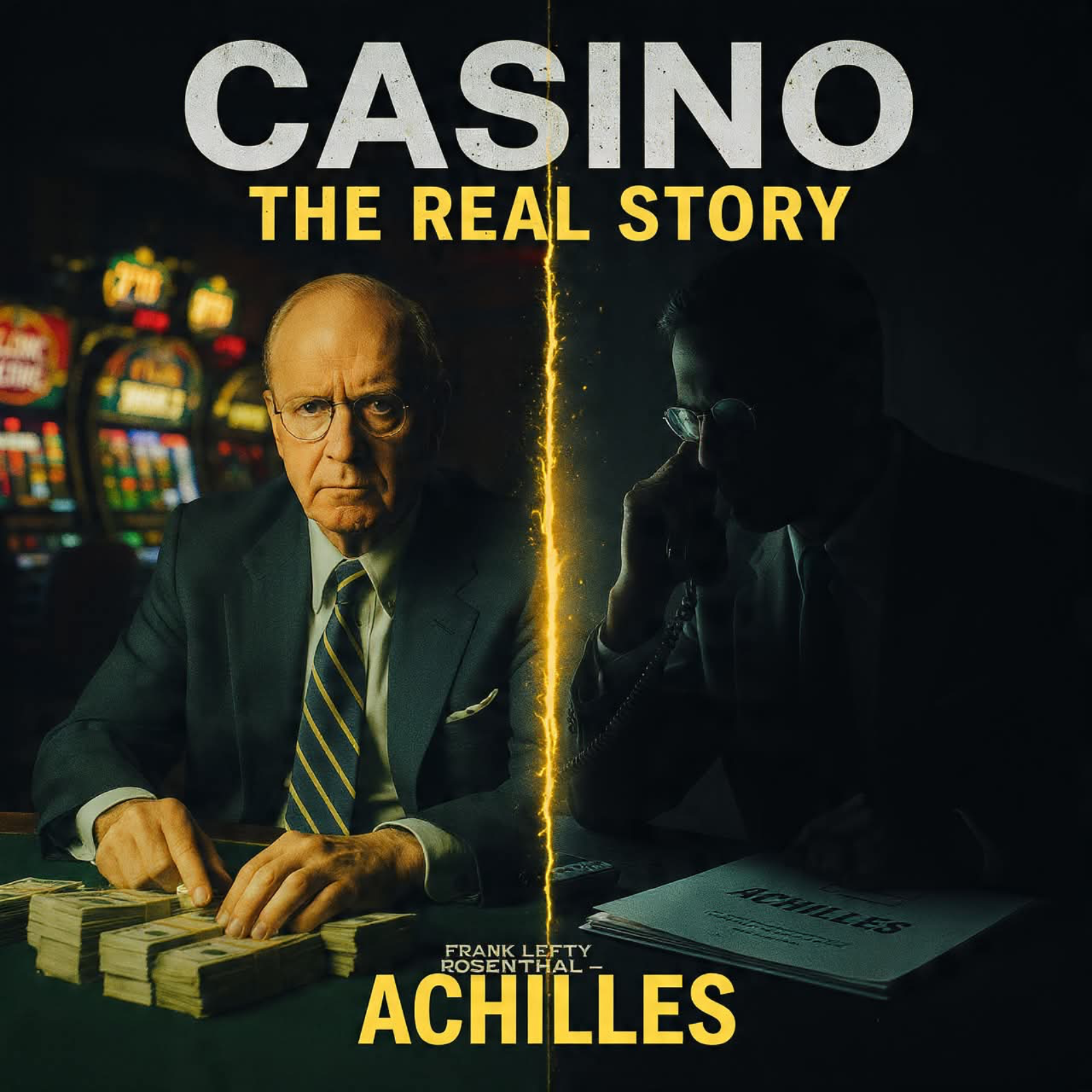
CASINO: FRANK LEFTY ROSENTHAL - The FBI Informant Who Ran Vegas
The Story
He was running the mob's biggest casinos.
Stardust. Fremont. Hacienda.
Skimming $50 million a year.
He was also FBI informant "Achilles."
Top Echelon.
For 25 years Frank "Lefty" Rosenthal played both sides.
He fed the Outfit...
and he dismantled it.
The car bomb in 1982 didn't kill him.
The truth did. 20 years after he died.
This is the real story of Lefty.
October 4th, 1982. Carbong. He survived because of a steel plate. But that wasn't the miracle. The miracle was this. For 25 years, the man running the mob's casinos was also codenamed Achille for the FBI. Top echelon. He skimmed millions for the outfit and explained exactly how to the government. Frank Rosenthal survived a car bomb in 1982 because of a manufacturing quirk in his Cadillac. But the real mystery isn't how he lived. It's that he was a top -tier FBI informant for decades while running the mob's biggest casinos.
We've all seen a movie casino that we know the story of Sam Ace Rothstein, the meticulous gambling genius who turned Las Vegas into a cash cow for the Chicago outfit. But the film misses the most jarring layer of the real -life story. The man who supposedly answered to the mafia was simultaneously whispering into the ears of the federal government. For over 25 years, Frank Lefty Rosenthal lived a double life that sounds like pure fiction, acting as the Bureau's secret asset under the code name Achilles.
This was just some low -level street snitch. Rosenthal was a top -echelon informant, a designation reserved for sources with direct access to the inner sanctum of organized crime leadership. While he was overseeing the massive skimming operation of the Stardust, feeding millions of dollars in untaxed cash back to the bosses in Chicago, Milwaukee, and Kansas City, he was also systematically dismantling those same bosses from the shadows. It is one of the most complex double -crosses in the history of American crime, and it forces us to re -evaluate everything we thought we knew about the fall of the mob in Vegas.
We're going to dig into how a man with a Rayman -like ability for numbers played both the outfit and the FBI against each other, and how he managed to die of natural causes in his own bed while almost everyone else from that era ended up in prison or a cornfield. It's a journey through the neon -lit boardrooms of the Strip and the cold, sterile offices of the FBI, exploring a betrayal that redefined the word professional. To understand how Frank Rosenthal became the ultimate double agent, you have to understand the specific kind of genius he possessed.
He wasn't a tough guy in the traditional sense. Born in 1929 on Chicago's West Side, Rosenthal was a numbers savant. His father owned racehorses, and while other kids were playing ball, Frank was at the track, not just watching the horses, but studying the math. He realized early on that every pitch, every swing, and every stride had a price. By his early 20s, he was already a legend in the underground bookmaking world. He had this uncanny, almost supernatural ability to set betting lines that were so precise, they virtually guaranteed the house would win.
This wasn't just gambling, it was a high -level mathematical discipline. The Chicago Outfit, the massive criminal organization once headed by Al Capone, took notice. They didn't care that he wasn't Italian. They cared that he was a money machine. They put him in charge of their illegal bookmaking operations, and he turned them into a national powerhouse. But that kind of success attracts heat. In 1961, Rosenthal was subpoenaed to appear before Senator John McClellan's subcommittee on gambling. This is where the lefty legend really took off.
He invoked the Fifth Amendment 37 times, refusing to answer a single question. There's a famous photo of him from that hearing, adjusting his tie with a look of pure cold defiance. But behind that wall of silence, the cracks were starting to form. Around the same time, the FBI began opening a file on him that would eventually grow to over 300 pages. The turning point seems to have happened in the early 1960s. In 1963, Rosenthal was convicted of bribing a college basketball player to shave points.
the only criminal conviction he would ever officially have. It's widely believed by historians and former law enforcement that this was the moment the FBI got their hooks into him. They offered him a choice, become a guest of the federal government for a very long time or become a partner. Rosenthal, the ultimate odds maker, looked at the board and realized the smartest bet was to play both sides. He became Achilles, a name that might have been a nod to his untouchable status, or perhaps more cynically, a reference to the one vulnerability he was trying to protect.
Part 2 Running the Strip and the Skim By 1968, the heat in Miami and Chicago was too much, so the outfit sent Rosenthal to Las Vegas. The Mafia had a problem. They had huge ownership stakes in casinos like the Stardust, the Fremont, and the Hacienda. but they couldn't run them openly. They needed a front man who was brilliant enough to maximize the profits and discreet enough to hide the skim. The skim was the lifeblood of the mob's Vegas operation. It was literally cash taken off the top in the counting rooms before it was ever recorded for taxes or corporate accounting.
We're talking about 30 to 50 million dollars a year being funneled into suitcases and driven across the desert to the bosses in the Midwest. Rosenthal was the architect. He wasn't just the manager, he was a revolutionary. He introduced the first sports book inside a casino, which changed the industry forever. He hired female dealers to increase revenue. He even obsessed over the number of blueberries in the muffins at the Stardust coffee shop. Every detail was curated to project an image of absolute professional legitimacy.
But while he was perfecting the art of the casino, he was also perfecting the art of the inform. FBI records declassified decades later show that during his time in Vegas, Rosenthal was feeding the Bureau incredible intel. He wasn't just giving them names of low -level street hoods. He was explaining the mechanics of the skim. He was identifying the couriers. He was providing the context that the FBI desperately needed to understand how the Midwest crime families were collaborating. It's a staggering paradox.
Every morning, he'd walk into stardust and work tirelessly to ensure the mob got their millions. Then, he'd find a way to let the government know exactly how it was happening. Why? Some think it was survival, a way to ensure that if the ship ever sank, he had a life raft. Others think it was about power. By informing, Rosenthal could subtly direct the FBI's attention toward his rivals, or toward people who were making his job difficult. In his mind, he wasn't a snitch. He was a consultant for two different, equally demanding corporations.
He managed to keep this place spinning for years, even as his relationship with his childhood friend and mob enforcer Tony Spolatro began to turn toxic. The 1980s saw the total collapse of this delicate ecosystem. The friction between Rosenthal and the Nevada Gaming Commission, led by a young Harry Reid, became a public spectacle. Rosenthal was denied a license because of his mob ties and his defiant, litigious reaction only made things worse. The boss's back home hated the publicity. At the same time, his personal life was a wreck.
His wife, Jerry McGee, who was also, it was later revealed, an FBI informant, was having an affair with Tony Spolatro, the trust was gone. In October 1982, someone tried to kill Rosenthal with that infamous car bomb at Tony Romus. He walked away with minor burns, saved by a steel plate under his seat, but he knew the game was over. The FBI immediately moved in, offering him witness protection if he would testify. And here is where Rosenthal's principles, as he called them, got really strange. He refused.
He told them, It's just not my style. He wouldn't take the stand. He wouldn't be the star witness in a courtroom. Instead, he simply disappeared from Vegas, moving first to California and then to Florida. But the damage he had done as Achilles was already echoing through the courts. The information he had provided over the decades formed the backbone of Operation Strawman, the massive federal investigation that ultimately crushed the outfits control of Las Vegas. In 1986, the leadership of the Chicago, Kansas City, and Milwaukee families were handed decades -long prison sentences.
They were gone. Tony Spolatro and his brother were beaten to death and buried in an Indiana cornfield. The old Vegas was dead. Yet, Frank Rosenthal lived on. He spent the next 20 years in Miami Beach, running a sports betting website, and eating at high -end restaurants. He never admitted to being an informant. Even his late as 2006. He died in 2008, and it wasn't until after his death that the truth was finally confirmed by law enforcement sources and the release of his files. He had outplayed the most dangerous men in America and the federal government, serving both and betraying both, and he somehow walked away the only winner.
When we look back at the history of the American Mafia, We usually see a story of decline through violence or stupidity. But Frank Roosevelt's story is a story of intelligence, a cold, calculating brand of intelligence that recognized the old rules of Omerda were obsolete. He realized that in the modern world, information was a more valuable currency than loyalty. By feeding the government just enough to stay useful, he bought himself the freedom to run the biggest illegal operation in the country.
He turned the FBI into his own personal protection service without them even fully realizing it. The cultural legacy he left behind is often filtered through the lens of Scorsese's movie, where he's portrayed as a tragic figure undone by his own hubris and a woman he couldn't control. But the real Frank Rosenthal was much more interesting and much more chilling. He was a man who lived without a side, a man whose only loyalty was to the math of the situation. He proved that you could be the center of a criminal empire and the government's best friend at the same time, provided you were smart enough to keep the books balanced.
The stunning revelation of his double life reminds us that the history we see in the movies is often just the surface. Behind every great operation, there's usually a man who knows where all the bodies are buried and he might just be the one who told the police where to dig. Rosenthal didn't just run the Stardust. He dismantled the world that created it, and he did it so quietly that the people he betrayed never even saw it coming. He died a free man, a wealthy man, and a man who took most of his secrets to the grave, leaving us to wonder just how many other Achilles types are out there, hiding in plain sight.
It's a sobering thought that the person running the house might be the biggest gambler of them all. betting on both teams and walking away with the pot while the stadium burns down behind him. You should share this episode with anyone who loves a story where the smartest person in the room is also the most dangerous. And that's the way I heard it.
 Apple Podcasts
 Castbox
 Castro
 Goodpods
 Moon FM
 Overcast
 Pocket Casts
 Podbean
 Podcast Addict
 Podcast Republic
 Spotify