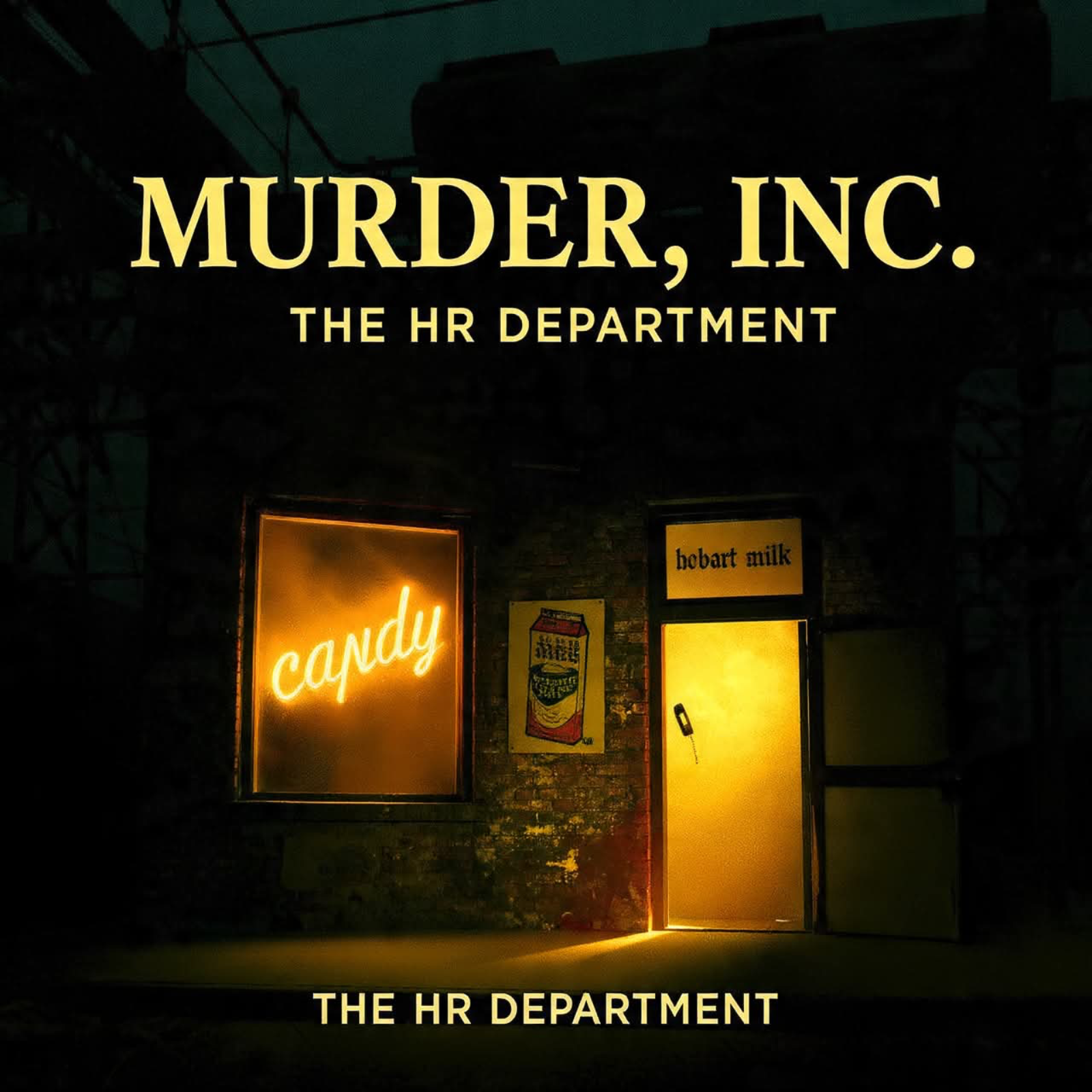
THE CORPORATION: MURDER INC. THE STRONG ARM OF THE MAFIA
The Story
They worked out of a candy store in Brooklyn.
$50 a week retainer. Malted milks in the front, contracts in the back.
Murder, Inc. wasn't a gang.
It was the HR Department for the American Mafia.
This is how Lucky Luciano turned murder into a business service.
Salvatore Maranzano sat behind his desk on the ninth floor of the New York Central Building on September 10th, 1931, listening to the heavy footsteps of four men in suits who claimed to be from the Internal Revenue Service. The office at 230 Park Avenue was the headquarters of his Eagle Building Corporation, a legitimate sounding front for an illegitimate empire of bootlegging and immigrant smuggling. Maranzano was the self -proclaimed boss of all bosses A man who modeled his life after Julius Caesar and rode the streets in a bulletproof Cadillac equipped with a machine gun.
But as these four men flashed badges and lined his staff against the wall, the Caesar of the underworld was caught off guard. These weren't federal agents. They were hit men hired by a young lieutenant named Lucky Luciano and they didn't look like the traditional Sicilian soldiers Maranzano was used to fighting. They were Jewish gangsters, secured with the help of Meyer Lansky and Bugsy Siegel, specifically chosen because their faces were unknown to Maranzano's inner circle. The hit was clinical.
The men stormed the private chamber, switchblades snapping open. Maranzano, despite his age, fought like a billy goat, but he was stabbed six times and riddled with five bullets. As the killers scrambled down the stairs, they bumped into Vincent Mad Dog call The very assassin Maranzano had hired to kill Luciano that same day. Luciano's timing was perfect. By the time the police reached the ninth floor, the old world of the Italian mafia was dead and a new corporate era of organized crime had begun.
Luciano realized that the bloody public wars between rival factions were bad for business. If the mob was going to survive the end of Prohibition, it needed to stop behaving like a collection of street gangs and start behaving like a national syndicate. This meant outsourcing the violence. Following the death of Maranzano, Luciano called a summit in Chicago. He invited the leaders of the five families of New York, along with Al Capone from Chicago and Stefano Megadeno from Buffalo. Standing before them, he did something radical.
He abolished the title of boss of all bosses. He argued that one man sitting at the top was nothing more than a target for every ambitious challenger. Instead, he proposed a commission, a board of directors that would oversee criminal activities across the United States, mediate disputes, and, most importantly, sanction the use of lethal force. Violence would no longer be a tool for personal vendettas. It would be a business decision. To enforce these decisions, the commission created a specialized unit that the press would later dub Murder, Inc.
Internally, the mobsters just called it the Combination. It was a professional enforcement arm designed to provide the leaders of the syndicate with total deniability. If a boss in New York wanted a rival in Los Angeles eliminated, he didn't send his own man. He put a contract through the Combination. The hitmen were professionals who had no personal connection to the victim and no loyalty to the specific family ordering the hit. This bureaucratic insulation made it nearly impossible for law enforcement to climb the ladder from the trigger man to the man who gave the order.
To see the heartbeat of this new machine, you had to travel to the Brownsville section of Brooklyn to a nondescript corner store at Saratoga and Lavonia Avenues. The Midnight Rose Candy Store run by a woman in her 60s named Rosie Gold, looked like a typical neighborhood haunt. It sat directly under the elevated tracks of the Three Train, the screeching of the subway cars masking the sounds of the men inside and on the surface. The store sold malted milks and nickel candy. But in the back room, some of the most prolific killers in history, men like Abe, Kid Twist, Relis, and Harry, Pittsburgh Phil Strauss, sat around sipping sodas and playing cards.
They were on retainer, earning a weekly salary of $50 to $250 just to be available. When a phone on the back wall rang, it wasn't a call for a malted. It was a contract. The killers would receive a few hundred or a few thousand dollars per hit, plus expenses. The system was methodical. The Lord High Executioner, Albert Anastasia, would relay the orders from the commission to Louis Lepka -Bucklter, the head of the operation. From there, The mechanics of the hit were handled with the precision of an assembly line.
They used a crash car, a stolen vehicle driven by a team member that would intentionally ram into any police car that attempted to chase the assassins. They favored ice picks for silent, close quarters work, and suppressed 45 caliber pistols for everything else. After a job was done, the weapon was often dropped in a sewer or disposed of in a pre -planned location. The killers would then return to Midnight Roses. waiting for the next ring of the bell. This corporate precision was put to its ultimate test in 1935 with the case of Dutch Schultz.
The beer baron of the Bronx was becoming a liability. Special prosecutor Thomas E. Dewey had launched a relentless crusade against Schultz's gambling rackets, and the pressure was making the mobster unstable. Schultz appeared before the commission and demanded permission to assassinate Dewey. The board members were horrified. Luciano argued that killing a high -ranking prosecutor would bring a level of heat from the federal government that could destroy the entire syndicate. The commission voted no.
Schulz, however, was not a man who respected committees. He stormed out of the meeting, declaring he would kill Dewey himself. For Luciano, the decision was simple. Schulz had to go before he brought the world down on their heads. The contract was issued through the combination. On the night of October 23, 1935, Dutch Schulz was at his unofficial headquarters, the Palace Chop House in Newark, New Jersey. He was in the back room with his inner circle, his accountant Otto Berman, his Lieutenant Abe Landau, and his bodyguard Lulu Rosencrantz.
At approximately 10, 15 p .m., Schulz stepped into the restroom to wash his hands. Two murder -incorporated assassins Charles the Bug, Workman, and Emmanuel Mindy Weiss enter the restaurant. Workman didn't hesitate. He walked the length of the bar, pushed open the door to the men's room, and found Schulz at the sink. He fired a single shot from a .45. The bullet hit Schulz in the side, ricocheting through his abdomen. As Schulz slumped to the floor, Workman and Weiss turned their attention to the back room, spraying the rest of the crew with buckshot and pistol fire.
Schulz didn't die immediately. He lingered for nearly 24 hours in a feverish delirium, his ravings recorded by a police stenographer who sat by his hospital bed. He spoke in riddles about French baked potato stuff and the big shot, refusing to name his attackers even as he drifted toward death. While Schulz raved, the syndicate was already absorbing his empire. There was no power vacuum, no retaliatory war. The combination had performed a surgical removal of a problematic branch, and Luciano remained entirely insulated from the blood on the floor of the palace chop house.
This was the peak of the system's efficiency, a moment where the mob functioned as a shadow government, executing its own laws without ever leaving a fingerprint. But the very secrecy that protected the syndicate was built on a fragile foundation, the silence of the men in the candy store. That silence began to crack in 1940. Abe Rellis, a high -ranking enforcer for Murder Incorporated, was facing the electric chair for a string of brutal. Rellis was a man who enjoyed his work. He was known for his mastery of the ice pick, often driving it through a victim's ear into the brain to make the death look like a natural hemorrhage.
But as the shadow of the chair loomed, his loyalty to the combination evaporated. He decided to sing. Relas became the ultimate government witness, providing Brooklyn District Attorney William O'Dwyer with a map of the syndicate's inner workings. He described over 70 murders in clinical detail, exposing the link between the street -level hitmen and the highest levels of the commission. His testimony was a thunderclap. For the first time, the public saw that the mob wasn't just a collection of thugs, but national bureaucracy of death.
Relis' evidence sent several of his former associates, including Harry Strauss and Martin Goldstein, to the electric chair. More importantly, he provided the link to Lepka Buckelter. The head of Murder Incorporated Lepka had been a ghost, a labor racketeer who controlled the Garment District through a network of terror, yet he had always remained untouchable. With Relis' testimony, the wall of deniability crumbled. Lepka was eventually convicted for the 1936 murder of Joseph Rosen, a candy store owner who had been targeted simply because Lepka feared he might talk to the authorities.
The fallout was catastrophic for the syndicate's old guard. The death of Relis effectively halted the prosecutions of the higher -ups. Albert Anastasia walked free, eventually becoming the boss of what would be known as the Gambino family. Recommend this story to a friend who appreciates the darker side of American history And that's the way I heard it
 Apple Podcasts
 Castbox
 Castro
 Goodpods
 Moon FM
 Overcast
 Pocket Casts
 Podbean
 Podcast Addict
 Podcast Republic
 Spotify