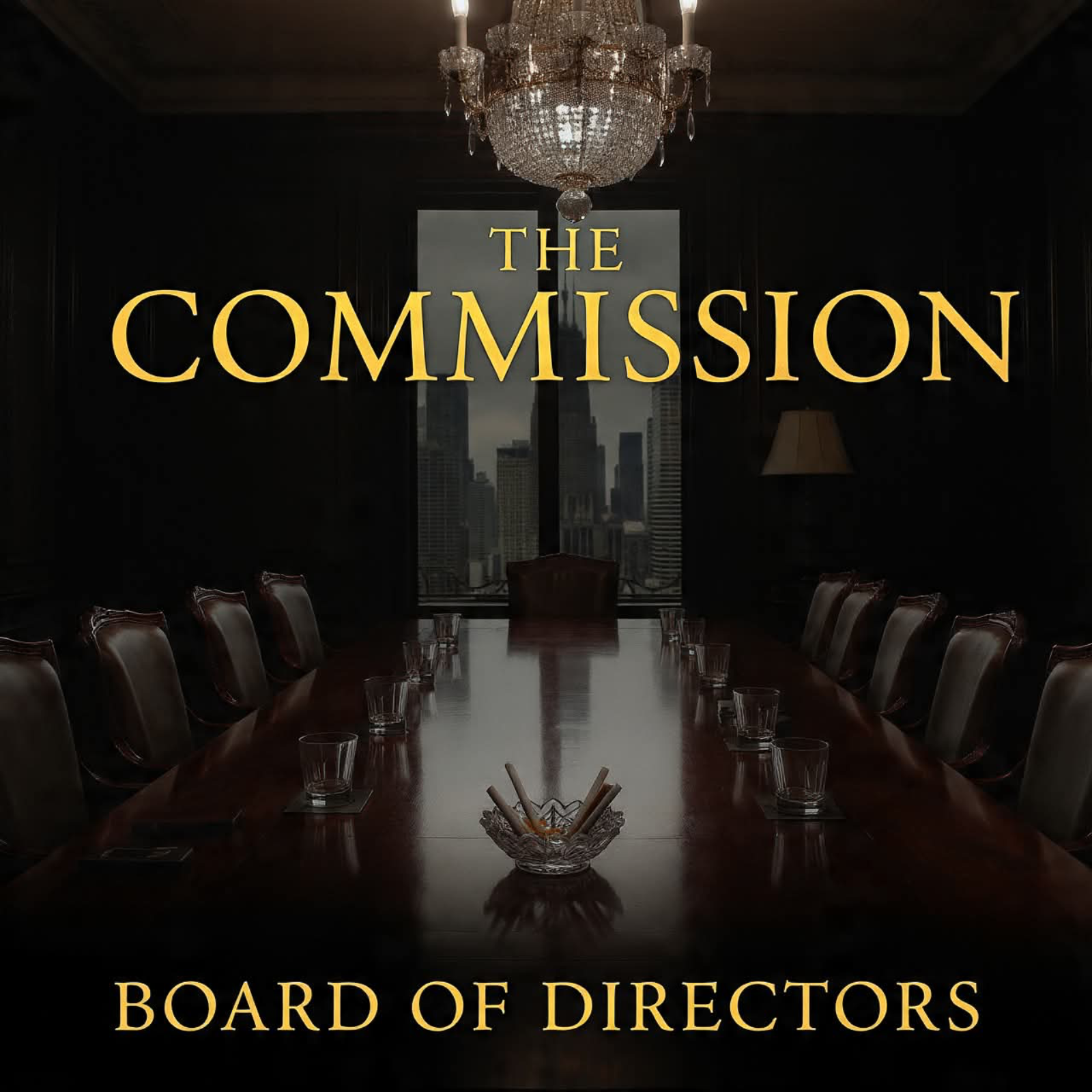
THE COMMISSION - The Seven Titans of crime
The Story
1931. The Mafia had a king.
So Lucky Luciano killed the position.
Instead of a Boss of All Bosses, he created a board of 7 men.
Disputes went to vote. Hits needed approval.
War became bad for business.
This is the story of The Commission.
The moment street gangs became a corporation.
Lucky Luciano didn't just win a gang war in 1931. He essentially filed the paperwork to incorporate the American underworld. After he orchestrated the removal of Salvatore Maranzano, the man who just spent months crowning himself the boss of all bosses, Luciano did something counterintuitive. He didn't take the crown. Instead, he smashed it. He realized that a single dictator was a single target. both for the law and for every ambitious kid with a Tommy gun. To replace that target, he created the Commission, a seven -man board of directors that traded the ego of the old world for the cold efficiency of American capitalism.
This wasn't just a change in leadership. It was the birth of a criminal conglomerate that would stabilize the mob for the next half century, turning street gangs into a national syndicate with the structural integrity of a Fortune 500 company. the death of the dictator. To understand why the commission was so radical, you have to look at what it replaced. Before 1931, the mafia in America was basically a feudal system. It was run by men who became known as mustache peets, traditionalists like Joe Messuria and Salvatore Maranzano.
These guys lived by old school Sicilian codes of honor and blood feuds. They were obsessed with the title of Capo di Tuti Cappi, or the boss of all bosses. In their world, power was absolute, and every other family owed the top guy a cut of their profits just for the privilege of existing. This led to the Castellamaris War, a brutal multi -year conflict that left dozens dead and, more importantly for people like Luciano, was absolutely terrible for business. Turf wars meant the police were always watching.
the public was outraged and the money stopped flowing. Luciano, who was rising through the ranks, saw this as archaic. He was a modernizer. He spent his time hanging out with non -Italian gangsters like Meyer Lansky and Bugsy Siegel, much to the chagrin of the old school dons who didn't trust anyone outside their own village, let alone outside their ethnicity. Luciano understood that the future wasn't in ethnic purity or medieval titles. It was in volume, efficiency and collective stability. The turning point came in September 1931.
Maranzano had won the war and set himself up as the supreme leader, but he was already planning to have Luciano killed. Luciano moved first. He sent four assassins, disguised as government agents, into Maranzano's Manhattan office. They didn't just shoot him. They made it clear that the era of the one -man rule was over. But instead of declaring himself the new king, Luciano called a meeting in Chicago. He invited the heads of the most powerful families and proposed something that felt like a corporate merger.
He argued that the title of boss of all bosses was a lightning rod. It created envy and it created a single point of failure. If the top guy went down, the whole thing collapsed. So he suggested a committee. A board. Seven seats at a table. where every man was theoretically an equal. This move was pure genius because it allowed Luciano to keep the power without the target on his back. He became the chairman of the board, a role that allowed him to lead by consensus rather than by decree. It was the moment the mafia stopped being a collection of warring tribes and started being the syndicate.
Part two, The Seven Titans. The original commission was composed of seven men. And looking at the roster is like looking at the founding board of a massive industry. You had the heads of the five families in New York, which made sense given that New York was the center of the criminal gravity. There was Luciano himself, representing what would become the Genovese family. Then there was Joseph Bonanno, the youngest of the group, who was actually a traditionalist at heart, but saw the wisdom in Luciano's plan.
There was Joe Proficy, the olive oil king, who ran a family that would eventually become the Colombos. Vincent Mangano took over the Brooklyn waterfront, heading the group that would become the Gambinos. And finally, Tommy Gagliano, a quiet, behind -the -scenes earner who led the precursor to the Lucchese family. But Luciano knew that to make this a national organization, he couldn't just keep it in New York. He needed the out -of -towners to buy in. So, he gave seats to the two other major power centers of the time.
One went to Stefano, Megadeno, and Buffalo, who controlled the vital smuggling routes across the Canadian border. The final seat went to the most famous gangster in the world, Al Capone, representing the Chicago outfit. By including Chicago and Buffalo, Luciano effectively federated the American underworld. These seven men weren't just buddies. They were representatives of specific territories and industries. The commission functioned as a supreme court. If two families had a dispute over a gambling territory in Harlem or a dock in Brooklyn, they didn't go to war.
They went to the commission. The board would hear both sides, look at the historical precedents, and then vote. If a family boss wanted to kill a maid member of another family, he had to get commission approval first. If you went rogue and started a war without the board's okay, The other six families would theoretically team up and crush you. It was a system of checks and balances that mimicked the U .S. government or a large corporation. They even established a separate enforcement arm known as Murder Incorporated, a pool of professional killers who didn't belong to any one family but worked for the commission as a whole.
This meant that if the board decided a boss had to go, the hit wasn't a personal vendetta. It was a business decision carried out by impartial contractors. This structure brought an unprecedented level of peace to the streets. Between 1931 and the late 1950s, the kind of open, city -wide warfare that defined the Prohibition era virtually vanished, replaced by a quiet, profitable era of cooperation. The genius of Luciano's corporate model was how it handled succession and expansion. In the old days, when a boss died, It usually triggered a bloodbath as underlings fought for the top spot.
Under the commission, the board had to ratify a new boss. They ensured that the transition was smooth and that the new leader was someone the other families could work with. This institutionalized the mafia. It was no longer about the personality of one man. It was about the office of the boss. If Luciano went to prison, which he did in 1936, the system didn't break. His family just moved an acting boss into the slot, and the commission kept meeting. This resilience is why organized crime was able to infiltrate the very fabric of the American economy.
With the streets stabilized, the mob could focus on long -term investments. They moved into labor unions, garment manufacturing, trucking, and eventually, the construction industry. They realized that you can make far more money by adding a mob tax to every bag of concrete poured in New York City than you ever could by selling bottles of bathtub gin. According to historians and law enforcement records from the era, by the 1940s, the Commission was overseeing a multi -billion dollar empire that touched almost every aspect of American life.
The Commission also allowed for joint ventures. Because the families were now partners rather than rivals, They could pool their resources for massive projects. When a mob decided to build Las Vegas, it wasn't just one family's project. It was a syndicate effort with money coming from New York, Chicago, and even the Jewish associates like Meyer Lansky. Lansky, despite not being Italian and therefore unable to hold a seat on the commission, was perhaps the board's most influential advisor. He was the one who helped Luciano set up the accounting systems and the offshore banking that kept the money safe.
This cross ethnic cooperation was a hallmark of the Luciano era. He famously said that there's no room for this blood thing when there was money to be made. By treating crime as a business and the commission as its board of directors, Luciano created a structure that was so stable it took the federal government over 50 years and the invention of the Rico Act to finally dismantle it. Even today, though the names and the faces have changed, the fundamental blueprint of the five families and the spirit of the commission remain the bedrock of what we think of as the American mafia.
The legacy of the 1931 reorganization is a reminder that the most dangerous form of power isn't the one that shouts from the rooftops, but the one that organizes quietly in the boardroom. Luciano's seven -man board turned a group of street thugs into a shadow government, proving that in the underworld, as in the legitimate one, stability is the ultimate currency. If you found this dive into the architecture of the mob interesting, consider recommending this story to a friend who appreciates a look at the hidden structures of history.
And that's the way I heard it.
 Apple Podcasts
 Castbox
 Castro
 Goodpods
 Moon FM
 Overcast
 Pocket Casts
 Podbean
 Podcast Addict
 Podcast Republic
 Spotify