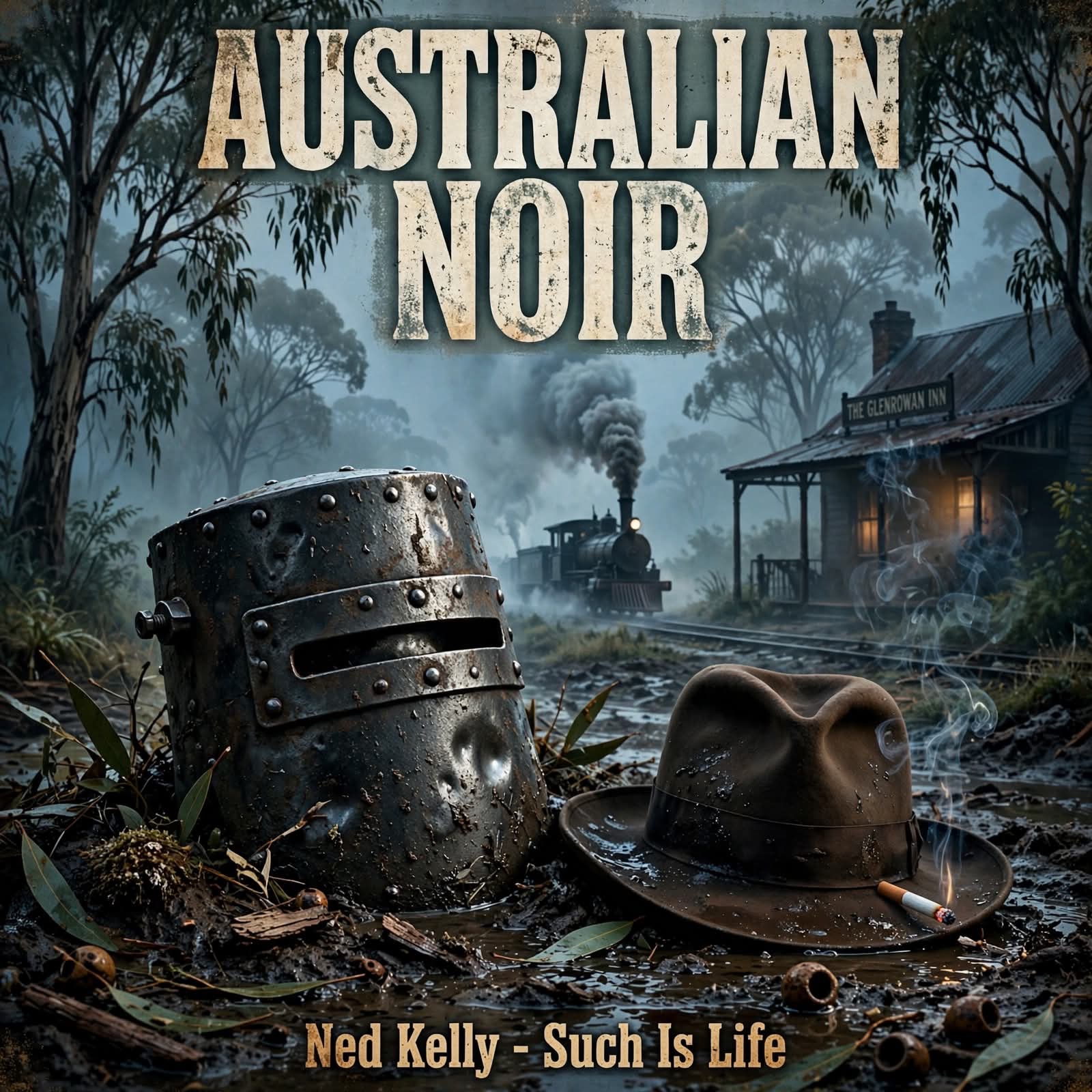
AUSTRALIA - The Iron Outlaw: Ned Kelly
The Story
Northeastern Victoria, April 1878. The rain doesn't wash the dirt, it turns it to soup.
Greta. A three-legged stool, turpentine brandy, and a 14-year-old girl named Kate Kelly trying to stay invisible.
Constable Alexander Fitzpatrick rides in with a horse-theft warrant for Dan Kelly. He doesn't want Dan. He puts a sweaty hand on Kate. Ellen Kelly answers with a coal shovel to his helmet. Clang.
Fitzpatrick rides out, writes a report that Ned shot him. Doctor says it's not a bullet wound. It's a scratch. Ellen, nursing an infant, gets three years hard labor on a liar's word.
Ned and Dan take to the wombats.
Stringybark Creek. Three troopers dead. Felons Apprehension Act — shoot Ned on sight.
June 1880, Glenrowan. Plow mouldboards beaten into 44kg armor. A ghost in iron walks through dawn mist. Bullets ping off like hail on tin. Then they aim low.
Melbourne Gaol. "Such is life." Trapdoor drops. Legend begins.
Told in Philip Marlowe noir style. Fireside Chat with Cage.
Stay curious, my friends.
The rain over Northeastern Victoria didn't wash away the dirt. It just turned into a soup that stuck to your boots like bad memories. It was April 1878, and the Australian bush didn't care about justice any more than a cheap bookie cares about your rent money. I'm sitting on a three -legged stool in Greta, nursing a glass of colonial brandy that tasted like turpentine and regret, watching the flies do laps around a kerosene lamp. In my line of work, you learn to read the silence. Out here, the silence was heavy, pregnant with the kind of trouble that wears a uniform but doesn't look you in the eye.
Her name was Kate Kelly. Fourteen years old, but in the bush years are measured in droughts and heartaches, not calendar pages. She had eyes the color of a bruised plum and a spine made of iron bark. But that night, she was just a kid caught in the headlights of a system designed to run her down. The setup was as old as the hills. You had the squatters, the big -money gents who owned everything from the fertile valleys to the local politicians. And you had the selectors. The Kellys were selectors.
Irish. Poor. Catholics in a Protestant circuit. To the law that made them guilty of breathing without a license. Enter Alexander Fitzpatrick. Fitzpatrick was a constable. which meant he had a badge, a horse, and a license to make a nuisance of himself. He wasn't a big man, but he carried himself like he'd personally invented the British Empire. He had a reputation that smelled worse than a dead sheep in a water tank, frequently drunk, always broke, and a liar by instinct. If he told you it was raining, you'd look out the window to double check.
He rode into the Kelly selection that evening under the guise of a warrant for Dan Kelly, Ned's younger brother. A horse stealing charge. Around these parts, stealing a horse from a squatter was practically a hobby, a way of balancing the ledger. The Kelly cabin smelled of wood smoke, boiled mutton, and the damp wool of survival. Ellen Kelly, the matriarch, was there with a newborn babe at her breast. Dan was at the table, eating his supper, and Kate was in the corner, trying to stay invisible. Fitzpatrick didn't care about the warrant.
Not really. He cared about the power. He sat himself down, reeking of cheap schnapps and authority, and started looking at Kate. Not the way a cop looks at a citizen. The way a stray dog looks at a butcher's shop. You're a pretty little thing, aren't you? Fitzpatrick said, his voice thick, his eyes tracking her like a hawk on a field mouse. Kate shrunk back, but Fitzpatrick didn't take the hint. He moved in close. Too close. Dropping a heavy sweaty hand on her arm. It wasn't police business anymore.
It was an assault cloaked in a blue coat Now Ellen Kelly wasn't the type of woman to file a formal complaint and wait six months for a magistrate to ignore it She was a bushwoman She picked up a heavy iron coal shovel from the hearth and brought it down on Fitzpatrick's helmet with the force of a falling red gum clang It sounded like a church bell tolling for a funeral that hadn't happened yet. Dan Lumet. Fitzpatrick scrambled back, drawing his revolver, but Dan was faster, wrestling the iron out his hand.
According to Fitzpatrick's later report, the one written in nice, neat ink on government paper, Ned Kelly burst through the door right then and put a bullet through his wrist. But Ned wasn't even in the territory. He was miles away, probably tracking cattle, or looking for clean break. The doctor who looked at Fitzpatrick's wrist the next day said it plain. It wasn't a bullet wound. It was a scratch. A superficial nick probably from the edge of the shovel or the latch on the door during the scuffle.
A cheap flesh wound used to buy an expensive lie. Fitzpatrick rode out of their bloody, embarrassed, and looking for vengeance. The law didn't wait for a trial. They didn't need one. They arrested Ellen Kelly. a mother with a nursing infant, and dragged her to the lockup. They put her in front of a judge who looked at her Irish face and saw a weed that needed pulling. They gave her three years of hard labor based entirely on the word of a drunk cop with a scratched wrist. When Ned heard what they'd done to his mother, something cracked inside him.
The system hadn't just been him. It had broken his family. He and Dan took to the wombats. The deep Unforgiving ranges where the scrub grows thick and the law doesn't go without a company of infantry. A few months later, at a place called Stringy Bar Creek, the trap was sprung. Four cops came looking for Ned and Dan, carrying enough firepower to start small war. They weren't looking to arrest, they were looking to kill. Ned ambushed the camp. When the smoke cleared from under the blue gums, three officers lay dead in the dirt.
That was the point of no return. You kill three troopers in Her Majesty's colony and you're no longer a thief. Your target. The government passed the Felons Apprehension Act. A fancy piece of legalese that meant anyone with a rifle could put a bullet in Ned Kelly's brain and collect a fat sack of gold for the trouble. But Ned wasn't running anymore. He was digging in. He didn't just want to survive. He wanted to make a statement. He took the iron moldboards from stolen plows. The very tools used to break the stubborn soil, and he beat them into something else.
He forged a suit of armor for pieces of iron, 44 kilograms of heavy, unyielding defiance. A cylindrical helmet with a slit just wide enough to see the world that hated him. By June 1880, it all came down to a tiny whistle stop called Glenrowan. Ned had a plan. He was going to derail a police train, take the survivors hostage, and forced the government to release his mother. It was a grand, desperate play. A republic of Victoria, born out of the mud and the blood of selectors. But plans in the bush have a habit of rusting.
A local schoolteacher sneaked out and warned the train. The cops arrived in force, surrounding the Glen Rowan and where the Kelly Gang was holed up. The siege lasted through the night. The hotel was riddled with thousands of rounds of ammunition. Inside, The gang drank, waited, and put on their iron skins. At dawn, the mist rose off the flats. Out of the smoke walked Ned Kelly. He looked like a ghost from an industrial nightmare. A man of iron walking through the eucalyptus, his long gray coat draped over the metal plates, his revolver barking into the fog.
The police fired and the bullets just pinged off his chest like hailstones on a tin roof. He kept coming, laughing through the ice slit, tapping his helmet with his pistol. Click clack. I'm a widow's son, he shouted into the morning air. You can't hurt me. For a minute, the cops thought they were fighting a demon. But a uniform doesn't make you smart, it just makes you persistent. Eventually, a sergeant noticed the fatal flaw in the blacksmith's design. The armor covered his head, his chest, his back.
But his legs were bare. moving like heavy trunks through the swamp grass. They blow. Two blasts of buckshot caught him in the thighs and the shins. The iron giant stumbled. The weight of his own defiance brought him down into the mud. They swarmed him like ants on a fallen beetle, tearing the helmet from his head. For months later, they stood him on a scaffold at the Melbourne jail. Fitzpatrick wasn't there to see it. He'd already been kicked out of the police force for being a habitual liar and a drunk, his badge taken away too late to save anyone.
Before they put the hemp rope around Ned's neck, he looked out at the witnesses, his eyes as cold and steady as the high country. He didn't beg. He didn't apologize. He just summed up the whole rotten business in four short words. Such is life, he said. The trapdoor dropped. and the Iron Man became a legend. But back in the Greta Bush, the rain kept falling, turning the soil into mud, waiting for the next poor bastard to try and plow it. As always, stay curious, my friends.
 Apple Podcasts
 Castbox
 Castro
 Goodpods
 Moon FM
 Overcast
 Pocket Casts
 Podbean
 Podcast Addict
 Podcast Republic
 Spotify