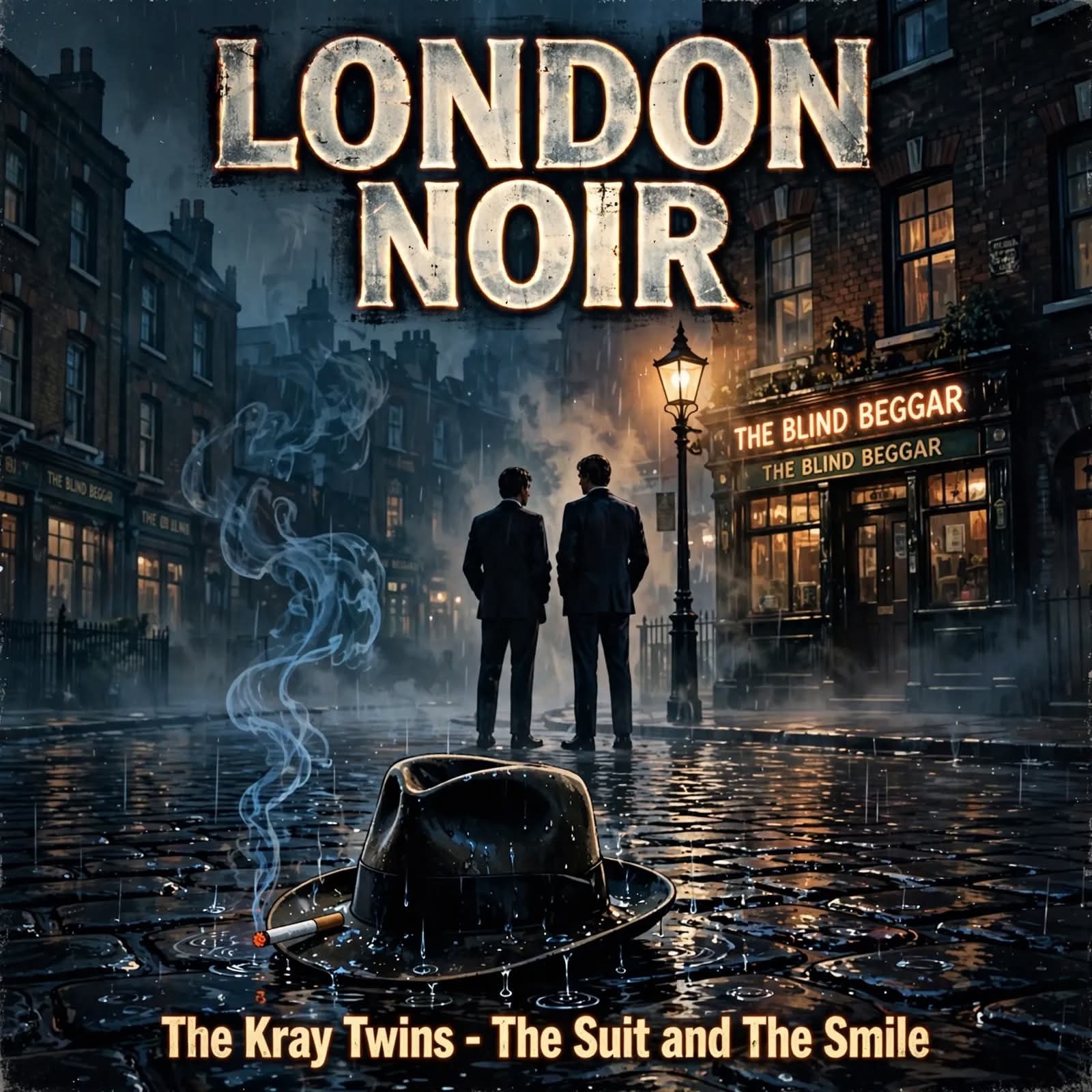
THE KRAY TWINS: East End Fog & The Firm
The Story
London, 1968. Fog off the Thames like a debt collector.
Two boys from Vallance Road, born 1933 to a scrap dealer, learn to box at Repton and learn that a fist builds empires.
Reggie - the charming one with a Savile Row suit and a dead wife.
Ronnie - the other half of the coin that didn't shine, hearing voices, openly gay in a city that punished both.
They call it The Firm. Esmeralda's Barn. Lords at their tables. Judy Garland sings while the East End bleeds quietly.
Then The Blind Beggar, March '66. George Cornell: "Well look who's here." A 9mm answer.
Then Stoke Newington, Oct '67. Jack The Hat McVitie doesn't walk out.
It took a small copper named Nipper Read a decade to make a jury see it.
This is London Noir, told in the style of Philip Marlowe. Fireside Chat with Cage.
Stay curious, my friends.
The fog came off the Thames like a debt collector, and East London swallowed a hole. I'd been in this business long enough to know that when a city keeps two names on everyone's lips at once, you're either looking at saints or the devil's own bookkeepers. In Bethnal Green, they called them the Twins, and there wasn't a soul between Valance Road and Bethnal Green Road who'd say the name Cray above a whisper, not if they wanted to keep their teeth in the drawer where they left them. I've been hired to look into a rumor, the kind of rumor that smells like cordite and cheap gin.
Ronald and Reginald Cray, twin sons of a scrap dealer, born in October of 33 in a two up two down that couldn't have held their ambition even if it had ten more rooms. They came up the hard way, the boxing gyms of the East End, two identical faces with identical left hooks, and somewhere between the ring and the street corner they figured out that a fist was a tool and the right tool applied often enough, built empires. They called their outfit the firm. Cute name for a business that traded in extortion, arson, and long silences in dark alleys.
I walked into their world the way you walk into a room full of smoke, slow, eyes half shut, waiting for the shapes to make sense. Reggie was the one you could talk to. Charming, They said, a snake oil smile that made you forget he'd just as soon put a knife between your ribs as shake your hand. Ronnie was the other half of that particular coin, and Ronnie's side didn't shine. Ronnie heard voices, they said, and not the kind that told him to buy insurance. He was, by every account I could dig up, a diagnosed, paranoid schizophrenic.
And he never bothered hiding what he was, not the illness and not the fact that he preferred the company of men. in a city in a century that had no mercy for either truth. Say what you want about the man's soul, but he never lied about which devil he was wrestling. They ran their business out a nightclub called Esmeralda's Barn up on the Wilton Place end of things tuxedos over torn knuckles. And here's the part that still turns my stomach when I think about it long enough. High society came calling.
Lord sat at their tables. Actresses posed for their cameras. I heard the name Judy Garland whispered in the same breath as Barbara Windsor, heard about a peer of the realm, Lord Boothby, who liked their company well enough that the papers had to be paid to look the other way. That's the peculiar poison of the craze. They didn't hide in the shadows like the rest of the trade. They stood in the light, shook their right hands, smiled for the right photographers, while underneath the velvet the East End bled quietly into the gutters.
I spent three weeks working the pubs, buying rounds nobody wanted to drink with me, trying to get a straight answer out of men whose faces went the color of wet newspaper the second I said the word cray. One night, in a place that smelled of hops and old fear, a barman with shaking hands told me about the blind beggar. March of 66, he said, like it was scripture, a man named George Cornell tied up with a rival outfit down south, the Richardson's walked into that pub and made the mistake of running his mouth.
Called Ronnie a name, the barman said, wouldn't repeat it, didn't have to. Ronnie Cray walked up, cool as the fog outside, and put a bullet in Cornell's forehead while the jukebox played on, some tune about walking away from love, and Ronnie let the record run out before he left. That's not the kind of thing a city forgets. That's the kind of thing a city learns to whisper about instead. The other twins' turn came the following year, and if Ronnie's crime was theater, Reggie's was a slow unraveling.
His wife, Frances, a girl from a neighborhood he'd married in 65 with more hope than sense, was dead within two years, her own hand the cause, and the men who knew Reggie best said he was never quite whole again after that. Grief does strange things to a man already halfway broken, and by October of 67, At a party in a basement flat up in Stoke Newington, Reggie put a knife into a man they called Jack the Hat, a small -time hood who'd made the fatal error of being unreliable in front of the wrong audience.
They say Ronnie held the man while Reggie did the work, though men who tell stories about the dead have a way of arranging the furniture to their liking. Whatever the precise choreography, Jack McVitie didn't walk out of that basement, and the firm's reputation already thick as blood, when a shade darker still. For years the law couldn't touch them. That was the real magic trick better than any nightclub act. Witnesses had a way of losing their memories and juries had a way of losing their nerve.
It took a copper with a bulldog's patience, a man named Leonard Redd, though everybody called him nipper, small in stature and relentless in temperament. Grinding away at the case for the better part of a decade, building it witness by frightened witness before the walls finally came down. They arrested the twins in the spring of 68, and by March of 69 a jury at the Old Bailey had heard enough. The judge handed down sentences the like of which London hadn't seen for a murder case in living memory, 30 years minimum.
The both of them, words that fell on the courtroom like a lid closing on a coffin. I want to see the old street after that, the one where they'd grown up, Valance Road. And it looked like any other street, gray brick and gray sky. Nothing to mark it as the birthplace of legend or nightmare, depending which paper you read. That's the trick of this town. It keeps its monsters in houses that look like everyone else's. Ronnie never left the walls again. Not really. His mind, already a stranger to him for years, took him somewhere the courts couldn't follow.
And eventually they moved him to Broadmoor, the hospital for men whose crimes and whose sicknesses had become impossible to separate. He died there in the spring of 95, a heart attack taking what the law never quite managed to, 40 years short of the life he might have had if the voices in his head had ever once let him alone. Reggie held on longer. A model prisoner, they said, the kind of phrase wardens use when they've run out of other things to say about a man. Whatever penance he was doing, he did it behind bars for the better part of three decades.
And when they finally let him out in the summer of 2000, It wasn't mercy so much as arithmetic. Cancer had already written the sentence the courts never could, and he was free for a matter of weeks before it finished the job. He died that October, and half of London turned out to watch the hearse go by, crowds thick on the pavement the way they might turn out for a king, which tells you something ugly and true about what this city loves. I never did find out who hired me to look into the rumor. Not really.
or maybe I did and just didn't want to write it down. Some cases end that way. The client dissolves into fog same as everybody else and you're left holding a file full of dead men and old headlines wondering what exactly you were paid to learn. What I learned for whatever it's worth to whoever's listening is that a city will forgive almost anything if you serve it with a smile and a decent suit. The craze understood that better than anyone I ever tangled with. They built their empire on charm in the front room and murder in the back and for a decade London let them because the Lord wanted their company and the papers wanted their photographs and the poor wanted somebody from their own street who'd made it big, never mind how.
I closed the file on a rainy Tuesday, poured two fingers of something that wasn't quite scotch and thought about the jukebox and the blind beggar still playing while a man bled out on the floorboards. That's London for you. The music doesn't stop for the dead. It just plays a little quieter, and everybody in the room agrees not to mention the body until somebody else finds it first. I put the file in the drawer with the others, the ones I don't like to open twice, and I told myself, same as always, that this was just a story about two brothers who never should have shared a face, let alone a legend.
But legends don't die easy in this town, and neither, it turned out, did the fear. Even now, years on, you mention the name in the wrong pub and watch the room go quiet. The way a room goes quiet when the fog outside gets thick enough to hide whatever's still out there walking. That's the truth of it, near as I could piece it together. And in this business, the truth is usually the only thing you get to keep. Everything else, the nightclubs, the tailored suits, the Sunday photographs with actresses on their arms, all of it burned off eventually.
like fog under a hard morning sun. What was left underneath was just two boys from a scrap dealer's house who learned that violence, dressed well enough, could pass for royalty in a city tired enough to believe it. I never did shake the cold I caught working that case. Some things follow you home. The craze were one of them. And I have a feeling wherever this city's fog rolls in tonight, they always will be. Stay curious my friends
 Apple Podcasts
 Castbox
 Castro
 Goodpods
 Moon FM
 Overcast
 Pocket Casts
 Podbean
 Podcast Addict
 Podcast Republic
 Spotify