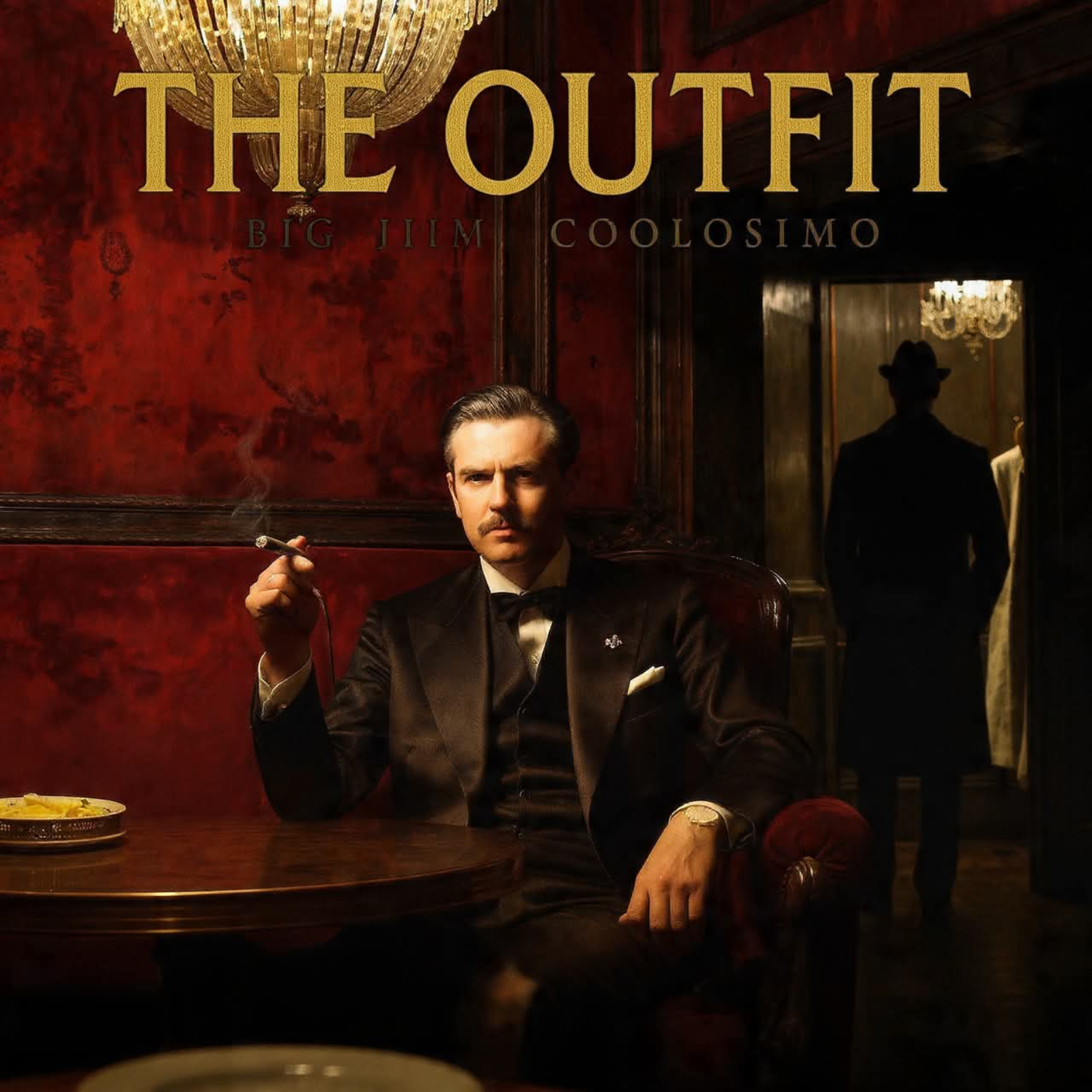
THE OUTFIT: BIG JIM COLOSIMO - The First Chicago Godfather
The Story
Before Al Capone.
Before the St. Valentine's Day Massacre.
There was Big Jim.
James Colosimo ruled Chicago's Levee District.
Gambling. Prostitution. Politics.
He built an empire on vice...
but refused to go to war for Prohibition.
On May 11, 1920, he was shot dead in his own restaurant.
His murder didn't end the Outfit.
It created it.
This is Big Jim.
1920, a restaurant in Chicago. The most powerful man in the city walks in alone. No bodyguards, no fear. By the end of the night, he was dead in his own coat room. His name was James Big Jim Colossimo, and his murder created the Chicago outfit. James Colossimo stood in the foyer of his world famous cafe on South Wabash Avenue. Checking the gold leaf detailing on the walls as the afternoon sun caught the white linen of his custom tailored suit. It was May 11th, 1920, and the man everyone called Big Jim was waiting for a delivery of whiskey that would never arrive.
Within minutes, a gunman would step from the cloakroom and fire a single .38 caliber bullet into the base of his brain, ending the reign of the man who turned Chicago's vice into a modern industry. The story of Big Jim Colossimo isn't just about a murder. It's the story of how a street sweeper with a bag of loose diamonds in his pocket built the foundation for the Chicago outfit, only to be outpaced by the very machine he helped create. Before he was the king of the levy district, Colossimo was Vincenzo Colossimo, arriving in Chicago from Calabria in 1895 at just 17 years old.
He didn't start with a gun or a gang. He started with a broom. In the late 1890s, the streets of the First Ward were buried under horse manure and coal dust, and Colossimo found work as a street sweeper. But he wasn't just pushing dirt, he was organizing the men around him. He founded a social club for the Italian street cleaners, turning a group of low -wage laborers into a disciplined voting bloc. This caught the eye of the two most powerful and corrupt men in Chicago, Alderman Michael Hincky, Dane Kenna, and John Bathhouse Coughlin.
They saw the young Italian's charisma and his ability to deliver votes, and they rewarded him with a promotion to street cleaning inspector. He wasn't a cop, but he had a badge and the authority to look the other way, a role that served as his master class in the intersection of politics and graft. His real rise, however, was a partnership of both business and marriage. In 1902, Colossimo met Victoria Moresco, an established madam who ran a second -rate brothel on Armor Avenue. Victoria was six years older and possessed a shrewdness for the vice trade that Colossimo matched with his political connections.
They married and immediately began expanding. Within a few years, they grew their operation from a single house to nearly 200 brothels across the city. They were clearing $50 ,000 a month. nearly three -quarters of a million dollars in today's money. Big Jim loved the wealth and wore it as a uniform. He became Diamond Jim, a man who wore a diamond ring on every finger, diamond studs on his shirt, and a massive diamond horseshoe pin to his vest. He was known to carry a small, shammy bag of loose, cut stones just to pour them from hand to hand while he talked, watching them sparkle in the light of his restaurant.
That restaurant Colossimo's Cafe became his sanctuary and the seat of his power. It was a place where the edges of society blurred. You could find the world renowned tenor Enrico Caruso at a corner table, sharing wine and spaghetti with a high ranking judge or notorious hitman. Colossimo worshipped the opera, often sitting in a trance as the high notes filled the room. A man who felt he had finally reached the pinnacle of respectability. But as his profile grew, So did the target on his back. By 1909, the Black Hand, a loose network of Italian extortionists, had noticed the diamonds and the cash flow.
They began sending him anonymous letters marked with a blackened palm, demanding $50 ,000 under threat of death. They bombed his businesses and ambushed him on the street. And for the first time, Big Jim's political protection wasn't enough. Desperate, he reached out to New York. Victoria suggested her cousin, a rising star in the Five Points gang, named Johnny Torrio. When Torrio arrived in Chicago, he brought a cold, calculated efficiency that the city's underworld had never seen. He didn't just protect Colossimo, he cleared the board.
In one instance, Torrio lured three black -hand extortionists to a bridge on the south side with the promise of a payment. As they approached, Torio's gunmen rose from a horse -drawn carriage and opened fire, killing two and mortally wounding the leader, Jim Cosmano. Within a month of Torio's arrival, ten Blackhanders were dead and the threats against Colossimo vanished. Torio was soon made second in command, the administrative brain to Colossimo's public charisma. The relationship began to fray as the 1920s approached and the Volstead Act loomed.
Torrio saw the potential for millions in illegal alcohol, but Colossimo was hesitant. He had his restaurant, his brothels, and a new obsession. A young singer named Dale Winter. He divorced Victoria, the woman who helped build his empire, and married Dale in 1920. Much to the disgust of Torrio, a devout Catholic who saw the divorce as a sign that Big Jim had gone soft. When Colossimo refused to pivot into bootlegging, fearing the heat from federal law enforcement, Torrio decided his mentor was no longer an asset.
On that May afternoon, Torrio allegedly called Colossimo to the restaurant for an important shipment. When Big Jim walked through the door to meet it, there was no whiskey. Only a gunman, believed by many to be New York hitman Frankie Yale, waiting to pull the trigger. Big Jim Colossimo's funeral was a spectacle Chicago would never forget. 5 ,000 mourners, including eight aldermen, three judges, and a congressman, followed his silver and mahogany casket to Oakwood Cemetery. It was the end of the mustache Pete era and the birth of the outfit.
With Colossimo out of the way, Torrio took control and brought in a young bouncer he had previously imported from New York, Al Capone. Colossimo had built the engine, but the men who came after him were the ones who truly learned how to drive it through the blood -soaked years of Prohibition. Sharing this look into the foundations of a Chicago outfit is a great way to introduce others to the hidden history of a city's most notorious era. And that's the way I heard it.
 Apple Podcasts
 Castbox
 Castro
 Goodpods
 Moon FM
 Overcast
 Pocket Casts
 Podbean
 Podcast Addict
 Podcast Republic
 Spotify