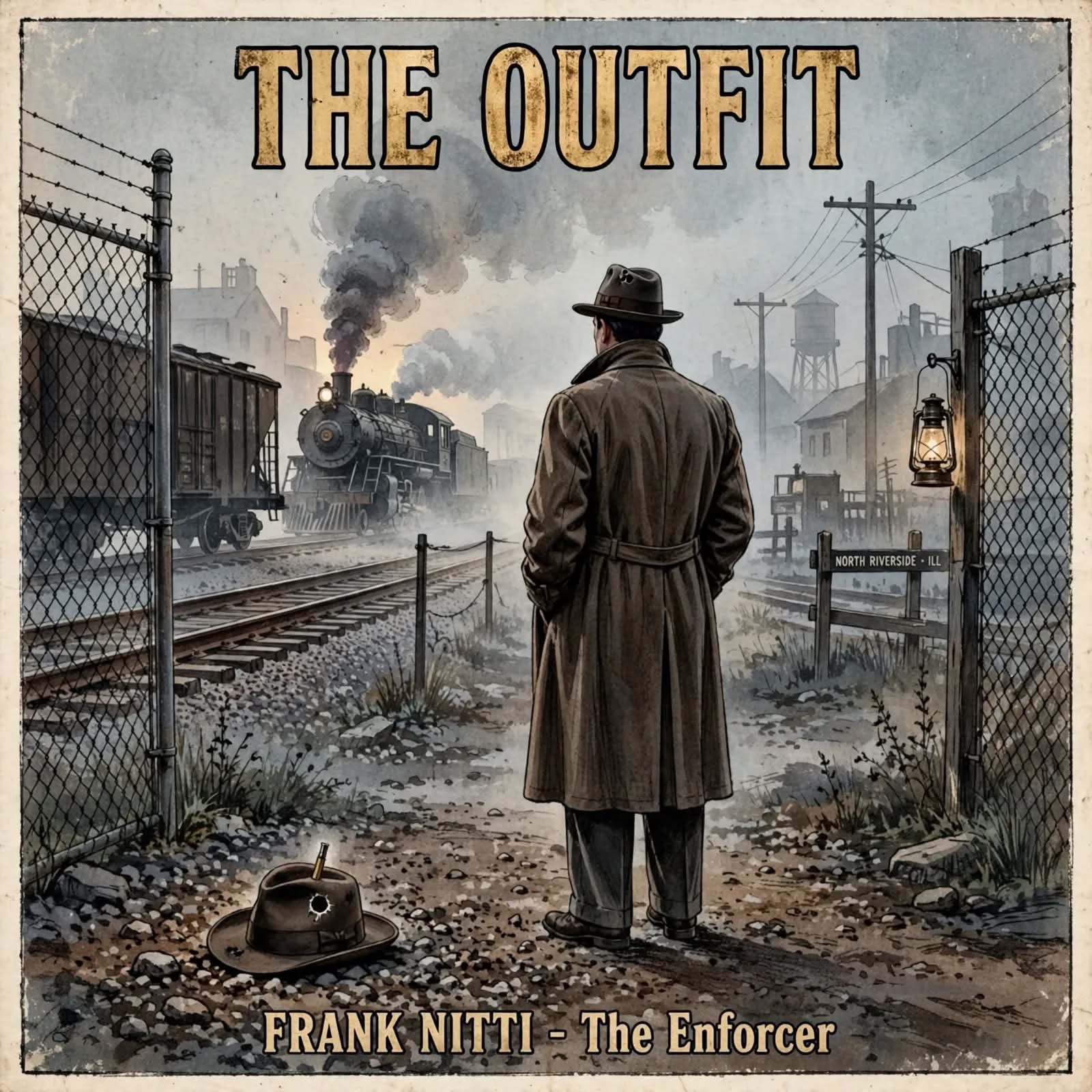
FRANK NITTI: The 3 Shots on the Railroad, the Outfit Saga
The Story
He wasn't a brawler. He was the mechanic.
While Al Capone was the celebrity, Frank Nitti was the man who managed the Canadian whiskey, signed the death warrants for Hymie Weiss and the Valentine's Day Massacre, and turned the Outfit into a corporation.
When Capone went to Alcatraz, Nitti took over. Survived an assassination attempt by Chicago police. Ordered a hit on a Mayor.
Then Hollywood brought him down.
In 1943, facing 20 years in a prison cell he couldn't psychologically survive, Nitti walked to a railyard in North Riverside with a .32 revolver and a bottle of whiskey.
Three shots. A dollar and fourteen cents in his pocket.
Was it suicide, or did the Outfit make sure he would never talk?
This is Fireside Chat with Cage - THE OUTFIT series.
March 19th, 1943. North Riverside, Illinois. A freight train rattles past. Foggy. Gravel. A 57 -year -old man in a fedora lifts a .32 to his head. First shot. Misses. Blows his hat off. Second shot. Threw the jaw. Third shot. Silence. The most powerful man in Chicago died with a $1 .14 in his pocket. This is Frank Nitti. Frank Niddy stood in the gravel of a rail yard in North Riverside, Illinois, watching a freight train rumble past him through a fog of whiskey and despair. It was March 19th, 1943, and the man the world knew as the Enforcer, the cool -headed successor to Al Capone, was unraveling in the gray light of a suburban afternoon.
He wasn't the cinematic monster people saw on the silver screen years later. He was a 57 -year -old man in a fedora, shivering as he raised a .32 caliber revolver to his temple. The first shot missed entirely, punching a hole through his hat. The second tore through his jaw. It took a third, final pull of the trigger as the train crew watched in horror from their caboose to finally silence the man who had spent two decades silencing Chicago. To understand why the most powerful boss in the Chicago outfit ended up bleeding out against a chain -link fence, you have to go back to the beginning, to the narrow streets of angry Italy, where Francesco Rafael Nitto was born in 1886.
He wasn't born to the gun. He was born to the blade, the barber's blade. After emigrating to Brooklyn and later migrating to Chicago in 1913, Nitti set up shop at 1914 South Halstead Street. His barber shop was a front, a quiet place for fencing stolen jewelry and rubbing shoulders with the rising stars of the underworld like Dino Banyan and Johnny Torrio. But it was a young Al Capone who saw the steel behind Nitti's quiet, business -like demeanor. Capone didn't just want muscle. He wanted a mechanic.
Nitti became the man who managed the flow of illegal Canadian whiskey through a network of speakeasies that turned the Chicago outfit into a multi -million dollar corporation. While Capone was the face, the loud -mouthed celebrity of the Prohibition era, Niddy was the brains. Here in the nickname the Enforcer, not because he was a street brawler, but because he was the one who signed the death warrants. He was a meticulous planner, a man who allegedly helped coordinate the 1926 assassination of Hemi Weiss and the logistics of the St. Valentine's Day massacre in 1929.
In a world of impulsive killers, Nitti was a strategist who understood that violence was a tool of business, best used sparingly but with absolute finality. The mechanics of his rise were as much about accounting as they were about ammunition. When the federal government finally managed to pin Capone for tax evasion in 1931, they didn't forget Nitti. Both men went down that year. But while Capone was shipped off to Atlanta and in Alcatraz for 11 years, Nitti pleaded guilty and received a relatively light 18 months.
He served his time at Leavenworth, but the experience fundamentally broke something inside him. The man who ruled the streets of Chicago found that he was a severe claustrophobe. The narrow confines of a prison cell weren't just a punishment for Nitti. They were a waking nightmare. He emerged from Leavenworth in 1932 as the acting boss of the outfit, but he was a man haunted by the four walls of a cell. His return to power was immediately met with a clash of blood and politics. In December 1932, a squad of Chicago police officers led by Detective Sergeant Harry Lang and Harry Miller burst into Niddy's office at 221 North LaSalle Street.
Without a word, Lang fired three shots into Nitti's back and neck, then shot himself in the finger to claim self -defense. It was an execution attempt ordered by the newly -elected Mayor Anton Cermak, who wanted to replace Nitti's crew with a rival faction led by Ted Newberry. Nitti survived by a miracle. Lying in a hospital bed while his father -in -law, Dr. Gaetano Ronga, pulled the bullets out. The outfit's response was swift and legendary point three weeks later. Newberry was found dead in a frozen cornfield, wrapped in barbed wire.
Two months after that, Mayor Cermak was killed by an assassin's bullet in Miami, a hit many historians believe was orchestrated by Niddy from his recovery bed. Under Niddy's leadership in the late 1930s, the outfit evolved. Prohibition was over, and the money was moving into labor racketeering and a massive extortion scheme targeting Hollywood. Niddy's men, Willie Byoff and George Brown, took control of the Stagehands Union, threatening major studios like Paramount and 20th Century Fox with strikes unless they paid millions in protection money.
It was a gold mine that brought in over $2 million, but it became the outfit's undoing. In 1943, under pressure from federal investigators, Byoff turned informant. He named the names Niddy had kept hidden for years, including top lieutenants like Paul the Waiter, Ricka, The controversy that led to the railroad tracks began at a meeting in Nitti's home on Selborne Road. Rikka and the other underbosses were furious. They blamed Nitti for the Hollywood disaster and demanded he take the fall. They knew about his claustrophobia.
They knew he couldn't handle another 20 years in a cage. The official history says Nitti, driven by fear and the news of his indictment, drank himself into a stupor and walked out to the tracks to end it himself. But rumors have persisted for decades. Some believe the outfit didn't just suggest suicide, they ensured it. There was talk that Nitti was suffering from terminal cancer, making his death a pragmatic exit for the organization. Others point to the three shots it took, a messy end for a man who valued precision.
suggesting he might have been assisted by his own associates who feared what he might say if the claustrophobia broke his silence in a federal cell. Frank Niddy remains a shadow in the history of the mob, a man who succeeded the loudest gangster in history only to die in a lonely railyard, leaving behind just a dollar and 14 cents in his pocket and a legacy of quiet, cold -blooded efficiency. His death marked the end of the Capone era and the beginning of the modern syndicate, proving that even the most feared enforcers are eventually expendable to the machine they helped build.
Share this look into Chicago's dark history with someone who loves a good mystery. And that's the way I heard it. As always, stay curious my friends.
 Apple Podcasts
 Castbox
 Castro
 Goodpods
 Moon FM
 Overcast
 Pocket Casts
 Podbean
 Podcast Addict
 Podcast Republic
 Spotify