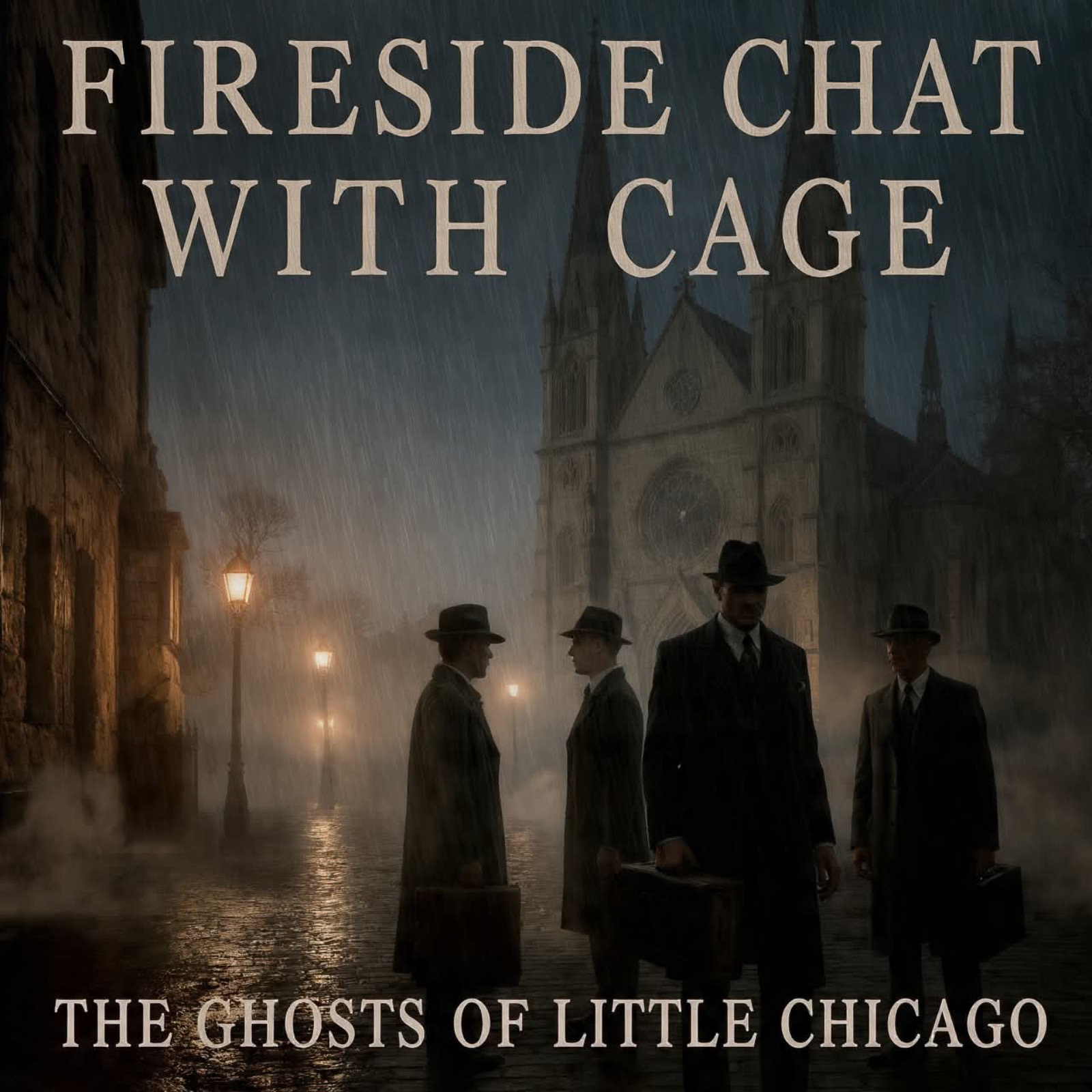
THE GHOSTS OF LITTLE CHICAGO: Guelph, Sleeman, and Canada's Booze Empire
The Story
Beneath Guelph, Ontario are sealed tunnels.
In the 1920s they moved beer from the Sleeman Brewery straight to the mob.
When Canada went "dry" in 1916, a loophole created billionaires.
The Sleeman brothers. Rocco Perri. And a pipeline to Al Capone.
This is the story of Canada’s bootlegging empire:
The 50-year ban, the King of the Bootleggers,
and why Ontario still has government liquor stores today.
From Silver Creek to Chicago.
This is Fireside Chat with Cage.
Beneath the limestone streets of Guelph, Ontario. Cold air. Wet stone. The smell of old yeast. If you look close at the brickwork, you'll see where they sealed it. A tunnel. A tunnel that once moved thousands of bottles of beer. Straight from the Sleeman Brewery to Al Capone, Chicago. This is Canada's dark, liquid past. Deep beneath the historic limestone paved streets of Guelph, Ontario. The air is cold. damp, and smells faintly of wet stone and old yeast. If you look closely at the foundational walls of some of the city's oldest buildings, you can still see where the brickwork shifts.
You're looking at sealed up history. A century ago, these subterranean passageways weren't quiet. They echoed with the frantic whispers of bootleggers, the heavy thud of wooden beer casks, and the clinking of unlabeled glass bottles. Welcome to Fireside Chat with Cage, a journey into Canada's dark, liquid past. Today, we are tracing a map of greed, family empires, an organized crime that stretches from the rolling hills of Wellington County to the violent streets of Al Capone, Chicago, and exploring how the ghosts of this era still dictate, how Canadians buy a drink today.
To understand how Canada became the world's most sophisticated illegal brewery, We have to go back to September 1916. While Canadian soldiers were fighting in the muddy trenches of Europe, a different kind of war was being waged at home. Driven by religious revivalists and the Women's Christian Temperance Union, the Ontario government passed the Ontario Temperance Act. The goal was noble, eliminate domestic abuse, save families from financial ruin, and purify society. Saloons were shuttered. Retail sales were outlawed.
The province, on paper, went completely dry. But Canadian lawmakers left open a massive, multi -million dollar loophole. You see, provincial governments only had the power to ban the sale of alcohol within their own borders. They couldn't stop federally licensed distilleries and breweries from manufacturing it for export. And that is where our story truly begins. Enter the Sleeman family of Guelph. The Slemans began running their operations under the cover of night. Unlabeled bottles of their famous ale were carted through a hidden tunnel connecting their Silver Creek brewery directly to the family estate, the manor.
From there, local farmers with false bottom coal carts would discreetly move the product. But local sales weren't enough to sustain an empire. The real money was waiting across the border. In 1920, the United States passed the 18th Amendment, plunging the entire American Republic into absolute prohibition. Suddenly, a bottle of Canadian beer or whiskey was worth its weight in gold. And a dark network began to stretch out from wealth. To get their product to the massive American market, the Slemans needed a middleman.
And they found the perfect partner just 40 miles down the road in Hamilton, Ontario. His name was Rocco Perry. To the public, Perry was a mild -mannered macaroni salesman. To the underworld, he was the king of the bootleggers. Alongside his brilliant and ruthless common -law wife, Bessie Starkman, Perry organized Canada's first true mafia syndicate. The pair is bought up Canadian liquor by the trainload. They use the Detroit Windsor funnel, a narrow strip of water separating Ontario from Michigan.
to ferry thousands of crates of booze into the United States using high -speed boats.
And who was buying on the other side? Yep, Chicago.
Rocco Perry's network plugged directly into the American syndicate. Chicago's undisputed underworld boss, Al Capone, and Detroit's notorious Purple Gang relied heavily on Canadian pipelines to keep their speakeasies flowing. The profits were astronomical. The Perry Empire alone was clearing an estimated $1 million a month in 1920s money. Back in Guelph, the Slemans were riding high on this global pipeline. But the Canadian government was growing tired of the lawlessness. While exporting was legal, tax evasion was not.
The government offered the Slemans a deal, pay taxes on the beer you're shipping out, and we'll look the other way. The Slemans, arrogant in their success, refused. It was their undoing. In 1933, the federal government swooped in. The brewery was raided, the family was bankrupted, and the Crown handed down a legendary corporate punishment. No member of the Sleeman family was legally permitted to brew beer in Canada for 50 years. The family recipe book was hurriedly hidden away by an aunt, and the Sleeman name vanished into obscurity.
By the late 1920s and early 30s, Canadian provinces realized prohibition had failed. It hadn't stopped drinking. It had just created billionaires out of mobsters. But when the government repealed the bans, they didn't want to return to the wild, wide, open saloons of the past. They wanted total control. This fallout created the heavily regulated Canadian system we know today, giving birth to strict government monopolies like the LCBO. Yet, Even as the provinces opened up, the battle between wet and dry forces didn't end in the 1930s.
In fact, it dragged on into modern times, fought block by block, town by town. Take the city of Owen Sound, Ontario. Nestled on the shores of Georgian Bay, this deeply religious port town fought viciously against the return of alcohol, long after the rest of the province was enjoying a legal drink. Owen Sound remained strictly dry. It wasn't until a fiercely contested referendum in 1972, nearly 40 years after federal prohibition ended, that the town finally allowed its first legal drink. Even more shocking is the story of Toronto's The Junction, this historic working -class neighborhood banned alcohol in 1904 to curb rowdy railway workers.
For nearly a century, residents actively fought off developers and restaurateurs to keep the ban alive. The Junction didn't officially see its first legal pint poured until 1997. Today, you can walk into a sleek, modern craft brewery in Guelph, or order a cocktail in a trendy restaurant in Toronto's Junction neighborhood. It feels normal. Universal. But if you look just beneath the surface, or deep into the basements of our oldest cities, the architecture of Canadian Prohibition is still right there.
It's written into the provincial tax laws, reflected in our government liquor stores, and buried in the bricked up tunnels where the ghosts of the Slemans and Rocco Perry still run their midnight routes. Thanks for listening to Fireside Chat with Cage. And that's the way I heard it.
 Apple Podcasts
 Castbox
 Castro
 Goodpods
 Moon FM
 Overcast
 Pocket Casts
 Podbean
 Podcast Addict
 Podcast Republic
 Spotify