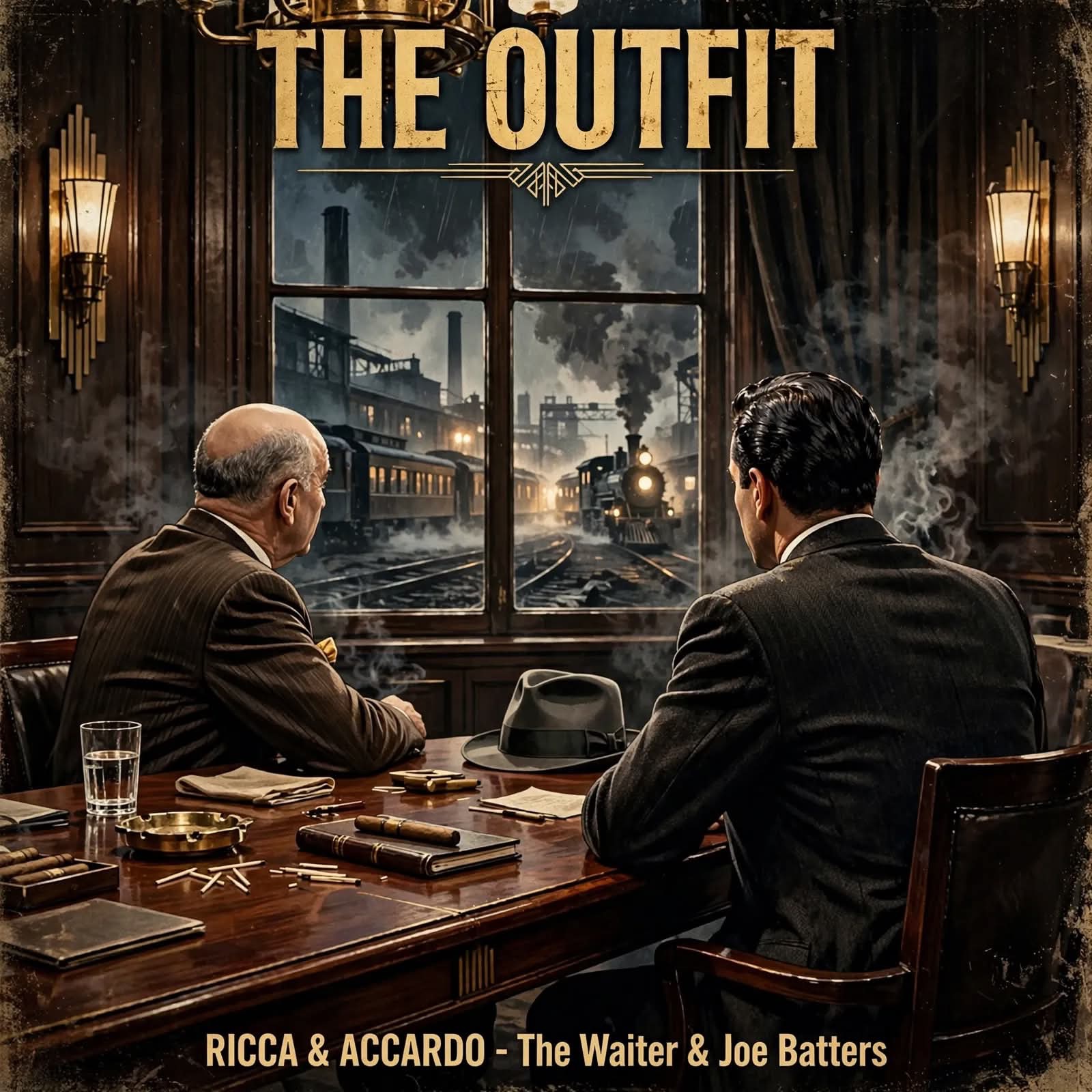
RICCA & ACCARDO - The Waiter and Joe Batters Who Inherited Chicago After Nitti
The Story
Frank Nitti died on March 19, 1943 with $1.14 in his pocket.
On March 18, he was in a room with Paul Ricca and Tony Accardo.
Ricca was born Felice DeLucia - convicted of murder twice in Naples before becoming "The Waiter" who said "Make-a him go away."
Accardo was "Joe Batters" - recruited by Machine Gun McGurn, made famous for beating 3 traitors to death with a baseball bat, possibly in the St. Valentine's Day garage.
Together they watched Nitti unravel. Claustrophobic. Facing prison. They told him he would plead guilty for the Hollywood extortion racket.
Next day Nitti was dead. Next day Ricca was boss and Accardo was underboss. For 30 years.
Did they kill him? Not with a gun.
This is the final chapter of THE OUTFIT. Fireside Chat with Cage.
Felice de Lucia. Two murders in Naples. Escapes to America. Becomes Paul Ricca. Becomes the waiter. Says five words. Making him go away. And a man vanishes. Next to him, Joe Batters. Baseball bad in Prohibition. Took out three traitors in one night. Together they sat across from Frank Nitti on his last night alive. They didn't bring a gun. They brought a choice. Go back to prison. Next day. Nitti was dead by the tracks. Next day, they owned Chicago. Long before he was Chicago's shadow king, Paul Ricca was already a murderer twice over.
Born Felice de Lucia, he grew up in Naples and was convicted of murder there in 1917, served two years in prison, murdered again, and fled to the United States in 1919. He anglicized his name, drifted to Chicago, and found work as a waiter which is where his nickname The Waiter came from, before rising quickly under Al Capone, who stood as best man at his 1927 wedding. By the time Capone was gone, Ricca was already the brains nobody saw. Tony Accardo came up the same brutal way. As a young Prohibition -era enforcer, jack machine gun McGurn, one of Al Capone's toughest hitmen, recruited a cardo into his crew and it didn't take long for a cardo to make his name written in blood during prohibition a cardo was nicknamed joe batters for using a baseball bat to kill three outfit traders and the story goes that al capone admiring his handiwork remarked that a cardo was a real joe batters and the name stuck for life some accounts even place the young a cardo among the gunmen inside the garage on saint valentine's day 1929 when four men gunned down seven of George Bugg's Moran's crew, though that has never been proven and probably never will be.
What made Ricka and Icardo so dangerous wasn't just violence. It was how differently each of them wore it. Ricka was quiet, precise, almost courtly, which made him worse. He didn't rage. He gave an order the way another man might ask for the check. Soft -spoken, but utterly ruthless. His preferred phrase for ordering a killing was the understated, make a hymn go away. No teatrix, no sretz, just a sentence. And then a man would vanish from the world. Rikka understood that fear didn't need volume.
It needed certainty. Accardo was the fist behind that certainty. He earned his nickname for wielding a bat against debtors and extortion victims and is one of the most successful and powerful mob bosses in American history. The ruthless boss crafted an epic reputation for his uncanny ability to shield himself from legal harm and evoke undying loyalty from his troops throughout a 45 -year reign. That reputation for brutality never dulled with age or respectability. Even decades later, when burglars made the mistake of robbing his river forest home.
Accardo allegedly had the thieves tracked down and brutally murdered with their throats cut, and years afterward several men were tried and convicted for carrying out that execution on his orders. The lesson was always the same. Touch what's mine, and it doesn't matter how many years have passed, you will be found. And yet, for all the bodies attributed to their era, despite numerous arrests for activities ranging from murder and kidnapping to extortion, union racketeering and gambling. Accardo never served real jail time, and a 1960 tax evasion conviction was even overturned on appeal that he died, famously, in his own bed, an old man, having outlasted every rival, every prosecutor, and nearly every partner he'd ever had.
By 1943, the Chicago outfit was cornered. Two of its own men had turned informant. Willie Byoff and George Brown, arrested for extortion, agreed to testify against the outfit leadership. And in March 1943, Ricca, Nitti, and other mob leaders were indicted for extorting the Hollywood studios. Frank Nitti, Capone's old successor, was staring down a prison sentence. and everyone in the room knew what prison had already cost him once. On the night of March 18th, the men who ran the outfits sat down with him.
Rikka and the outfit leadership met with Nitti, and since the movie studio racket had been Nitti's idea in the first place, they demanded that he plead guilty to the extortion charges to save the rest of them from prison. Tony Accardo, by then the outfit's chief enforcer, was very much part of that leadership circle. It was in its way a death sentence dressed up as a business decision. Everyone at that table understood what they were asking a man who could not bear confinement. Terrified at the prospect of prison due to his severe claustrophobia, Niddy shot himself to death the next day.
Other accounts add a grim, almost theatrical detail. He shot himself three times before the wound finally proved fatal, and he did it at a Chicago rail yard. the day before he was due to appear before the grand jury. Even the church bent its own rules for him. Though Nitti was an Italian Catholic, and Catholic doctrine normally bars suicides from consecrated ground, the coroner ruled he had been temporarily insane from intoxication and depression, which cleared the way for him to be buried in a Catholic cemetery.
So, did they kill him? Not with their own hands and not with anyone else's as far as any court coroner or historian has ever found Frank Nitti's death was officially and by every account since a Suicide by his own gun alone by the tracks Nobody forced the trigger But ask whether ricka and a cardo had anything to do with it and the honest answer is more Unsettling than a clean murder would be they didn't need to pull a trigger They simply gathered around a man they knew was fragile, told him the racket had been his idea, and informed him he was going to plead guilty and go back behind bars, knowing full well what that would do to him.
Nitti was claustrophobic and fearful of serving a second prison term, and his own partners used that fear as leverage rather than mercy. They didn't need a gun. They needed only to hand a terrified man an impossible choice and walk out of the room. and then walked out of that room into everything Nitti had built. Ricca became the official boss of the outfit within a day of Nitti's death, with Tony Accardo installed as his underboss, and the two of them would go on to run the outfit together for the next 30 years.
Accardo ultimately acquired undisputed control after Nitti's suicide and Ricca's own imprisonment, and by 1950 the Chicago Crime Commission had named him the number one overlord of Chicago's crime syndicate. Whether that succession was the plan all along, or simply the ruthless efficiency of men who never let a crisis go to waste, is a question history has never fully answered. What's certain is this, the two men who inherited Frank Niddy's empire were the same two men sitting across the table from him on the last night of his life, and neither of them ever showed the slightest flicker of guilt about it.
And that's the way I heard it. Stay curious, my friends.
 Apple Podcasts
 Castbox
 Castro
 Goodpods
 Moon FM
 Overcast
 Pocket Casts
 Podbean
 Podcast Addict
 Podcast Republic
 Spotify