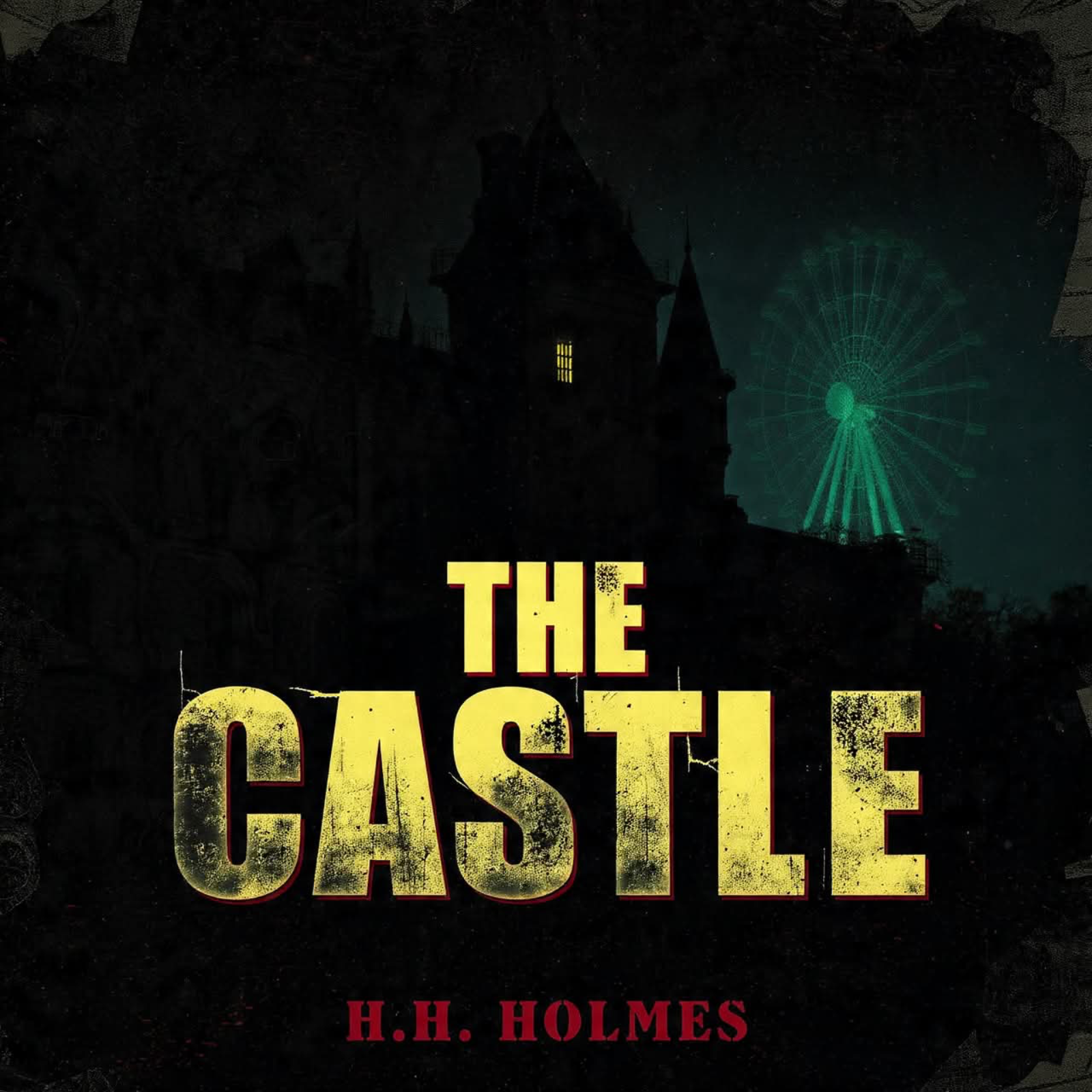
THE CASTLE: How H.H. Holmes Turned Murder Into Industry
The Story
In 1893 Chicago hosted the World's Fair. 27 million people came to see progress.
Across from the fairgrounds, Dr. H.H. Holmes opened a hotel.
It had gas chambers, acid vats, and chutes to the basement.
This is the story of how he turned murder into a business.
Herman Webster Mudgett pushed open the heavy laboratory doors at the University of Michigan in 1882 with a singular, quiet ambition that had nothing to do with healing. He was a medical student, but the lecture halls and surgical theaters weren't places of discovery for him. They were supply rooms. Within months of arriving in Ann Arbor, Herman discovered that the dead were far more profitable than the living. He began a ghoulish routine of stealing cadavers from the university's own labs, disfiguring the faces beyond recognition, and then planting them in staged accident scenes.
He would take out life insurance policies on non -existent people, present the mangled remains as the policy holder, and collect the payouts with a coolness that unnerved those few who caught a glimpse of his true nature. By the time he graduated in 1884, Herman had already refined a business model that would eventually define his legacy in Chicago. The conversion of human life into cold, hard cash. When he arrived in Chicago's Englewood neighborhood in 1886, he wasn't Herman Mudgett anymore. He was Dr. Henry Howard Holmes.
A name he reportedly chose as a nod to the era's most famous detective, Sherlock Holmes. He found work at a pharmacy on the corner of 63rd and Wallace Streets, owned by a woman named Elizabeth Holton. Within a year, Elizabeth's husband had died, and soon after, Elizabeth herself vanished. Holmes told concerned neighbors she had moved to California. A script he would use many times over the coming decade, he took over the pharmacy and purchased the vacant lot across the street, beginning a construction project that would baffle the locals for years.
He constantly hired and fired contractors, never letting a single crew see the building's full layout. If a carpenter asked why a staircase led directly into a brick wall, or why a room had no windows and five doors that only locked from the outside, they were dismissed. This disorienting labyrinth spanning an entire city block became known to the neighborhood simply as the Castle. As the 1893 World's Columbian Exposition began to rise in Jackson Park, just a few miles away, Holmes saw his greatest opportunity.
The White City, as the fair was called, was a shimmering testament to human progress, lit by the brand new magic of electricity and dominated by the massive rotating silhouette of the first Ferris wheel. Over 27 million people flooded into Chicago, many of them young women traveling alone for the first time, looking for work or adventure in the big city. Holmes opened the upper floors of his castle as the World's Fair Hotel. advertising low rates to lure these unsuspecting travelers. But the building was an architectural nightmare designed for one purpose.
The second floor was a maze of airtight rooms equipped with gas jets controlled from a panel in Holmes' private office. He could asphyxiate a guest in their sleep without ever leaving his desk. Beneath the floorboards, secret chutes led directly to the basement, where a dissecting table, acid vats, and a high -temperature kiln waited to erase any trace of his visitors. The mechanical nature of Holmes' crimes was chillingly efficient. He didn't just kill, he processed. In the dark of the basement, he would often use his medical training to strip the flesh from his victim's bones.
He wasn't just hiding evidence, he was creating inventory. Working with an associate named Charles Chappell, an articulator, Holmes would reassemble the bones into professional -grade medical skeletons. He then sold these articulated remains back to the very medical schools that had trained him, completing a grotesque cycle of profit. One of his confirmed victims, Emeline Sigrand, had been his personal stenographer. She disappeared in December 1892 after Holmes allegedly locked her in a massive, soundproof bank vault in his office.
When the police finally investigated years later, they found the imprint of a woman's footprint on the inside of the vault door, a permanent mark of her final, desperate struggle for air. But as the World's Fair ended and the crowds thinned, Holmes' debts began to catch up with him. He was a master of the long con, but the sheer volume of his frauds, ranging from stolen furniture hidden behind false walls to complex insurance scams, meant he was always one step ahead of a process server. In 1894, he fled Chicago, eventually landing in Philadelphia with his most loyal associate, Benjamin Pidazol.
Pizzle was a man who knew many of Holmes' secrets, but he believed he was a partner in a $10 ,000 life insurance fraud. The plan was for Pizzle to fake his own death in a laboratory explosion, using a cadaver provided by Holmes. But Holmes decided that a real body was simpler than a fake one. On September 2nd, 1894, at a house on Callow Hill Street. Holmes knocked Pittazel unconscious with chloroform and set him on fire. He then convinced Pittazel's widow, Carrie, that her husband was still alive and hiding in South America and persuaded her to let him take three of her children, Alice, Nellie, and Howard, to reunite them with their father.
The investigation that finally brought Holmes down wasn't triggered by the disappearances in Chicago. but by a tip from a disgruntled cellmate named Marion Hedgepeth. Hedgepeth had helped Holmes plan the Pizzle scam while they were briefly jailed together in St. Louis, but Holmes had never paid him his $500 finders fee. Infuriated, Hedgepeth told the authorities everything. The Pinkerton Detective Agency began a cross -country manhunt, tracking Holmes through Indianapolis, Detroit, and Toronto. Leading the charge was Philadelphia detective Frank Geyer, who followed a trail of shadows and lies to a rental house in Toronto.
In the cellar, Geyer discovered the remains of Alice and Nellie Pizzle buried in a shallow grave. In Indianapolis, he found a charred teeth and bone fragments of young Howard in the chimney of another cottage Holmes had rented. The image of the charming, well -dressed doctor was finally shattered, replaced by the reality of a predator who had systematically destroyed a family just to tie up loose ends. Holmes was arrested in Boston on November 17th, 1894, that while he sat in Moyamintzing Prison in Philadelphia awaiting trial, the Chicago police finally entered the castle in Englewood.
What they found was a house of horrors that defied logic. They navigated the false floors, the blind hallways, and the grease -slicked chutes. They found a room lined with iron plates to deaden sound and a vat of quicklime in the basement that still contained traces of human remains. The press, led by the sensationalist Hearst Newspapers, dubbed him the Beast of Chicago and the archfiend of the century, desperate for money and one last bit of fame. Holmes sold a confession to the Philadelphia Inquirer for $7 ,500, claiming to have murdered 27 people.
He wrote, with a characteristic mix of arrogance and delusion, I was born with the devil in me. I could not help the fact that I was a murderer. No more than the poet can help the inspiration to sing. On the morning of May 7th, 1896, H .H. Holmes was led to the gallows at Moya Mensing Prison. Even at the very end, his composure was unnerving. He was described as the coolest man in the room, chatting calmly with the guards and the priest. He denied the very murders he had confessed to only weeks before.
claiming he was the victim of a conspiracy. When the trap door finally swung open, the drop failed to break his neck. He hung there, twitching for 15 minutes before he was finally pronounced dead. But his last request was perhaps his most telling. Terrified that someone would do to him what he had done to so many others. Steal his body, strip his flesh and sell his bones. He demanded that his coffin be filled with cement and buried 10 feet deep in a double -layered grave. He wanted to ensure that while he had made a business of a dead, he would never become part of the inventory himself.
The castle didn't survive long after its creator. In August 1895, while Holmes was still in prison, the building was gutted by a mysterious fire. Some said it was the work of neighbors who wanted the stain of the murders erased. Others whispered that Holmes had associates who needed to destroy the evidence that still lay hidden within the walls. The structure remained a hollowed out shell until it was finally raised in 1938 to make way for a post office. Today, there is no plaque or monument at the corner of 63rd and Wallace to mark the site of the World's Fair Hotel.
The legacy of H .H. Holmes isn't found in a building, but in the chilling realization of what can happen when the anonymity of a growing city meets a mind capable of turning murder into an industry. He wasn't just a killer. He was a pioneer of a modern, bureaucratic kind of evil that hid in plain sight behind the shimmering lights of the White City. The next time you're walking through a crowded city, remember that the most dangerous people often look exactly like the ones trying to help you and pass this story along to anyone who enjoys a glimpse into the darker side of history.
And that's the way I heard it.
 Apple Podcasts
 Castbox
 Castro
 Goodpods
 Moon FM
 Overcast
 Pocket Casts
 Podbean
 Podcast Addict
 Podcast Republic
 Spotify