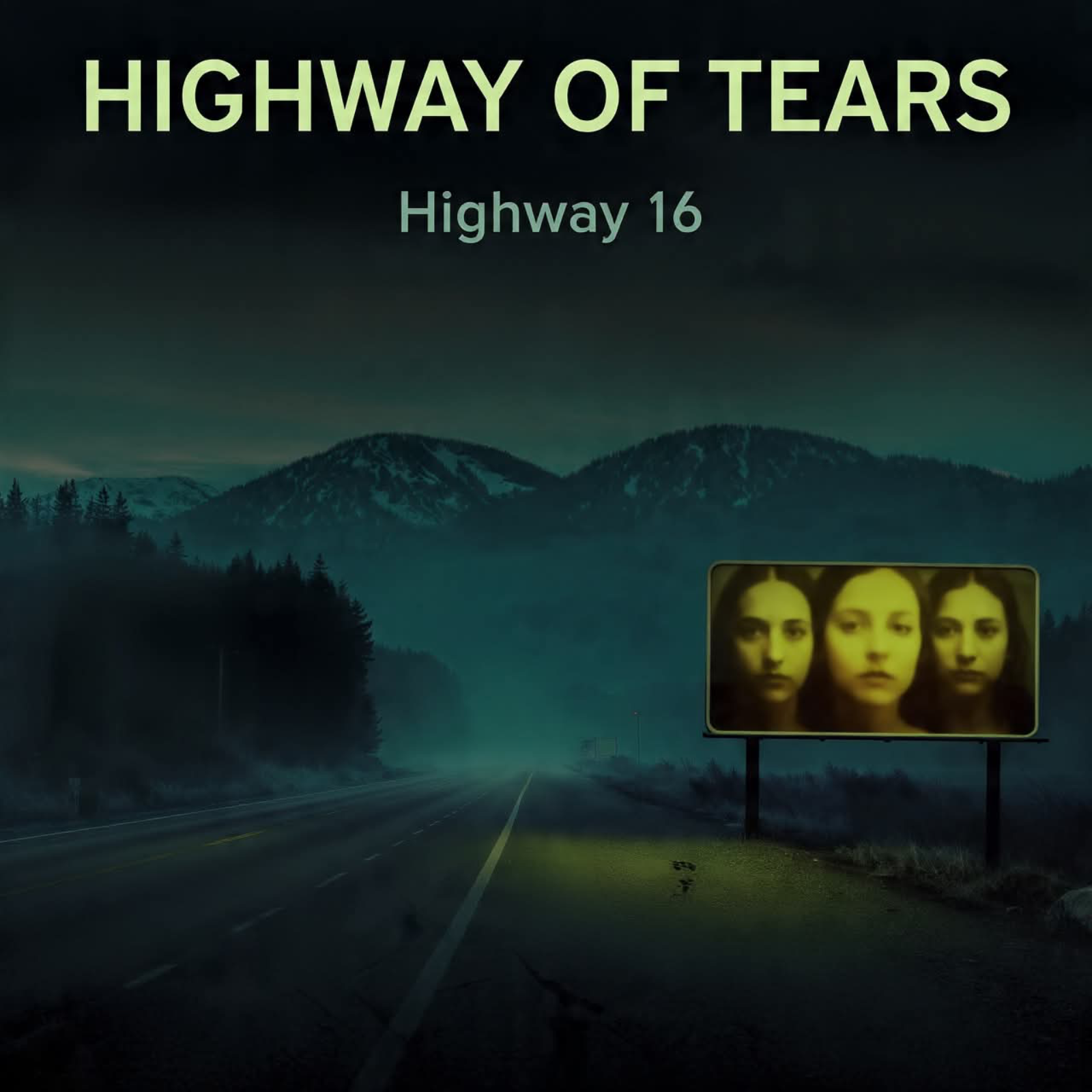
This is Highway 16. They call it the Highway of Tears.
The Story
June 11, 1994. Smithers, BC. 16-year-old Ramona Wilson left to meet friends and never came home. Highway 16 stretches 719km through northern BC. No buses. No cell service. For decades, women traveling this road disappeared. This is the story of Ramona, Alberta, and the mothers who refused to let them become statistics.
On June 11th, 1994, 16 -year -old Ramona Wilson vanished in the remote town of Smithers, British Columbia, leaving her mother, Matilda, waiting by a silent telephone as the darkness swallowed the edges of Highway 16. That ribbon of asphalt, winding through the dense pine forests and river valleys of the Canadian wilderness, would soon cement its reputation as the Highway of Tears. Ramona was the youngest of six children. She was a teenager who had just been hired as a peer counselor for the local community service center.
She was ecstatic about the job. She possessed a contagious laugh, a bright spirit, and an entire life mapped out ahead of her. On that Saturday, she planned to meet friends. But in Smithers and across the vast stretches of northern British Columbia, public transit was practically nonexistent. There were no buses running between the scattered towns and indigenous reserves to get anywhere. People walked along the gravel shoulders where they held out a thumb. Ramona stepped out into the June air and she never came home.
For 10 agonizing months, Matilda Wilson lived in a state of suspended animation. Every passing car on the highway outside town held a ghost. Every ring of the telephone brought a spike of adrenaline and a hollow drop in the stomach. The silence of the wilderness became a suffocating presence. Then, on April 9, 1995, the phone finally rang with the news no mother can ever prepare to hear. The local police were on the line. They needed Matilda to come down to the station to identify her daughter's belongings.
Ramona's remains have been found in a wooded area near Yelick Road. her body bearing the violent marks of assault and strangulation. The light of Matilda's life had been extinguished, leaving behind a void that no passage of time could fill. This stretch of Yellowhead Highway 16 spans 719 kilometers, roughly 450 miles, connecting Prince George and the interior to Prince Rupert on the rugged Pacific coast. It is a landscape of profound, isolating beauty. Towering evergreens stand like sentinels against a backdrop of snow -capped mountains.
Mist hangs low over the Skeena River. But beneath the canopy, there is an eerie quiet. Self -service dies out entirely for long stretches. The towns are small, separated by hours of driving through unforgiving terrain. For the indigenous communities that dot this route, the highway is a necessary artery for survival. a requirement for attending school, visiting family, or reaching a hospital. When the provincial government failed to provide adequate public transportation, young women were forced into a perilous mechanic of travel.
They stood by the side of the road, vulnerable to whoever offered an open car door. The Royal Canadian Mounted Police officially recognize 18 women who vanished or were murdered along this corridor between 1969 and 2006. The families, the local activists, and the indigenous communities who have lived this nightmare know the true number is much higher, climbing past 40, perhaps even 50. The discrepancy itself is a source of deep, festering conflict. Five years before Ramona Wilson disappeared, another family was fractured by the same highway.
In the summer of 1989, 24 -year -old Alberta Gale Williams was working at a fish cannery in the coastal town of Prince Rupert. Alberta was known for her kindness, a polite young woman who, according to her family, would not hurt a fly. August 25th was a Friday, her last day of work for the season. To celebrate, she went out to a local establishment called Popeye's Pub. Her sister, Claudia, was there that night. The air was thick with the late summer coastal dampness. Alberta was wearing a blue sweatshirt, black stretch pants, and slip -on shoes.
At some point in the early morning hours, Claudia turned her head away in a crowded, noisy environment. When she looked back, her sister was gone. Claudia searched. The family panicked. Three weeks later, a group of people scavenging for old railroad ties near the Taiye Overpass, about 37 kilometers east of Prince Rupert, stumbled upon a horrific sight. About 50 feet from the road, Alberta's naked body lay discarded in the brush. The physical trauma indicated she had been strangled and sexually assaulted.
The proximity of the body to the highway suggested she had been killed very close to where she was dumped. For Claudia, the loss was absolute. It was a devastation compounded by the realization that the killer was still out there, driving the same roads, breathing the same coastal air. The friction between the grieving families and the authorities tasked with finding answers became its own agonizing battleground. In the early years of these disappearances, families of missing indigenous women reported being dismissed.
When they tried to file missing persons reports, they were met with assumptions that their daughters, sisters, and mothers were simply runaways, or that their lifestyles made them disposable. This systemic apathy allowed predators to operate with impunity, utilizing the isolation of Highway 16 as a hunting ground. It was not until 2005 that the RCMP launched Project EPANA, a task force specifically dedicated to investigating the unsolved murders and disappearances along the Highway of Tears. Deep within the RCMP headquarters, investigators like Sergeant Wayne Clary were confronted with the physical weight of decades of tragedy.
They stood before more than 750 cardboard boxes filled with thousands of documents, field notes, and witness statements dating back to 1969. Every box represented a shattered family. But the passage of time is a cruel adversary in a murder investigation. Memories fade, evidence degrades. A field note from the Alberta Williams case indicated that bloody clothes resembling what Alberta wore the night she vanished were found near the Prince Rupert Ferry terminal shortly before her body was discovered.
Those clothes were seized, but because a body had not yet been found, the evidence was reportedly not treated with the urgency it demanded and the items were likely destroyed. That loss of evidence is a tangible wound for families desperate for justice. In the absence of swift justice, the families of the victims became the loudest voices demanding change, transforming their grief into a powerful force for advocacy. They refused to let their loved ones become mere statistics or cold cases gathering dust in an archive.
Matilda Wilson, despite her suffocating grief, became a fierce protector of her daughter's memory. In 1998, during a vigil in the town of Terrace, A community member named Florence Nasiel coined the phrase, Highway of Tears, a direct reflection of the families weeping for the women they had lost. The name stuck, forcing the rest of Canada to confront the geography of this violence. The legacy of these women is now etched into the very landscape of Highway 16. For years, yellow billboards loomed alongside the asphalt, warning young girls not to hitchhike.
The signs read, killer on the loose. It was a message of fear, a constant reminder of vulnerability. But the families recognized that this message placed the burden of safety entirely on the potential victims, rather than addressing the systemic failures or demanding accountability from the communities. They pushed for a new narrative. In a poignant ceremony in Prince George, a prototype for a new series of billboards was unveiled. Family members gathered under the broad sky, hugging each other and passing out tissues, their tears a testament to decades of shared sorrow.
These new billboards were designed to honor the missing and murdered, but also to reclaim the territory. They emphasize hope and the resilience of indigenous families, putting the onus on all travelers to keep the route safe. Julie Dom, an advocate working with the families, stood before the crowd and articulated the shift. They wanted to change the message from a place of despair to an acknowledgement that this beautiful territory is their home and that everyone deserves to be safe within it. Matilda Wilson draws strength from those new signs.
Decades after Ramona vanished, Matilda continues to walk sections of the highway. Her daughter Brenda walks with her. They trace the route from Lake Kathleen to Yelick Road, feeling the gravel under their feet, feeling the vastness of the northern air. They pray for concrete information, for the one missing piece of the puzzle that might finally bring a killer to justice. Matilda thinks of her little baby every day. The physical act of walking the highway is a refusal to be silenced, a demand that the world remember Ramona's laugh, her spirit, and the unjust truncation of her life.
The Highway of Tears remains a physical scar across British Columbia. a testament to the devastating consequences of systemic neglect and the vulnerability of marginalized women. But it is also a monument to the fierce, unyielding love of the mothers, sisters, and cousins who continue to search the tree lines, who continue to demand answers, and who refuse to let the darkness of that 719 kilometer stretch extinguish the memories of the women they lost. Send this episode to someone you trust. So these stories travel further.
And that's the way I heard it.
 Apple Podcasts
 Castbox
 Castro
 Goodpods
 Moon FM
 Overcast
 Pocket Casts
 Podbean
 Podcast Addict
 Podcast Republic
 Spotify