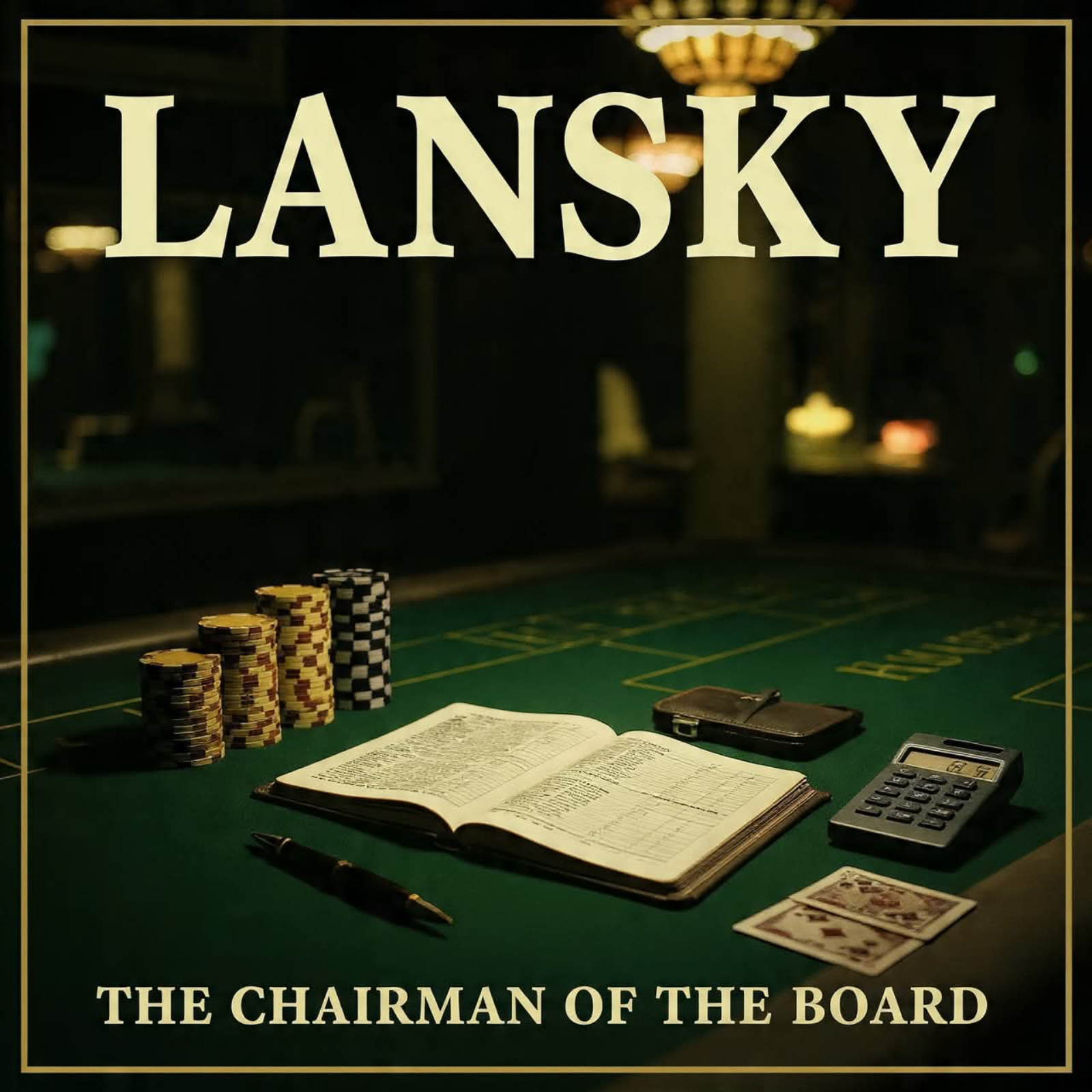
THE CORPORATION: LANSKY - The Chairman of the Board
The Story
He said the Mob was bigger than U.S. Steel.
He was right.
Meyer Lansky didn't carry a gun.
He carried a calculator.
From the Lower East Side to Swiss banks to the casinos of Havana,
this is the story of the man who made organized crime into a corporation.
And then watched it all disappear.
Meyer Lansky once boasted that the criminal organization he helped build was literally bigger than US Steel, a claim that seems like hyperbole until you look at the sophisticated financial architecture he pioneered. He wasn't just a bootlegger. He was the person who effectively invented modern money laundering, using the 1934 Swiss Banking Act to hide illicit cash in numbered accounts. We are talking about a man who transitioned from the violent streets of New York's Lower East Side to becoming the chairman of the board for a multi -ethnic crime syndicate.
How did a boy who arrived at Ellis Island with almost nothing end up managing the finances of the entire American underworld? It really comes down to the fact that Lansky was a mathematical prodigy born into a world of chaos. He was born Meyer Suchel Lansky in 1902 in what's now Belarus. But his family fled to New York in 1911 to escape the anti -Semitic pogroms. That early exposure to collective trauma and hypervigilance essentially became his survival mechanism. By the time he was a teenager, he wasn't just playing craps in the street.
He was analyzing the odds. He understood the math of the game better than the people running it. That's actually how he met Lucky Luciano. The story goes that Luciano tried to shake him down for protection money and Lansky despite being quite small, just refused to pay. Luciano was so impressed by his defiance and his sharp mind that they formed a partnership that would last for decades. It was a revolutionary alliance because it bridged the gap between the Jewish and Italian mobs, moving away from ethnic gang wars and toward a corporate model of crime.
It's interesting you mention that move toward a corporate model. We often think of the mob in terms of the godfather or street -level violence, but Lansky seemed to view it as a logistics and finance problem. During Prohibition, he and Bugsy Siegel formed the Bugs and Meyer Mob, which was known for being incredibly efficient and violent. But even then, Lansky was looking past the trucks of illegal whiskey. He was focused on how to make that cash clean and how to invest it so it would grow. If Luciano was the public face and the muscle, Lansky was the one looking at the spreadsheets, wasn't he?
Exactly. He was the mob's accountant. But that title really understates his role. He was the chief strategist. When the conviction of Al Capone for tax evasion sent shockwave through the underworld in 1931, Lansky was the one who realized that the biggest threat to their survival wasn't a rival gang. It was the Internal Revenue Service. He set out to find a way to make their money untraceable. By 1932, he was already shifting funds from illegal gambling in New Orleans into Swiss accounts. When the Swiss passed their secrecy act in 1934, Lansky saw it as a gift.
He eventually bought his own bank in Switzerland to facilitate loan -back schemes. The idea was simple, but brilliant. You deposit your dirty cash in a Swiss account, and then that same bank gives you a loan to buy a legitimate business in the US suddenly. You have a legal source of wealth. and you're even getting a tax deduction on the interest payments for the loan. He was decades ahead of federal investigators in understanding how to exploit international banking loopholes. That innovation basically built the foundations of modern tax havens.
But he didn't just stay in New York or Switzerland. He looked south to Cuba. There's this image of Havana in the 1940s and 50s as a mob playground, and Lansky was the one who orchestrated that. He wasn't just running a few casinos. He had a deep, almost symbiotic relationship with the Cuban dictator, Fulgencio Batista. It seems like Lansky saw Cuba as the perfect open city where the mob could operate without the constant heat of the FBI. Cuba was his masterpiece. He convinced the National Crime Syndicate to invest heavily in Havana because it was a legal gambling environment, just a short flight from Miami.
At the 1946 Havana conference, held at the Hotel Nacional, he basically presented a business plan to the top mobsters from across the US. He wasn't just selling them on casinos, he was selling them on an integrated tourism and gambling empire. He oversaw the construction of the Habana Riviera, which was incredibly lavish, costing somewhere between $14 million and $18 million at the time. And he wasn't just a silent partner. He was appointed as Cuba's gambling czar by Batista. He ensured that the games were honest, not out of morality, but because he knew that if people trusted the games, they would spend more money.
The house edge was all they needed to get rich, as long as the volume was high that IT was a gold mine until the 1959 revolution.
That's the great irony of his career. He was so meticulous, so focused on hedging every risk. But he couldn't account for a political revolution. When Fidel Castro took over and nationalized the casinos, Lansky reportedly lost everything he had invested there. He later said he crapped out, which is a rare admission of failure for him. But even after losing Cuba, he didn't just disappear. He shifted focus to the Bahamas and even London. It's almost as if he was constantly looking for the next frontier where the law hadn't caught up to the technology of finance.
That adaptability is a huge part of his legacy. But we also have a talk about the dimension of his life that doesn't fit the gangster mold, his role during World War II. It's one of the most fascinating strange bedfellows stories in history. In 1942, after the SS Normandy caught fire in New York Harbor, the Office of Naval Intelligence was terrified of Nazi sabotage on the docks. They knew the government didn't control the waterfront. The mob did as they approached Lansky to act as an intermediary for Operation Underworld.
Lansky, being a fiercely proud Jew, didn't need much convincing to fight Nazis. He had already been organizing Jewish mobsters to break up German -American Bund rallies in Yorkville, literally throwing Nazis out of windows and chasing them with lead pipes. He helped broker the deal where Luciano, who was in prison at the time, would ensure there were no strikes or sabotage on the docks. The mob even provided intelligence for the Allied invasion of Sicily, using their local connections to map out the coastlines.
It's a bizarre paradox. A man whose entire career was dedicated to subverting the laws of the United States was simultaneously instrumental in protecting its borders during the war. And yet, after the war, The government didn't exactly say thank you. The 1950s and 60s saw a massive crackdown on organized crime. Robert Kennedy and the Kefauver committee were breathing down his neck. Despite decades of investigation by the FBI, they could never really pin anything major on him. He was famously convicted only once of illegal gambling and served just two months in jail.
How did he stay so clean? while everyone around him was being indicted or killed. It was his obsession with structure and secrecy. He didn't keep papers. He kept the entire financial map of the syndicate in his head. He also lived a remarkably modest life, which stood in stark contrast to the flashy, neon lifestyles of guys like Bugsy Siegel or Frank Costello. He lived in a modest apartment in Miami, walked his dog, and never displayed the kind of wealthy FBI attributed to him. In 1970, when the heat finally got too high, he tried to flee to Israel under the law of return.
He wanted to retire there and be buried near his grandfather on the Mount of Olives. But the U .S. government pressured Israel and they eventually denied him citizenship, claiming his criminal record made him a danger to public welfare. He was deported back to the U .S., but even then, the government's case fell apart. He was acquitted of tax evasion in 1974, partly because the testimony against him was so unreliable and partly because he was in failing health. There's a lot of debate about just how much money he actually had at the end.
The FBI estimated his net worth at $300 million to $400 million, which would be billions today. But when he died of lung cancer in 1983, His estate was valued at just $57 ,000. His granddaughter later said he left behind almost nothing. This leads to the two main theories. Either he was the ultimate financial wizard who hid his fortune so deeply that even his family couldn't find it, or the FBI's estimates were a total myth, fueled by his own bigger -than -U .S. steel boast. Which one do you think is closer to the truth?
It's likely a mix of both. The Cuban revolution definitely wiped out a massive chunk of his liquid assets. But it's also true that his wealth was never held in his own name. IT was tied up in layered trusts, shell companies, and offshore partnerships. For someone like Lansky, money wasn't just for spending. It was for power and insurance. If he did have hundreds of millions, he wouldn't have left a map to it in his will. He was a master of the loan back and the skimming operations in Las Vegas. where millions of dollars were literally taken off the top of the counting rooms before being recorded.
That kind of money just disappears into the system. Even his role in the murder of Bugsy Siegel in 1947 shows his cold, analytical approach. Siegel was skimming from the skimmers of the Flamingo Hotel, and despite their lifelong friendship, Lansky reportedly gave the green light for the hit because Siegel had become a bad investment. He sublimated all his personal feelings into the needs of the organization. That coldness, that ability to treat people like numbers on a ledger, is what made him so effective and so terrifying that he basically provided the intellectual capital for the mafia to survive into the modern age.
Before Lansky, they were just gangs. After Lansky, they were a global business enterprise. He was the inspiration for the Hyman Roth character in The Godfather Part II, And that famous line about being bigger than U .S. steel is the perfect summary of his ambition. He didn't want to be a king. He wanted to be the architect of the kingdom. And he succeeded in a way few others did. Most of his contemporaries died in prison or in a hail of bullets. Lansky died in his bed at the age of 80 in Miami Beach, but he was never broken by the legal system, even if his empire was eventually dismantled by political changes he couldn't control.
His legacy isn't just in the history of crime, it's in the very structure of the global financial system. The techniques he used to hide mob money, the offshore accounts, the layered companies, the exploitation of banking secrecy are the same tools used by white -collar criminals and tax evaders today. He was a pioneer of the shadow economy. It makes you wonder if we're even looking in the right places when we talk about organized crime today. We focus on the violence, but the real power is in the math.
Lansky proved that if you can control the money, you can control the world, or at least a very significant and dark corner of it. It's a sobering thought that the most successful gangster in history wasn't a hitman, but a man with a calculator. If this deep dive into the chairman of the board shifted your perspective on history, consider sharing it with someone who loves a complex character study. And that's the way I heard it.
 Apple Podcasts
 Castbox
 Castro
 Goodpods
 Moon FM
 Overcast
 Pocket Casts
 Podbean
 Podcast Addict
 Podcast Republic
 Spotify