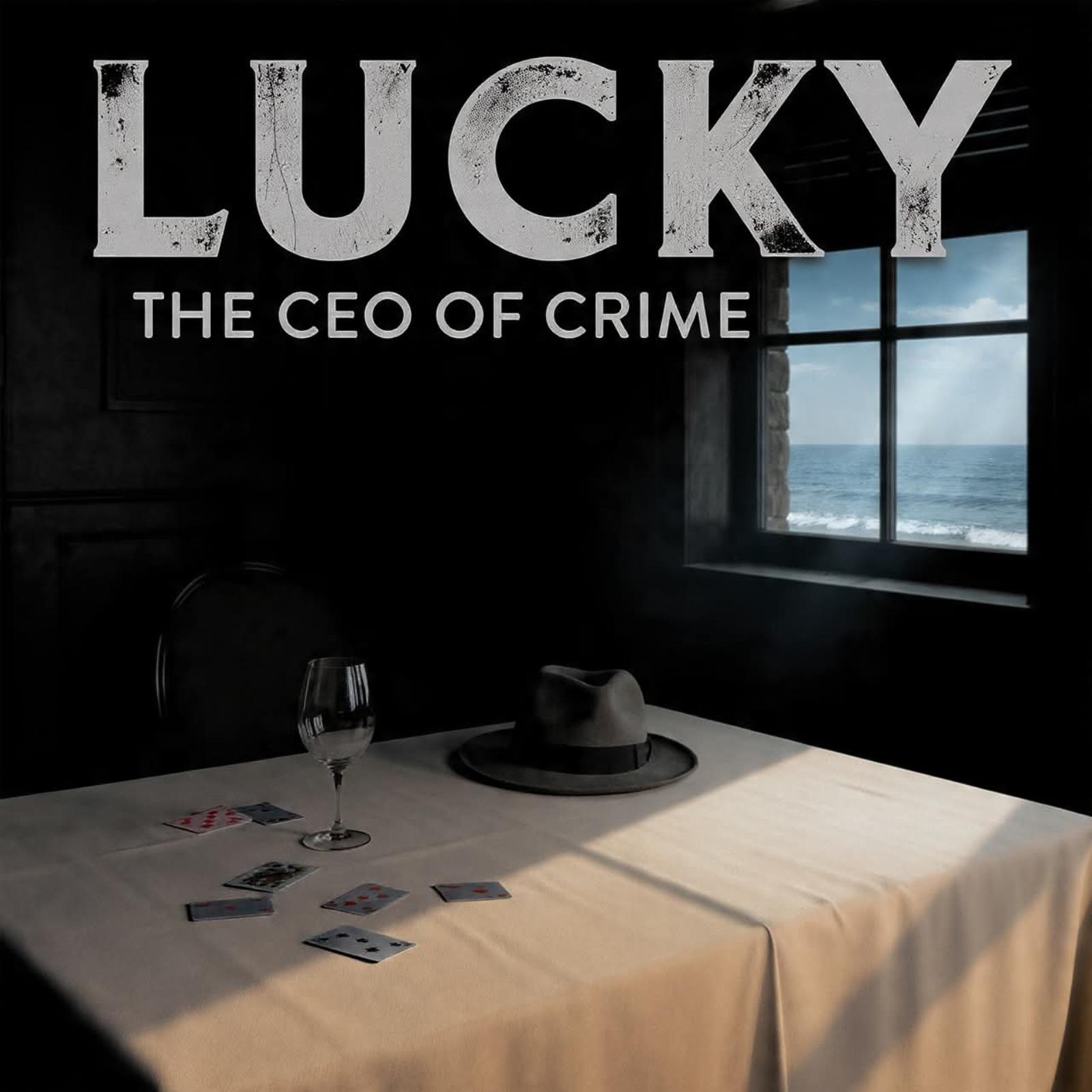
THE CORPORATION-LUCKY Luciano: The Man Who Became The CEO of Crime
The Story
April 15, 1931. Coney Island.
Joe "The Boss" Masseria was eating lobster when 4 men walked in.
By the time Lucky Luciano walked out of the bathroom, the Mafia had a new CEO.
He didn't want to be king.
He wanted a board of directors.
This is Lucky Luciano. The man who turned street gangs into a corporation.
Joe Messuria was halfway through a hand of Scopa when the bathroom door clicked shut behind his top lieutenant, Charles Luciano. It was April 15th, 1931, at the Nuova Villa Tomorrow restaurant on Coney Island. And for a moment, the only sound in the dining room was the clink of silverware and the ocean breeze rattling the window panes. Messuria, the man they called Joe the Boss, had just finished a heavy lunch of lobster and pasta. He felt secure. He was the undisputed king of the New York underworld, or so he thought.
But as Luciano washed his hands in the back for men, Vito Genovese, Albert Anastasia, Bugsy Siegel, and Joe Adonis stepped through the front door. They didn't say a word. They just opened fire. Messurio was hit five times in the back. His body slumped over the table, still clutching the ace of diamonds. By the time Luciano walked back into the room, his boss was dead. The shooters were gone, and the entire structure of the American mafia had just been decapitated. Within 24 hours, the man the world would soon know as Lucky Luciano would begin a transformation of organized crime that turned a collection of warring street gangs into a multi -billion dollar corporate syndicate that would outlast every man in that room.
The path to that blood -stained tablecloth began years earlier in the sulfur mines of Lurcra Fritti, Sicily. where Salvatore Lucania was born in 1897. His family arrived at Ellis Island when he was 10, settling into the crushing poverty of Manhattan's Lower East Side. Salvatore didn't stay in school long. By 14, he was running a protection racket, charging other kids a penny a day to ensure they weren't bullied on the way to class. It was here he met a skinny Jewish kid named Meyer Lansky. Lansky refused to pay.
Instead of fighting, Luciano saw something in him. a cold, analytical brain that matched his own ambition. They became lifelong partners, a partnership that defied the old world rule that Italians only worked with Italians. Luciano was a child of the New World, and he realized early on that the traditional Sicilian way of doing business, built on feudal loyalty and ancient blood feuds, was a recipe for bankruptcy. While the older generation of mobsters, The Mustache Peets spent their profits on flamboyant funerals for their rivals.
Luciano was looking at the balance sheets of legitimate corporations like U .S. Steel. By the late 1920s, the New York underworld was being torn apart by the Castelmaris War, a brutal power struggle between Joe Massuria and a rival named Salvatore Maranzano. For two years, bodies had been piling up across the five boroughs. and for Luciano, it was an intolerable waste of resources. He was serving as Missouri's top aide, but he watched as the war drained their bootlegging profits and brought unnecessary heat from the police.
In 1929, Luciano was kidnapped, beaten, stabbed with an ice pick, and left for dead on a Staten Island beach with his throat slit from year to year. He survived, earning the nickname Lucky and a permanent droopy eye, but the experience solidified a conviction. the old guard had to go. He didn't just want to survive the war, he wanted to end it on his own terms. He reached out to Maranzano in secret, offering to deliver Massuria's head in exchange for peace and a top spot in the new order. The hit at Nuova Villa tomorrow was the fulfillment of that dark bargain.
With Massuria gone, Maranzano took the throne. He organized a massive banquet for 500 mobsters at a hall in the Bronx. and declared himself capo di tutti cappi, the boss of all bosses. He divided New York into five families, appointing Luciano to lead the largest of them, the group that would eventually become the Genovese family. But Maranzano was a man obsessed with Julius Caesar and the Roman Empire. He wanted tribute. He wanted absolute dictatorial control. Luciano, watching from the sidelines, realized he had simply traded one mustache Pete for another.
Maranzano began to grow suspicious of his young lieutenant's influence and hired a professional hitman, Vincent Mad Dog Call, to eliminate him. But Luciano was faster. On September 10, 1931, four men posing as IRS agents entered Maranzano's ninth floor office in a Helmsley building on Park Avenue. They pushed past his bodyguards, stabbed Maranzano, and then finished him with several gunshots. As they fled down the stairs, they passed mad dog call, who was literally on his way up to the office for his final briefing on how to kill Luciano.
Now, at 33 years old, Lucky Luciano was the most powerful criminal in America. He could have easily declared himself the next boss of all bosses, but he did something much more radical. He abolished the title entirely. He knew that a king is just a target. Instead, He proposed a structure based on the corporate boards he had studied. He called a meeting at the Blackstone Hotel in Chicago, gathering the heads of the most powerful crime families from across the country. In the hotel's crystal ballroom, under the ornate chandeliers, he laid out his vision for the commission.
It would be a seven -man board of directors designed to mediate disputes, set territories, and approve major hits, ensuring that no single man could ever again plunge the underworld into a total war. The initial seats were held by the heads of the five families of New York, Luciano himself, Vincent Mangano, Tommy Gagliano, Joseph Bonanno, and Joe Proficy, along with Al Capone from Chicago and Stefano Megadeno from Buffalo. This wasn't just about settling scores. It was about efficiency. Luciano's commission acted as a supreme court for crime.
If a family wanted to expand into a new territory or kill a high -ranking member, they had to bring the case to the board. He also formalized the internal hierarchy that still defines the Mafia today. The boss, the underboss, the consuliera, the capos, and the soldiers, TO ensure the board's orders were carried out without the messiness of personal vendettas. Luciano and Lansky helped create a separate enforcement arm known as Murder, Inc. It was a pool of professional contract killers, mostly from the Brooklyn docks, who were on call to handle hits sanctioned by the commission.
By separating the business of money making from the business of killing, Luciano stabilized the underworld. He turned the mafia into a national crime syndicate that operated with the cold precision of a multinational bank. Luciano's reign at the top was lived in the height of luxury, but he moved into sweet 39C at the Waldorf Astoria Towers, living under the name Charles Ross and paying his $800 monthly rent and $100 bills. He wore silk suits, dated showgirls like Gay Orlova, and was a regular fixture in the city's most exclusive nightclubs.
He was the CEO of an empire that controlled everything from the New York waterfront and the Garment District to illegal gambling and narcotics. But his high -profile lifestyle was his undoing. A young, ambitious prosecutor named Thomas Dewey made it his mission to bring Luciano down. In 1936, after a massive investigation into a prostitution ring that Luciano allegedly oversaw, Dewey secured conviction. Luciano was sentenced to 30 to 50 years in a frigid Clinton prison in Danimora. known as Little Siberia.
It seemed the architect of the modern mafia would spend the rest of his life in a cell.
History, however, has a way of turning the most unlikely people into allies. When World War II broke out and the US Navy feared German sabotage on the New York docks, they realized they didn't control the waterfront. The mob did. Through his attorney and Meyer Lansky, Luciano reached a deal with the government. from his prison cell. He ordered the longshoremen to cooperate with naval intelligence, ensuring no strikes or sabotage occurred during the war effort. Some accounts even suggest he provided key contacts for the Allied invasion of Sicily in 1943.
In 1946, as a reward for his wartime service, Thomas Dewey, now the governor of New York, commuted Luciano's sentence on the condition that he be deported to Italy and never returned to the United States. Luciano spent his final years in Naples, still influential, still a legend, but forever exiled from the city he had rebuilt in his own image. Luciano died of a heart attack at the Naples airport in 1962, just as he was arriving to meet with a film producer about his life story. He had outlived his enemies and seen his corporate model of organized crime succeed beyond his wildest dreams.
He was the man who realized that blood is bad for business and that true power doesn't come from being a king, but from being the man who owns the system. He took a centuries old tradition of vendettas and turned it into a modern machine, a legacy that still echoes through every boardroom and backroom in the world of crime. If you found this look into the rise of the commission compelling, please share this episode with a friend. And that's the way I heard it.
 Apple Podcasts
 Castbox
 Castro
 Goodpods
 Moon FM
 Overcast
 Pocket Casts
 Podbean
 Podcast Addict
 Podcast Republic
 Spotify