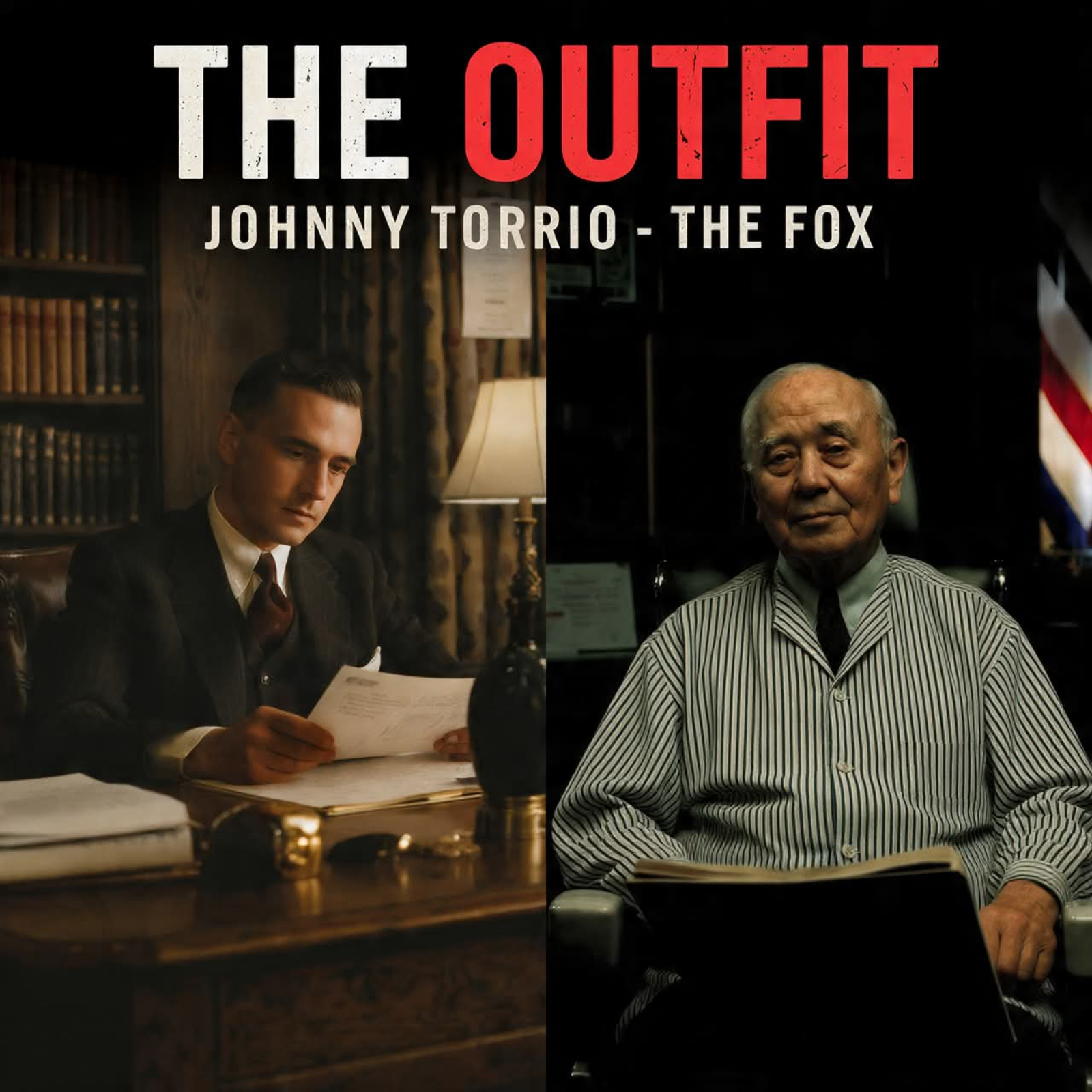
THE FOX: How Johnny Torrio Built The Chicago Outfit
The Story
Al Capone was just the face.
The brain was Johnny Torrio.
He taught Capone everything.
How to dress. How to bribe. How to kill.
He turned Chicago's gangs into a corporation.
Territories. Profits. No wars.
He survived 5 bullets in 1925.
Then he did what no mob boss ever did:
He quit.
This is Johnny "The Fox" Torrio.
The architect of the Chicago Outfit.
January 24th, 1925. Five bullets. Groceries in his hands. Bugs more in, puts a gun to his head, and pulls the trigger. Click. Empty. Johnny Torrio lived. And three months later, he did the impossible. He quit. Handed a $100 million dollar empire to Al Capone. And took a train to New York. Now let's see how he got there. Johnny Torrio was a man who preferred the balance sheet to the Tommy Gun, yet he's the primary reason Chicago became the blood -soaked capital of the Prohibition era. He was the one who taught Al Capone how to dress, how to negotiate, and how to kill with clinical efficiency.
Most people remember Capone as the face of the American mob, but he was essentially an apprentice to Torrio, a man so calculating and elusive he earned the nickname the Fox. It is a profound irony that the architect of a sprawling criminal empire, a man who survived being riddled with bullets by his rivals, eventually passed away not in a hail of gunfire, but quietly while sitting in a barber's chair waiting for a haircut. It is that quiet and that really underscores how different Torrio was from the gangsters who came after him.
He was born in southern Italy in 1882, but his story truly begins in the slums of Manhattan's Lower East Side. After his father died in a work accident when Johnny was just two, his mother moved the family to New York. He grew up working in his stepfather's grocery store, which was actually a front for a drinking den. While other kids were playing in the streets, Torrio was learning the mechanics of illegal commerce. By his teens, he was already leading the James Street Gang. He wasn't the biggest kid on the block, but he was undoubtedly the smartest.
He had this cold, calculated manner that led his peers to call him Terrible Johnny, even back then. That nickname is interesting because it stands in such stark contrast to his later reputation as a diplomatic elder statesman. How did he make the jump from leading a group of street toughs to becoming a lieutenant in the infamous Five Points Gang? He caught the eye of Paul Kelly, whose real name was Paolo Vaccarelli. Kelly was a sophisticated racketeer who ran the Five Points Gang and understood that if you wanted to stay in power, you had to look and act like a businessman.
Kelly became Torrio's first real mentor, teaching him to avoid swearing, to dress in professional suits, and to treat crime as an enterprise rather than a street brawl. Torrio took those lessons to heart. By 1905, he had merged his James Street group into Kelly's organization and eventually became his right -hand man. This was also when he first met a young, hot -headed kid named Al Capone. Torrio saw something in Capone, a mix of raw muscle and untapped ambition, and took him under his wing as an enforcer.
So the mentorship that defined Chicago's history actually started on the docks of Brooklyn. But Torrio didn't stay in New York. He moved to Chicago in 1909, and the reason is often cited as a family connection. Was he actually related to the man he would eventually betray, Big Jim Colossimo? The family tree is a bit murky, but most historical records, including those cited by the Mob Museum, suggest he was the nephew of Victoria Maresco, who was Big Jim Colossimo's wife. Colossimo was the vice lord of Chicago at the time.
running a massive empire of brothels and gambling dens. He was being squeezed by the Black Hand, a group of extortionists who were threatening to kill him if he didn't pay up. Colossimo reached out to New York for help, and Torrio was the one who answered the call. He didn't just come to provide protection, he came to solve the problem permanently. Shortly after he arrived, a group of Black Hand extortionists were lured to a meeting and gunned down. Torrio proved his worth immediately, and Colossimo made him his top lieutenant.
It seems like a classic story of a young protege arriving to modernize the old boss's operation. Colossimo was a flamboyant figure, known as Diamond Jim for his love of flashy jewelry, while Torrio was the back office manager. But then 1920 happened. The year prohibition became the law of the land. That seems to be the moment where the relationship between the two men truly clashed. Prohibition was the ultimate business opportunity for someone with Torio's foresight. He saw that the illegal sale of alcohol could generate millions, far eclipsing the profits from prostitution and gambling.
But Colossimo was old school. He was content with his brothels and his popular restaurant, Colossimo's Cafe, that he was also distracted. He had recently divorced Torio's aunt, Victoria, to marry a younger singer named Dale Winter. This was a double insult to Torio. First, Colossimo was refusing to enter the most lucrative market in history, and second, he had humiliated Torio's family by casting aside the woman who helped build his empire. According to many historians, Torio decided that his mentor was no longer a leader, but an obstacle.
The betrayal that followed was incredibly clinical. Colossimo was murdered in his own restaurant in May 1920, just as the riches of Prohibition were starting to flow. Torrio was never convicted, but it is widely accepted that he orchestrated the hit. This is where Torrio really earns his reputation as the brain. He didn't want a bloody war. He wanted a monopoly. He actually tried to negotiate peace treaties with the various ethnic gangs in Chicago, didn't he? He wanted everyone to share the profits rather than fight over the streets.
He was the first to propose the idea of territorial boundaries. He told the other gang leaders that there was enough money for everyone if they just stopped shooting each other. He divided the city into sectors, giving the north side to Dean O 'Banion's gang while he and Capone took the south side. For a few years, it actually worked. The profits were astronomical. During this period, Torrio brought Capone out from New York to serve as his right -hand man. He was grooming Capone to be a leader, teaching him the finer points of political corruption and how to buy off the police and city officials.
Capone later said that everything he knew about the business, he learned from Johnny. But the peace was fragile. The conflict with Dean O 'Banion eventually shattered Torio's dream of a peaceful criminal syndicate. O 'Banion wasn't like Torio. He was erratic and enjoyed taunting his rivals. The tension reached a breaking point over a brewery raid, which seems like a scene straight out of a movie. It was a classic double -cross. O 'Banion told Torio he wanted to retire and offered to sell him his share of the Zeban Brewery for half a million dollars.
Torrio agreed, but on the day of the transfer, the police raided the brewery. Obanion had known the raid was coming and set Torrio up to get arrested. That was the end of the diplomacy. In November 1924, just after the death of a powerful political ally who had kept the peace, Torrio sent three gunmen to Obanion's flower shop. They shot him dead while he was clipping chrysanthemums for a funeral. That hit sparked a brutal five -year gang war that Torrio hadn't wanted. But he was now right in the middle of it.
And that war almost ended Torio's life long before the barber chair. In January 1925, the North Side gang, now led by Hemi Weiss and Bugs Moran, came looking for revenge. They didn't just want to kill him. They wanted to humiliate him. They ambushed him outside his apartment while he was returning from a shopping trip with his wife, Anna, that he was carrying bags of groceries when they opened fire. Torrio was hit in the jaw, lungs, groin, and legs. As he lay bleeding on the sidewalk, one of the gunmen, likely Bugs Moran, walked up to him and put a pistol to his temple for the final shot.
But the gun clicked. It had jammed or run out of ammo. The sirens were getting closer, so the assassins fled, leaving Torrio for dead. He spent weeks in the hospital, and Al Capone famously sat outside his room with a submachine gun to make sure no one finished the job. That experience seems to have changed him fundamentally. Most mob bosses would have come out of that hospital looking for blood, but Torrio did something completely unexpected. He walked away. It is one of the most unique moments in organized crime history.
When he recovered, He was sentenced to nine months in jail for the brewery -rate O 'Banion had set him up for. While he was in his cell, he called Capone to a meeting and told him, it's all yours, Al. He handed over an empire worth tens of millions of dollars at the age of 43. He took his wife and his mother back to Italy and ostensibly retired. He realized that the world of the street -level gangster was becoming too chaotic for his temperament. He was a man of systems. and the system was breaking down into raw violence.
However, his retirement wasn't quite the end of his influence. He eventually returned to the United States because of the pressure Mussolini was putting on the mafia in Italy. When he came back to New York in the late 1920s, he didn't try to take back his throne. Instead, he became a sort of consultant for the next generation of mobsters like Lucky Luciano. He was the visionary behind the National Crime Syndicate He convinced Luciano and the other bosses that they needed a board of directors The commission to settle disputes without resorting to open warfare He wanted to take the Chicago model of territorial divisions and apply it to the whole country Even though he wasn't running a family his advice was so respected that he was often called the brain by the newer generation He was an elder statesman in a world where most men didn't live past 30 He lived quietly in Brooklyn, invested in real estate, and generally stayed out of the headlines, though he did serve a two -year stint in prison for tax evasion in the late 1930s.
It is fascinating that the man who created Al Capone lived to see Capone's own downfall, his imprisonment, and his eventual death from syphilis. Torrio outlived almost all his contemporaries. How did the public finally learn that the legendary Fox was gone? In a way that perfectly fit his life, they didn't learn for weeks. On April 16th, 1957, Torrio was sitting in a barber's chair in Brooklyn. He suffered a massive heart attack and died a few hours later in a hospital. But he was living under such a low profile that the newspapers didn't even realize he had died until three weeks after he was buried.
There were no flashy headlines, no massacres, just a quiet interment in a family mausoleum. He proved that it was possible to be the most powerful man in the underworld and still die a natural death, provided you knew when to walk away. His legacy is often overshadowed by Capone's flamboyance, but without Torrio, there is no Chicago outfit and arguably no modern American mafia. He provided the intellectual framework for organized crime to function as a business. He was the one who realized that the greatest threat to a criminal's profit isn't the law but other criminals.
By trying to replace violence with a corporate structure, he changed the nature of the American underworld forever. It is a legacy of strategic betrayal and organizational genius that still defines how we think about the mob today. Every mob boss in America was taken out by a bullet, a courtroom, or betrayal. five times outside his own front door. The kill shot misfired. Torrio survived, handed Chicago to Capone, and caught a train to New York without looking back. He died in 1957 in a Brooklyn barber's chair.
75 years old. Natural causes. Still a free man. No other boss in American mafia history pulled that off. Drop the name of another mobster who knew when to quit. The contrast between his violent rise and his suburban end is really the most telling part of his character. He was always calculating the odds, and in the end, he calculated that a quiet life was worth more than a crown of thorns in Chicago. He remains a shadow figure, the man who stood behind a throne and taught the king how to rule, only to step back into the dark when the light became too hot.
It's a reminder that often the most influential people in history are the ones we hear about the least. Johnny Torio's life is a case study in how quiet power could be far more enduring than the loudest gunfire. If this deep dive into the architect of the Chicago outfit sparked your interest, consider sharing this episode with someone who enjoys the hidden history of the American underworld. And that's the way I heard it.
 Apple Podcasts
 Castbox
 Castro
 Goodpods
 Moon FM
 Overcast
 Pocket Casts
 Podbean
 Podcast Addict
 Podcast Republic
 Spotify