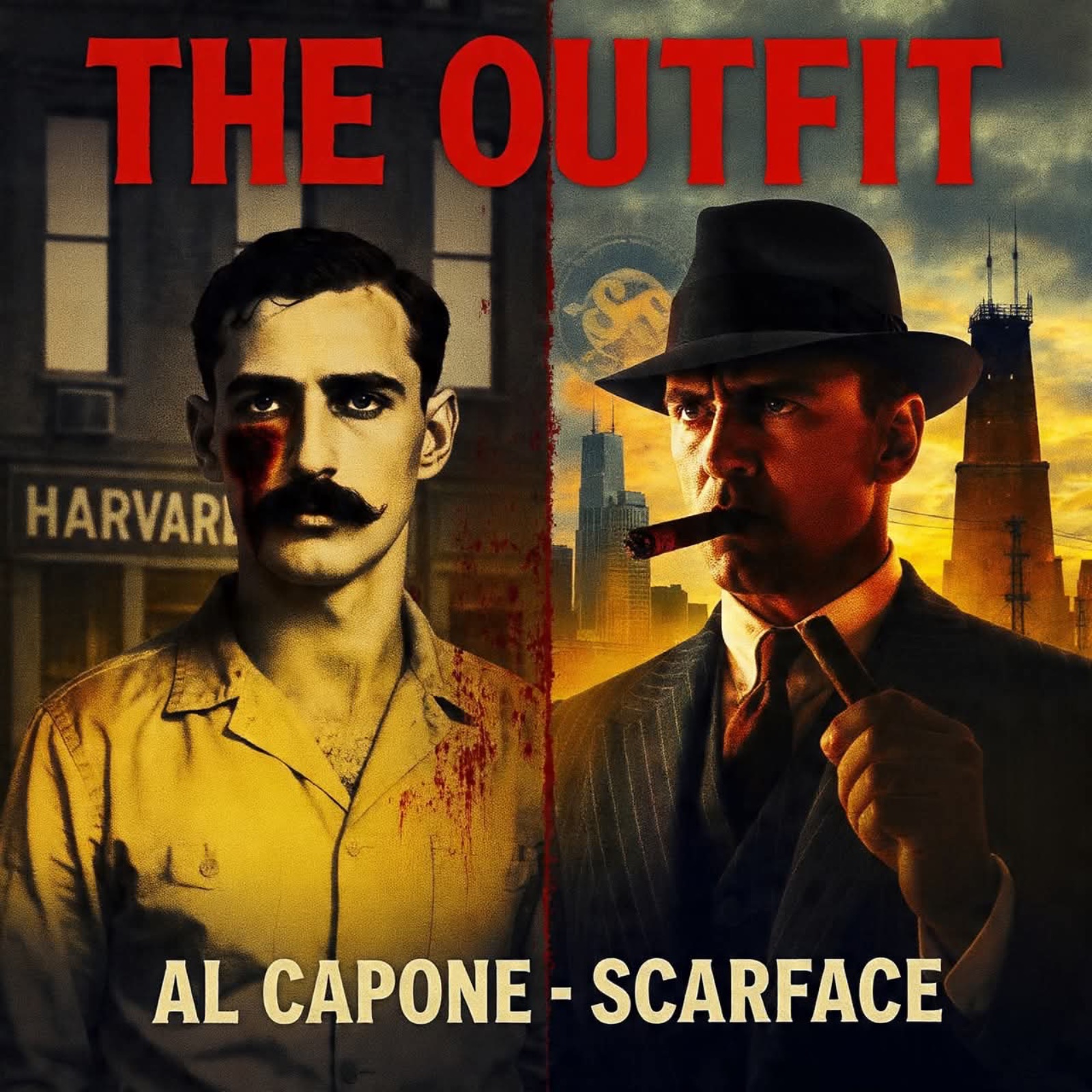
THE OUTFIT: AL CAPONE - From Brooklyn to Chicago
The Story
Everyone knows Scarface.
Almost no one knows he was connected to Ontario.
Born in Brooklyn. Made in Chicago.
Al Capone built the most powerful criminal empire in America.
But his liquor network ran through Canada.
Guelph. "Little Chicago". The Sleeman Brewery.
This is the story of the scars, the massacre, the soup kitchens,
and the tax accountants who finally brought him down.
From the Harvard Inn to Alcatraz.
This is Al Capone.
February 14th, 1929 at 1030 a .m. 2122 North Clark Street. Two men in police uniforms walk in. Seven men line up against the wall. 70 rounds from Thompson's submachine guns. Bugs Moran wasn't even there. The day Chicago lost its soul. And Al Capone got the nickname he hated most, public enemy number one. Al Capone's rise to infamy began long before he became the face of Chicago crime. Rooted in the rough streets of Brooklyn, where a single violent encounter earned him the nickname Scarface. That title, which he famously despised, serves as the perfect entry point into a life that was as much about carefully constructed myth as it was about brutal reality.
We often see him as this caricature of the roaring 20s. But the actual mechanics of his ascent and his strange connections to places like Ontario reveal a much more calculating figure. To understand how a kid for Brooklyn ends up controlling the liquor flow of the American Midwest, we have to look at the environment that produced him. It really starts in the Navy Yard section of Brooklyn at the turn of the century. Born in 1899 to Neapolitan immigrants, Alphonse Capone didn't actually grow up in a criminal household.
His father, Gabrielle, was a barber, and his mother, Teresina, was a seamstress. They were, by all accounts, a hard -working, law -abiding family. But the Brooklyn streets at that time were a different story. According to biographies like the one by Diederbeer, Capone was a bright student until about the sixth grade. That's when things fractured. He allegedly struck a female teacher. got hit back by the principal, and basically walked out of the school system forever at age 14. That transition from a stable home to the street gangs is where the transformation begins.
The gang names from that era sound almost like something out of a comic book. The Junior 40 Thieves, the Brooklyn Rippers, and eventually the James Street Boys. It seems like a natural progression of escalation. You start with petty vandalism and move toward organized racketeering. It's during this Brooklyn period that he meets the man who would essentially build him, Johnny Torrio. Torrio wasn't just another street thug. He was known as the Fox because he was a strategist. He saw potential in Capone, but before they could move their operation to Chicago, there's that pivotal moment at the Harvard Inn in 1917.
The Harvard Inn was a saloon and brothel in Coney Island owned by Frankie Yale, another mentor of Capone's. Capone was working the door as a bouncer and waiting tables. One night, a man named Frank Galucio came in with his sister, Lena. Capone, who was about 18 at the time, made a crude comment to Lena, something about her having a nice backside, though the phrasing varies depending on the source. Galucio didn't take it lightly. He pulled a knife or a razor and slashed Capone across the left cheek three times.
Those wounds required 80 stitches and left the permanent scars that gave him the nickname he loathed. He would later tell people they were war wounds from his time with the Lost Battalion in France, but records show he never actually served in the military. There's a persistent question about whether he ever sought revenge for those scars. In the world of the Five Points Gang, you'd expect a violent retaliation, but the resolution was strangely professional. Instead of ordering a hit on Gal Lucio, Capone was reportedly forced by his bosses to apologize for insulting the woman.
There's a rumor Gal Lucio had strong connections in the underworld. The irony is that years later, once Capone was the king of Chicago, he actually hired Frank Gal Lucio as a bodyguard. It's a fascinating power move. By putting the man who scarred him on the payroll, he wasn't just showing forgiveness. He was demonstrating absolute dominance. He took the one man who had physically bested him and turned him into a subordinate. That move to Chicago in 1919 was a turning point. Torrio had already gone out there to work for Big Jim Colossimo, who ran a massive vice empire.
Capone followed because things were getting too hot for him in New York after a run in with the Irish White Hand Gang. When he arrived in Chicago, he started a place called the Four Deuces. It was a four -story building that functioned as a microcosm of their entire business model. A saloon on the first floor, gambling on the second, a brothel on the third, and Torrio's offices on the fourth. When Prohibition hit in 1920, the infrastructure was already there to capitalize on the sudden illegality of alcohol.
Prohibition turned these local racketeers into national CEOs. But there is a specific piece of the Capone puzzle that often gets overlooked in American histories. And that's his connection to Guelph, Ontario, that there's been a lot of debate among historians about how often he actually crossed the border. But the local legends in Guelph are incredibly persistent. The city was nicknamed Little Chicago during the 20s. The central piece of evidence usually cited is the Sleeman Brewery. The Sleeman family was caught smuggling beer into the U .S.
in 1933. which resulted in a 50 -year ban on the brewing beer. John W. Sleeman has even stated that his family lore confirms they were supplying Capone's organization. The geography makes sense. Guelph was a railway hub, and it was far enough from the border to avoid the immediate scrutiny that places like Windsor or Niagara Falls faced. There are stories of Capone staying at the King Edward Hotel or visiting the Sleeman family to negotiate shipments. Some historians, like Michael Matchett, argue that the primary contact in Canada was actually Rocco Perry, the so -called king of the bootleggers in Hamilton.
Perry was essentially the Canadian version of Capone. Even if Capone wasn't personally walking the streets of Guelph every week, his logistics network definitely ran through that part of Ontario. The green door in Guelph is still pointed out by locals as a spot where these transactions allegedly occurred. It highlights how prohibition created this international shadow economy. But as the profits grew, so did the violence leading to the St. Valentine's Day Massacre in 1929. This is the event that really broke his relationship with the public.
It wasn't just a gang hit. It was a military style execution in broad daylight. The goal was to eliminate George Bugs Moran, the head of the North Side Gang, who had been hijacking Capone's liquor shipments and trying to assassinate his associates. Capone's plan involved four men, two of them dressed as police officers, raiding a garage at 2122 North Clark Street. The technical precision of that hit was terrifying that Moran's men thought it was a routine police raid, so they lined up against the wall without a fight.
The attackers then used Thompson sub -machine guns to fire 70 rounds into seven men. The brutal detail that usually sticks out is that the attackers marched the two men in civilian clothes out of the building with their hands up as if they were being arrested by the two officers. This fooled the neighbors into thinking the situation was under control. The tragic irony is that Bugs Moran wasn't even there. He saw the police car arriving, thought it was a bust, and kept driving. He survived, but his gang was effectively broken.
Capone had a perfect alibi, of course. He was at his home in Palm Island, Florida, at the time of the shooting. He even made sure to be seen by local authorities there. But the massacre backfired. Before the shooting, Capone was seen by many as a sort of colorful folk hero, a man giving the people the beer the government tried to take away. After seven men were found slaughtered in a garage, the public enemy number one label started to stick. This brings us to the soup kitchens. In 1931, at the height of the Great Depression, he opened a kitchen that served thousands of meals a day.
Was that a genuine attempt to help his fellow citizens, or was it a desperate PR move to salvage his reputation? It was almost certainly both, but heavily weighted toward ego and optics. By 1930, the federal government, under orders from President Herbert Hoover, was closing in on him. The soup kitchen at 935 South State Street was a massive operation, serving breakfast, lunch, and dinner to the unemployed. It was one of the few places where no questions were asked and no one had to prove their poverty.
For the people who were starving, the motivation didn't matter. They were getting fed. But for Capone, it was a way to say to the public, look, the government is letting you starve, but the so -called gangster is the one putting bread on your table. It's a classic move in the playbook of organized crime, the social bandit archetype. If you can embed yourself into the community as a benefactor, the community is less likely to cooperate with the police. However, even the charity had a dark side. There were reports during the trial of Daniel Ceratella, a Capone associate, that some of the food served in the kitchen, like donated ducks, had actually been extorted from local businesses.
He was essentially forcing legitimate companies to fund his philanthropy. It wasn't Robin Hood stealing from the rich to give to the poor. It was a billionaire mobster using his muscle to buy a better image. That image couldn't save him from the Treasury Department. It's one of the great anticlimaxes of history that the man linked to hundreds of murders was finally brought down by accountants. Because he never filed a tax return, the IRS was able to track his massive expenditures, custom suits, the Florida mansion, the armor Cadillac, and prove that he had income he wasn't reporting.
In 1931, he was convicted of tax evasion and eventually sent to Alcatraz. That's where the story takes a very dark turn, as the syphilis he had contracted as a young man in the Brooklyn brothels began to ravage his brain. It's a stark contrast to the man who once sat at the center of the world's most sophisticated criminal network. By the time he was released in 1939, he had the mental capacity of child. The man who orchestrated the St. Valentine's Day massacre and negotiated beer deals in Guelph was reduced to fishing in his swimming pool in Florida.
It's a reminder that the empire he built was entirely dependent on a sharp, calculating mind that eventually betrayed him. His legacy isn't just about the crime. It's about how he showed that a criminal organization could be run with the efficiency of a Fortune 500 company, provided you have the right leverage and the right myths. The cultural footprint he left is massive. He defined the visual language of the American gangster. The fedora, the cigar, the pinstriped suit. But the reality of his childhood in Brooklyn and those early mentors like Torrio show that he didn't just emerge from a vacuum, that he was a product of an era where the law was at odds with public desire, and he was smart enough to step into that gap.
Whether he was a monster or a misunderstood businessman depends entirely on which part of his life you choose to focus on. But you can't deny he changed the structure of American crime forever. His story remains a complex weave of genuine charity. extreme violence, and international logistics that stretch from the streets of Chicago all the way into the breweries of Ontario. If you found this look into the mechanics of the Capone Empire insightful, consider sharing this episode with someone who enjoys a deeper dive into the shadows of history.
And that's the way I heard it.
 Apple Podcasts
 Castbox
 Castro
 Goodpods
 Moon FM
 Overcast
 Pocket Casts
 Podbean
 Podcast Addict
 Podcast Republic
 Spotify